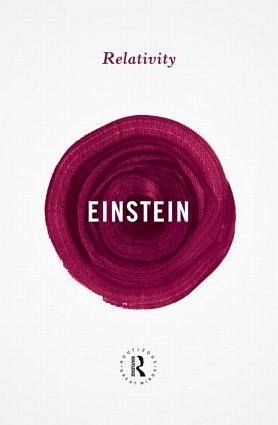
Foreword to the Routledge Great Minds Edition Preface PART I: The Special Theory of Relativity 1. Physical Meaning of Geometrical Propositions 2. The System of Co-ordinates 3. Space and Time in Classical Mechanics 4. The Galileian System of Co-ordinates 5. The Principle of Relativity (in the Restricted Sense) 6. The Theorem of the Addition of Velocities Employed in Classical Mechanics 7. The Apparent Incompatibility of the Law of Propagation of Light with the Principle of Relativity 8. On the Idea of Time in Physics 9. The Relativity of Simultaneity 10. On the Relativity of the Conception of Distance 11. The Lorentz Transformation 12. The Behaviour of Measuring-Rods and Clocks in Motion 13. Theorem of the Addition of Velocities. The Experiment of Fizeau 14. The Heuristic Value of the Theory of Relativity 15. General Results of the Theory 16. Experience and the Special Theory of Relativity 17. Minkowski's Four-dimensional Space PART II: The General Theory of Relativity 18. Special and General Principle of Relativity 19. The Gravitational Field 20. The Equality of Inertial and Gravitational Mass as an Argument for the General Postulate of Relativity 21. In what Respects are the Foundations of Classical Mechanics and of the SpecialTheory of Relativity Unsatisfactory? 22. A Few Inferences from the General Principle of Relativity 23. Behaviour of Clocks and Measuring-Rods on a Rotating Body of Reference 24. Euclidean and non-Euclidean Continuum 25. Gaussian Co-ordinates 26. The Space-Time Continuum of the Special Theory of Relativity Considered as a Euclidean Continuum 27. The Space-Time Continuum of the General Theory of Relativity is not a Euclidean Continuum 28. Exact Formulation of the General Principle of Relativity 29. The Solution of the Problem of Gravitation on the Basis of the General Principle of Relativity PART III: Considerations on the Universe as a Whole 30. Cosmological Difficulties of Newton's Theory 31. The Possibility of a "Finite" and yet "Unbounded" Universe 32. The Structure of Space according to the General Theory of Relativity APPENDICES: 1. Simple Derivation of the Lorentz Transformation [Supplementary to Section 11] 2. Minkowski's Four-dimensional Space ("World") [Supplementary to Section 17] 3. The Experimental Confirmation of the General Theory of Relativity (a) Motion of the Perihelion of Mercury (b) Deflection of Light by a Gravitational Field (c) Displacement of Spectral Lines towards the Red 4 The Structure of Space according to the General Theory of Relativity [Supplementary to Section 32] 5. Relativity and the Problem of Space Bibliography Index
Foreword to the Routledge Great Minds Edition Preface PART I: The Special Theory of Relativity 1. Physical Meaning of Geometrical Propositions 2. The System of Co-ordinates 3. Space and Time in Classical Mechanics 4. The Galileian System of Co-ordinates 5. The Principle of Relativity (in the Restricted Sense) 6. The Theorem of the Addition of Velocities Employed in Classical Mechanics 7. The Apparent Incompatibility of the Law of Propagation of Light with the Principle of Relativity 8. On the Idea of Time in Physics 9. The Relativity of Simultaneity 10. On the Relativity of the Conception of Distance 11. The Lorentz Transformation 12. The Behaviour of Measuring-Rods and Clocks in Motion 13. Theorem of the Addition of Velocities. The Experiment of Fizeau 14. The Heuristic Value of the Theory of Relativity 15. General Results of the Theory 16. Experience and the Special Theory of Relativity 17. Minkowski's Four-dimensional Space PART II: The General Theory of Relativity 18. Special and General Principle of Relativity 19. The Gravitational Field 20. The Equality of Inertial and Gravitational Mass as an Argument for the General Postulate of Relativity 21. In what Respects are the Foundations of Classical Mechanics and of the SpecialTheory of Relativity Unsatisfactory? 22. A Few Inferences from the General Principle of Relativity 23. Behaviour of Clocks and Measuring-Rods on a Rotating Body of Reference 24. Euclidean and non-Euclidean Continuum 25. Gaussian Co-ordinates 26. The Space-Time Continuum of the Special Theory of Relativity Considered as a Euclidean Continuum 27. The Space-Time Continuum of the General Theory of Relativity is not a Euclidean Continuum 28. Exact Formulation of the General Principle of Relativity 29. The Solution of the Problem of Gravitation on the Basis of the General Principle of Relativity PART III: Considerations on the Universe as a Whole 30. Cosmological Difficulties of Newton's Theory 31. The Possibility of a "Finite" and yet "Unbounded" Universe 32. The Structure of Space according to the General Theory of Relativity APPENDICES: 1. Simple Derivation of the Lorentz Transformation [Supplementary to Section 11] 2. Minkowski's Four-dimensional Space ("World") [Supplementary to Section 17] 3. The Experimental Confirmation of the General Theory of Relativity (a) Motion of the Perihelion of Mercury (b) Deflection of Light by a Gravitational Field (c) Displacement of Spectral Lines towards the Red 4 The Structure of Space according to the General Theory of Relativity [Supplementary to Section 32] 5. Relativity and the Problem of Space Bibliography Index
Es gelten unsere Allgemeinen Geschäftsbedingungen: www.buecher.de/agb
Impressum
www.buecher.de ist ein Internetauftritt der buecher.de internetstores GmbH
Geschäftsführung: Monica Sawhney | Roland Kölbl | Günter Hilger
Sitz der Gesellschaft: Batheyer Straße 115 - 117, 58099 Hagen
Postanschrift: Bürgermeister-Wegele-Str. 12, 86167 Augsburg
Amtsgericht Hagen HRB 13257
Steuernummer: 321/5800/1497
USt-IdNr: DE450055826