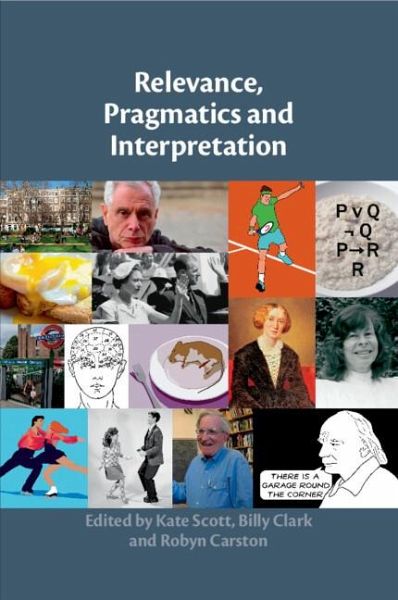
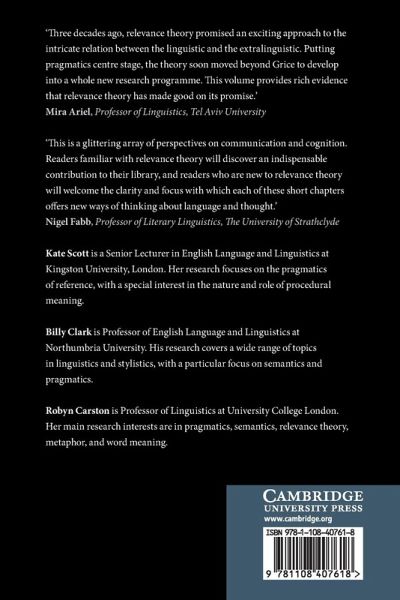
Presents new research from leading scholars employing the relevance-theoretic (RT) pragmatics framework, demonstrating the interdisciplinary significance of the theory. It will become a key reference on RT for students and scholars of pragmatics, semantics, discourse analysis, human communication, child development, stylistics and education.
Presents new research from leading scholars employing the relevance-theoretic (RT) pragmatics framework, demonstrating the interdisciplinary significance of the theory. It will become a key reference on RT for students and scholars of pragmatics, semantics, discourse analysis, human communication, child development, stylistics and education.
Introduction Robyn Carston, Billy Clark and Kate Scott; Reflections on the development of relevance theory; Personal notes on a shared trajectory Dan Sperber; The source of relevance Neil Smith; Part I. Relevance Theory and Cognitive Communicative Issues: 1. Scientific tractability and relevance theory Nicholas Allott; 2. Language processing, relevance and questions Richard Breheny; 3. Quasi-factives and cognitive efficiency Axel Barceló and Robert J. Stainton; 4. Evidential explicatures and mismatch resolution Victoria Escandell-Vidal; 5. Representation and metarepresentation in negation Jacques Moeschler; 6. Pronouns in free indirect discourse: a relevance-theoretic account Anne Reboul; 7. The development of pragmatic abilities Myrto Grigoroglou and Anna Papafragou; Part II. Pragmatics and Linguistic Issues: 8. Mood and the analysis of imperative sentences Mark Jary and Mikhail Kissine; 9. The Korean sentence-final Suffix ci as a metarepresentational marker Eun-Ju Noh; 10. Expressive epithets and expressive small clauses Diane Blakemore; 11. Ad Hoc concepts, polysemy and the lexicon Robyn Carston; 12. The polysemy of a Norwegian modal adverb Thorstein Fretheim; 13. Noun-noun compounds from the perspective of relevance theory Anne Bezuidenhout; 14. Procedural syntax Eleni Gregoromichelaki and Ruth Kempson; Part III. Figurative Language and Layered Interpretations: 15. Metaphor and metonymy in acquisition: a relevance-theoretic perspective Ingrid Lossius Falkum; 16. Relevance and metaphor understanding in a second language Elly Ifantidou; 17. Component processes of irony comprehension in children: epistemic vigilance, mind-reading and the search for relevance Tomoko Matsui; 18. Allegory in relation to metaphor and irony Christoph Unger; 19. Slave of the passions: making emotions relevant Tim Wharton and Claudia Strey; 20. Adaptations as communicative acts: a relevance-theoretic perspective Anne Furlong.
Introduction Robyn Carston, Billy Clark and Kate Scott; Reflections on the development of relevance theory; Personal notes on a shared trajectory Dan Sperber; The source of relevance Neil Smith; Part I. Relevance Theory and Cognitive Communicative Issues: 1. Scientific tractability and relevance theory Nicholas Allott; 2. Language processing, relevance and questions Richard Breheny; 3. Quasi-factives and cognitive efficiency Axel Barceló and Robert J. Stainton; 4. Evidential explicatures and mismatch resolution Victoria Escandell-Vidal; 5. Representation and metarepresentation in negation Jacques Moeschler; 6. Pronouns in free indirect discourse: a relevance-theoretic account Anne Reboul; 7. The development of pragmatic abilities Myrto Grigoroglou and Anna Papafragou; Part II. Pragmatics and Linguistic Issues: 8. Mood and the analysis of imperative sentences Mark Jary and Mikhail Kissine; 9. The Korean sentence-final Suffix ci as a metarepresentational marker Eun-Ju Noh; 10. Expressive epithets and expressive small clauses Diane Blakemore; 11. Ad Hoc concepts, polysemy and the lexicon Robyn Carston; 12. The polysemy of a Norwegian modal adverb Thorstein Fretheim; 13. Noun-noun compounds from the perspective of relevance theory Anne Bezuidenhout; 14. Procedural syntax Eleni Gregoromichelaki and Ruth Kempson; Part III. Figurative Language and Layered Interpretations: 15. Metaphor and metonymy in acquisition: a relevance-theoretic perspective Ingrid Lossius Falkum; 16. Relevance and metaphor understanding in a second language Elly Ifantidou; 17. Component processes of irony comprehension in children: epistemic vigilance, mind-reading and the search for relevance Tomoko Matsui; 18. Allegory in relation to metaphor and irony Christoph Unger; 19. Slave of the passions: making emotions relevant Tim Wharton and Claudia Strey; 20. Adaptations as communicative acts: a relevance-theoretic perspective Anne Furlong.
Es gelten unsere Allgemeinen Geschäftsbedingungen: www.buecher.de/agb
Impressum
www.buecher.de ist ein Internetauftritt der buecher.de internetstores GmbH
Geschäftsführung: Monica Sawhney | Roland Kölbl | Günter Hilger
Sitz der Gesellschaft: Batheyer Straße 115 - 117, 58099 Hagen
Postanschrift: Bürgermeister-Wegele-Str. 12, 86167 Augsburg
Amtsgericht Hagen HRB 13257
Steuernummer: 321/5800/1497
USt-IdNr: DE450055826