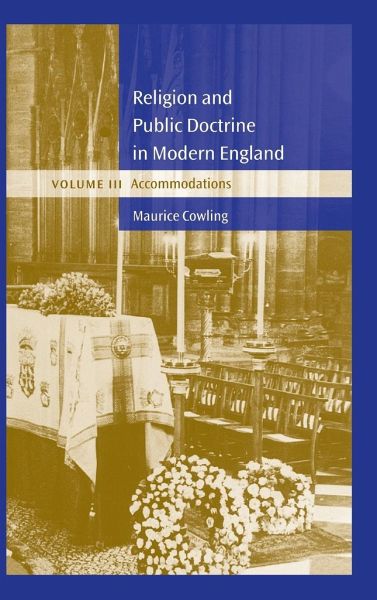
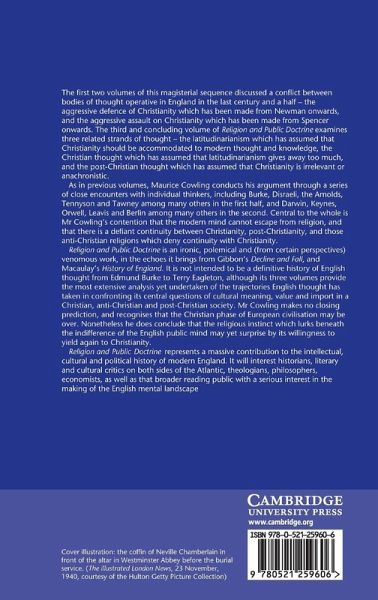
The third and concluding volume of Maurice Cowling's magisterial sequence examines three related strands of English thought - latitudinarianism, the Christian thought which has assumed that latitudinarianism gives away too much, and the post-Christian thought which has assumed that Christianity is irrelevant or anachronistic. As in previous volumes, Maurice Cowling conducts his argument through a series of encounters with individual thinkers, including Burke, Disraeli, the Arnolds, Tennyson and Tawney in the first half, and Darwin, Keynes, Orwell, Leavis and Berlin in the second. Central to…mehr
The third and concluding volume of Maurice Cowling's magisterial sequence examines three related strands of English thought - latitudinarianism, the Christian thought which has assumed that latitudinarianism gives away too much, and the post-Christian thought which has assumed that Christianity is irrelevant or anachronistic. As in previous volumes, Maurice Cowling conducts his argument through a series of encounters with individual thinkers, including Burke, Disraeli, the Arnolds, Tennyson and Tawney in the first half, and Darwin, Keynes, Orwell, Leavis and Berlin in the second. Central to the whole is Mr Cowling's contention that the modern mind cannot escape from religion. Religion and Public Doctrine in Modern England represents a massive contribution to the intellectual and cultural history of modern England, of interest to historians, literary and cultural critics, theologians, philosophers, economists, as well as to that broader reading public with a serious interest in the making of the English mental landscape.
Maurice Cowling was born in London in 1926. He was educated at Battersea Grammar School and Jesus College, Cambridge, where he read History. He did military service between 1944 and 1948 in the British and Indian armies. He as a Fellow of Jesus College from 1950 to 1953 and, after a period spent chiefly in London, returned to Jesus as a Fellow in 1961. Since 1963 he has been a Fellow of Peterhouse, Cambridge, and from 1976-93 University Reader in Modern English History.
Inhaltsangabe
Introduction; Part V. The Christian Intellect and Modern Thought in Modern England: 1. The reanimation of protestantism I: Carlyle Froude and Kingsley; 2. Christianity and literature I: Burke and Disraeli; 3. The reanimation of protestantism II: Thomas Arnold Bunsen Jowett Stanley Lyall and Max Muller; 4. The enlargement of Christianity: Matthew Arnold Seeley Sidgwick and Wicksteed; 5. Christianity and literature II: Dickens Tennyson Browning Pater and Wilde; 6. Christianity and modern knowledge I: Stirling Wallace Caird and Green; 7. Whiggism liberalism and Christianity I: Macaulay Lecky Bryce and Fisher; 8. Whiggism liberalism and Christianity II: Fitzjames Stephen Acton Maine Inge Henson and Smuts; 9. Christianity and modern knowledge II: Whewell Stubbs and Cunningham; 10. Christianity in an unfriendly world I: Shaftesbury Maurice Westcott Tawney and Temple; 11. Christianity in an unfriendly world II: Forsyth Masterman Gore Figgis and Lewis; 12. Christianity in an unfriendly world III: Underhill Eddington Needham Zaehner and Jung; 13. Christianity in an unfriendly world IV: Balfour Ashley and Joseph Chamberlain; 14. Christianity in an unfriendly world V: Milbank and Macintyre; Part VI. The Post-Christian Consensus: 15. Modern knowledge and the post-Christian consensus I: Darwin Dawkins Galton and Pearson; 16. Modern knowledge and the post-Christian consensus II: Freud J. B. S. Haldane Huxley and Popper; 17. Modern knowledge and the post-Christian consensus III: F. H. Bradley Bosanquet R. B. Haldane A. C. Bradley Elgar Parry and Hadow; 18. Modern knowledge and the post-Christian consensus IV: Maitland Hobhouse Keynes and Hayek; 19. English socialism as English religion: The Webbs Macdonald Laski Orwell and Crossman; 20. Literature and the post-Christian consensus: Wordsworth Hardy Kipling and Forster; 21. Modern knowledge and the post-Christian consensus V: Richards and Leavis; 22. Modern knowledge and the post-Christian consensus VI: Williams Eagleton Kenny Skinner and Scruton; 23. Judaism and the post-Christian consensus: Namier Berlin Koestler and Steiner; 24. Complication and dilapidation; Conclusion: the author and the argument; Index.
Introduction; Part V. The Christian Intellect and Modern Thought in Modern England: 1. The reanimation of protestantism I: Carlyle Froude and Kingsley; 2. Christianity and literature I: Burke and Disraeli; 3. The reanimation of protestantism II: Thomas Arnold Bunsen Jowett Stanley Lyall and Max Muller; 4. The enlargement of Christianity: Matthew Arnold Seeley Sidgwick and Wicksteed; 5. Christianity and literature II: Dickens Tennyson Browning Pater and Wilde; 6. Christianity and modern knowledge I: Stirling Wallace Caird and Green; 7. Whiggism liberalism and Christianity I: Macaulay Lecky Bryce and Fisher; 8. Whiggism liberalism and Christianity II: Fitzjames Stephen Acton Maine Inge Henson and Smuts; 9. Christianity and modern knowledge II: Whewell Stubbs and Cunningham; 10. Christianity in an unfriendly world I: Shaftesbury Maurice Westcott Tawney and Temple; 11. Christianity in an unfriendly world II: Forsyth Masterman Gore Figgis and Lewis; 12. Christianity in an unfriendly world III: Underhill Eddington Needham Zaehner and Jung; 13. Christianity in an unfriendly world IV: Balfour Ashley and Joseph Chamberlain; 14. Christianity in an unfriendly world V: Milbank and Macintyre; Part VI. The Post-Christian Consensus: 15. Modern knowledge and the post-Christian consensus I: Darwin Dawkins Galton and Pearson; 16. Modern knowledge and the post-Christian consensus II: Freud J. B. S. Haldane Huxley and Popper; 17. Modern knowledge and the post-Christian consensus III: F. H. Bradley Bosanquet R. B. Haldane A. C. Bradley Elgar Parry and Hadow; 18. Modern knowledge and the post-Christian consensus IV: Maitland Hobhouse Keynes and Hayek; 19. English socialism as English religion: The Webbs Macdonald Laski Orwell and Crossman; 20. Literature and the post-Christian consensus: Wordsworth Hardy Kipling and Forster; 21. Modern knowledge and the post-Christian consensus V: Richards and Leavis; 22. Modern knowledge and the post-Christian consensus VI: Williams Eagleton Kenny Skinner and Scruton; 23. Judaism and the post-Christian consensus: Namier Berlin Koestler and Steiner; 24. Complication and dilapidation; Conclusion: the author and the argument; Index.
Es gelten unsere Allgemeinen Geschäftsbedingungen: www.buecher.de/agb
Impressum
www.buecher.de ist ein Internetauftritt der buecher.de internetstores GmbH
Geschäftsführung: Monica Sawhney | Roland Kölbl | Günter Hilger
Sitz der Gesellschaft: Batheyer Straße 115 - 117, 58099 Hagen
Postanschrift: Bürgermeister-Wegele-Str. 12, 86167 Augsburg
Amtsgericht Hagen HRB 13257
Steuernummer: 321/5800/1497
USt-IdNr: DE450055826