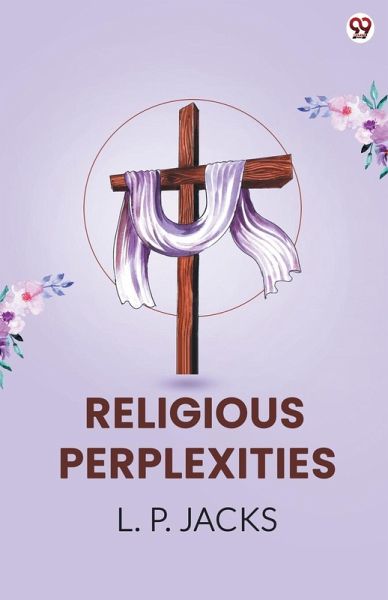
Religious perplexities examines the struggle between faith and doubt, questioning the nature of existence and the search for meaning. It reflects on the tension between reason and belief, arguing that uncertainty is not an obstacle to faith but an essential part of the human experience. The book challenges the notion that religion should provide definitive answers, instead presenting it as a journey requiring courage in the face of life's complexities. It explores how people grapple with their fears, seeking purpose within an uncertain world, and suggests that true spirituality lies in…mehr
Religious perplexities examines the struggle between faith and doubt, questioning the nature of existence and the search for meaning. It reflects on the tension between reason and belief, arguing that uncertainty is not an obstacle to faith but an essential part of the human experience. The book challenges the notion that religion should provide definitive answers, instead presenting it as a journey requiring courage in the face of life's complexities. It explores how people grapple with their fears, seeking purpose within an uncertain world, and suggests that true spirituality lies in embracing these struggles rather than escaping them. The relationship between suffering and transcendence is central, portraying faith as a force that both acknowledges hardship and offers resilience. The book encourages a perspective where uncertainty becomes a means of personal and communal growth, advocating for a more profound engagement with religious questions. By integrating theology, philosophy, and personal reflection, it presents faith not as a rigid structure but as an evolving, introspective process.
Lawrence Pearsall Jacks was an English philosopher, educator, and Unitarian minister who gained recognition between World War I and World War II. Born on October 9, 1860, in Nottingham, he pursued higher education at the University of Oxford, where he developed a deep interest in philosophy and religion. His intellectual career was marked by a commitment to exploring the relationship between faith, reason, and human purpose. Jacks became the editor of The Hibbert Journal, a publication focused on theology and philosophy, through which he influenced contemporary religious and philosophical thought. He advocated for a form of spirituality that embraced uncertainty, emphasizing the importance of questioning and personal growth. Throughout his life, he wrote extensively on ethics, education, and the philosophical challenges of modernity, often blending theological inquiry with reflections on human experience. His contributions extended beyond academia, as he sought to make philosophical and religious discussions more accessible to a wider audience. He died on February 17, 1955, in Oxford at the age of 94. His son, G. V. Jacks, carried on the family's intellectual legacy in the field of environmental science.
Es gelten unsere Allgemeinen Geschäftsbedingungen: www.buecher.de/agb
Impressum
www.buecher.de ist ein Internetauftritt der buecher.de internetstores GmbH
Geschäftsführung: Monica Sawhney | Roland Kölbl | Günter Hilger
Sitz der Gesellschaft: Batheyer Straße 115 - 117, 58099 Hagen
Postanschrift: Bürgermeister-Wegele-Str. 12, 86167 Augsburg
Amtsgericht Hagen HRB 13257
Steuernummer: 321/5800/1497
USt-IdNr: DE450055826