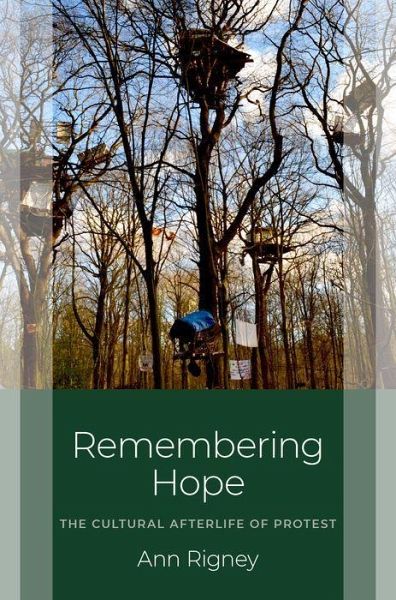
In Remembering Hope, Ann Rigney examines the role of storytelling in transferring hope in social transformation from one generation of activists to another. She uses the tools of cultural memory studies to explain how shared narratives about protest are produced using words, images, video, and performance. Rigney's long-term approach shows that cultural memory and activism are deeply entwined across generations and reveals how cultural memory work has been used as a form of resistance to historical outcomes and as a tool for kick-starting older campaigns in new contexts. Above all, the book…mehr
In Remembering Hope, Ann Rigney examines the role of storytelling in transferring hope in social transformation from one generation of activists to another. She uses the tools of cultural memory studies to explain how shared narratives about protest are produced using words, images, video, and performance. Rigney's long-term approach shows that cultural memory and activism are deeply entwined across generations and reveals how cultural memory work has been used as a form of resistance to historical outcomes and as a tool for kick-starting older campaigns in new contexts. Above all, the book challenges the assumption that grievance rather than active citizenship has always been at the heart of collective memory.
Ann Rigney is emeritus Professor of Comparative Literature at Utrecht University, the Netherlands, and founder of the Utrecht Forum for Memory Studies. She has published widely on theories of cultural memory and on memory cultures from the nineteenth century to the present, including The Afterlives of Walter Scott (Oxford, 2012) and The Visual Memory of Protest (co-edited with T. Smits; 2023). In the period 2019-2024, she was recipient of a European Research Council Advanced Grant for the project Remembering Activism (ReAct).
Inhaltsangabe
Preface List of Illustrations Introduction Chapter 1: Memory in Activism: The Commonweal, 1885-1894 Chapter 2: Marking Time with Radical Calendars Chapter 3: Mediations of Outrage: Remembering as Non-Violent Resistance Chapter 4: The Agency of the Aesthetic: Keeping the Commune Alive Chapter 5: Toppling Monuments: End or Means? Chapter 6: Activist Archiving as Prefigurative Practice Chapter 7: Memory Work in Climate Activism Conclusion Notes References Index
Es gelten unsere Allgemeinen Geschäftsbedingungen: www.buecher.de/agb
Impressum
www.buecher.de ist ein Internetauftritt der buecher.de internetstores GmbH
Geschäftsführung: Monica Sawhney | Roland Kölbl | Günter Hilger
Sitz der Gesellschaft: Batheyer Straße 115 - 117, 58099 Hagen
Postanschrift: Bürgermeister-Wegele-Str. 12, 86167 Augsburg
Amtsgericht Hagen HRB 13257
Steuernummer: 321/5800/1497
USt-IdNr: DE450055826