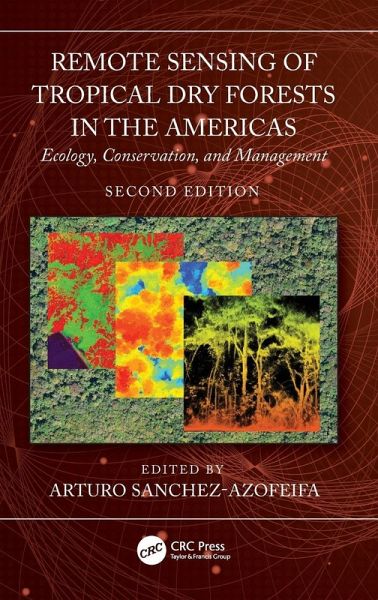
Focuses on tropical dry forests in the Americas and provides a comprehensive overview of new studies conducted in recent years, giving new insights into the most endangered ecosystem in the tropics. Case studies included analyze the biophysical properties and the status of TDFs in different regions of Mexico, Costa Rica, Brazil, and Bolivia.
Focuses on tropical dry forests in the Americas and provides a comprehensive overview of new studies conducted in recent years, giving new insights into the most endangered ecosystem in the tropics. Case studies included analyze the biophysical properties and the status of TDFs in different regions of Mexico, Costa Rica, Brazil, and Bolivia.
Dr. Arturo Sanchez-Azofeifa is a professor in the Department of Earth and Atmospheric Sciences at the University of Alberta and serves as the director of the University's Centre for Earth Observation Sciences (CEOS). His research combines remote sensing with ground-based wireless sensor networks to enhance environmental monitoring and climate change assessment in tropical dry forests. Dr. Sanchez-Azofeifa has received numerous accolades, including a Fulbright Fellowship, the Aldo Leopold Leadership Fellowship from Stanford University's Woods Institute for the Environment, the Canadian Forest Service Merit Award, and the Sir McMaster Fellowship from Australia's Commonwealth Science and Research Innovation Organization (CSIRO). Furthermore, he has been a fellow at the Centre for Advanced Studies (CAS) at Ludwig Maximilian University (LMU) in Munich, Germany, and he holds an adjunct professor position at the University of Helsinki, Finland. At the University of Alberta, he has been honoured with the Faculty of Science Research Award for Outstanding Contributions, the McCalla Research Professorship, and the Faculty of Science Research Fellowship, among many other distinctions. Dr. Sanchez-Azofeifa has published over 200 peer-reviewed scientific articles and authored three books, significantly advancing the fields of environmental science and remote sensing, particularly in relation to tropical dry forests throughout the Americas.
Inhaltsangabe
Section 1: LiDAR Remote Sensing. 1. Review of LiDAR Technology in Tropical Dry Forests. 2. Simultaneous Localization and Mapping (SLAM) in Tropical Dry Forests. 3. Emergent Trees in Tropical Dry Forests Using Airborne Laser Scanning. 4. Aboveground Biomass and Biomass Change Estimates of Tropical Dry Forest Using Aerial and Terrestrial LiDAR. 5. Entropy in Tropical Dry Ecosystems. Section 2: Remote Sensing Ecology. 6. Applications of Remote Sensing in Tropical Dry Forests to Predict Biodiversity. 7. Successional Variation in Spectral and Biophysical Leaf Traits in Two Latin American Tropical Dry Forests. 8. Comparing Ground-based and Remote Sensing Methods to Assess Phenological Patterns along a Successional Gradient in a Tropical Dry Forest. 9. Deep Learning with Synergized Airborne LiDAR and Hyperspectral Data for Mapping Tropical Dry Forest Successional Stages. 10. Intra- and Interannual Variation in Tree Deciduousness in a Tropical Dry Forest in Yucatán, México: Effects of Successional Age and Topography. 11. Resilience of Tropical Dry Forests Management Systems in the Yucatan Peninsula. 12. Identifying Priority Zones for Reforestation in the Montane Dry Forests of Bolivia with Machine Learning, Remote Sensing and GIS Methods. Section 3: Ecosystem Services. 13. Environmental Drought Approach to Understanding Droughts in Tropical Dry Forests: A Review. 14. Assessing Water Ecosystem Services in the Conservation Area of Guanacaste, Costa Rica: A Hydrological Modeling Approach Integrating Land Use and Ecosystem Dynamics. 15. Quantifying Water Provisioning Services at the Guanacaste Conservation Area, Costa Rica. Section 4: Ecology. 16. Additive Partitioning of Phyllostomid Bat Diversity in Seasonally Dry Tropical Forests in Minas Gerais State, Southeastern Brazil. 17. Nutrient Deposition Dynamics along a Dry Forest Chronosequence in the Brazilian Semi-Arid Region. 18. Unravelling the factors influencing floristic composition: Insights from a local-scale study in Seasonally Dry Tropical Forests.
Section 1: LiDAR Remote Sensing. 1. Review of LiDAR Technology in Tropical Dry Forests. 2. Simultaneous Localization and Mapping (SLAM) in Tropical Dry Forests. 3. Emergent Trees in Tropical Dry Forests Using Airborne Laser Scanning. 4. Aboveground Biomass and Biomass Change Estimates of Tropical Dry Forest Using Aerial and Terrestrial LiDAR. 5. Entropy in Tropical Dry Ecosystems. Section 2: Remote Sensing Ecology. 6. Applications of Remote Sensing in Tropical Dry Forests to Predict Biodiversity. 7. Successional Variation in Spectral and Biophysical Leaf Traits in Two Latin American Tropical Dry Forests. 8. Comparing Ground-based and Remote Sensing Methods to Assess Phenological Patterns along a Successional Gradient in a Tropical Dry Forest. 9. Deep Learning with Synergized Airborne LiDAR and Hyperspectral Data for Mapping Tropical Dry Forest Successional Stages. 10. Intra- and Interannual Variation in Tree Deciduousness in a Tropical Dry Forest in Yucatán, México: Effects of Successional Age and Topography. 11. Resilience of Tropical Dry Forests Management Systems in the Yucatan Peninsula. 12. Identifying Priority Zones for Reforestation in the Montane Dry Forests of Bolivia with Machine Learning, Remote Sensing and GIS Methods. Section 3: Ecosystem Services. 13. Environmental Drought Approach to Understanding Droughts in Tropical Dry Forests: A Review. 14. Assessing Water Ecosystem Services in the Conservation Area of Guanacaste, Costa Rica: A Hydrological Modeling Approach Integrating Land Use and Ecosystem Dynamics. 15. Quantifying Water Provisioning Services at the Guanacaste Conservation Area, Costa Rica. Section 4: Ecology. 16. Additive Partitioning of Phyllostomid Bat Diversity in Seasonally Dry Tropical Forests in Minas Gerais State, Southeastern Brazil. 17. Nutrient Deposition Dynamics along a Dry Forest Chronosequence in the Brazilian Semi-Arid Region. 18. Unravelling the factors influencing floristic composition: Insights from a local-scale study in Seasonally Dry Tropical Forests.
Es gelten unsere Allgemeinen Geschäftsbedingungen: www.buecher.de/agb
Impressum
www.buecher.de ist ein Internetauftritt der buecher.de internetstores GmbH
Geschäftsführung: Monica Sawhney | Roland Kölbl | Günter Hilger
Sitz der Gesellschaft: Batheyer Straße 115 - 117, 58099 Hagen
Postanschrift: Bürgermeister-Wegele-Str. 12, 86167 Augsburg
Amtsgericht Hagen HRB 13257
Steuernummer: 321/5800/1497
USt-IdNr: DE450055826