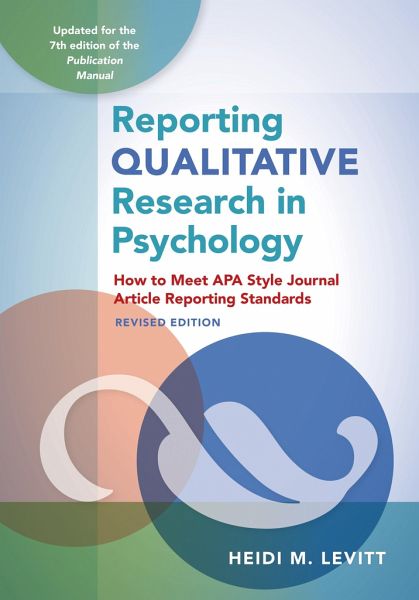
Guiding researchers in applying APA reporting standards for qualitative, mixed methods, and meta-analysis studies, the text details key elements of any studyâ from design choices and participant recruitment to data analysis and methodological integrity. Journal examples illustrate tailoring reporting to specific methodologies.
Guiding researchers in applying APA reporting standards for qualitative, mixed methods, and meta-analysis studies, the text details key elements of any studyâ from design choices and participant recruitment to data analysis and methodological integrity. Journal examples illustrate tailoring reporting to specific methodologies.
Heidi M. Levitt, PhD, is a professor of clinical psychology in the Department of Psychology at the University of Massachusetts Boston. She was chair of the American Psychological Association (APA) Publications and Communications Board Working Group on Journal Article Reporting Standards for Qualitative Research (JARS Qual Working Group Levitt et al., 2 8). From 2 7 to 2 8, she was president of the Society for Qualitative Inquiry in Psychology (SQIP APA Division 5, Quantitative and Qualitative Methods). In addition, she chaired the SQIP task force to develop a white paper on recommendations for designing and reviewing qualitative research. She has been associate editor for the journals Qualitative Psychology and Psychotherapy Research. She is an APA Fellow in Division 5 (Quantitative and Qualitative Methods), Division 29 (Society for the Advancement of Psychotherapy), Division 32 (Society for Humanistic Psychology), and Division 44 (Society for the Psychology of Sexual Orientation and Gender Diversity).
Inhaltsangabe
Acknowledgments Chapter 1. Reporting Standards for Qualitative Research in Psychology: What Are They, and Why Do We Need Them? Chapter 2. Telling Your Qualitative Story: How the Purpose of Your Research Influences Your Reporting Chapter 3. Methodological Integrity: Establishing the Fidelity and Utility of Your Research Chapter 4. How to Situate Your Mission: Title Page, Abstract, and Introduction Chapter 5. How to Describe Your Inquiry Process: The Method Section Chapter 6. What Did You Find? The Results Section Chapter 7. What Does It All Mean? The Discussion Section Chapter 8. Reporting a Qualitative Meta-Analysis: Key Features Chapter 9. Reporting Mixed Methods Research: Bridging Reporting Standards Chapter 10. Considering Rhetorical Style and Methodological Integrity: Troubleshooting and Tips for Publishing and Reviewing Appendix. Abstracts of the 15 Articles Used as Examples in Text References Index About the Author
Acknowledgments Chapter 1. Reporting Standards for Qualitative Research in Psychology: What Are They, and Why Do We Need Them? Chapter 2. Telling Your Qualitative Story: How the Purpose of Your Research Influences Your Reporting Chapter 3. Methodological Integrity: Establishing the Fidelity and Utility of Your Research Chapter 4. How to Situate Your Mission: Title Page, Abstract, and Introduction Chapter 5. How to Describe Your Inquiry Process: The Method Section Chapter 6. What Did You Find? The Results Section Chapter 7. What Does It All Mean? The Discussion Section Chapter 8. Reporting a Qualitative Meta-Analysis: Key Features Chapter 9. Reporting Mixed Methods Research: Bridging Reporting Standards Chapter 10. Considering Rhetorical Style and Methodological Integrity: Troubleshooting and Tips for Publishing and Reviewing Appendix. Abstracts of the 15 Articles Used as Examples in Text References Index About the Author
Es gelten unsere Allgemeinen Geschäftsbedingungen: www.buecher.de/agb
Impressum
www.buecher.de ist ein Internetauftritt der buecher.de internetstores GmbH
Geschäftsführung: Monica Sawhney | Roland Kölbl | Günter Hilger
Sitz der Gesellschaft: Batheyer Straße 115 - 117, 58099 Hagen
Postanschrift: Bürgermeister-Wegele-Str. 12, 86167 Augsburg
Amtsgericht Hagen HRB 13257
Steuernummer: 321/5800/1497
USt-IdNr: DE450055826