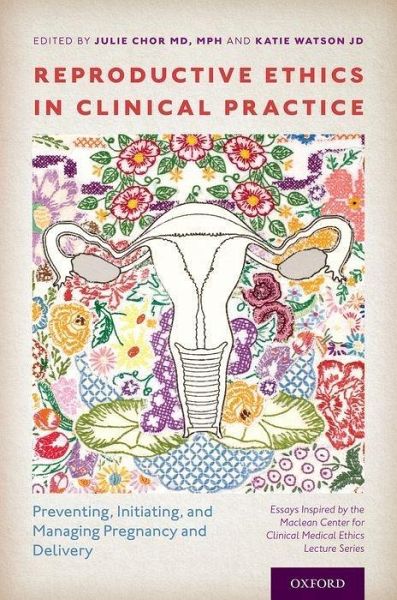
Reproductive health care professionals in fields such as Obstetrics and Gynecology, Family Medicine, and Pediatrics face difficult ethical issues because they work at the crossroads of patient decision-making, scientific advancement, political controversy, legal regulation, and profound moral considerations. The dilemmas these professionals face expose big-picture bioethics questions of interest to everyone. Yet for clinicians striving to deliver excellent patient care, the ethical questions that make daily practice challenging can be just as nuanced. This volume presents a carefully curated…mehr
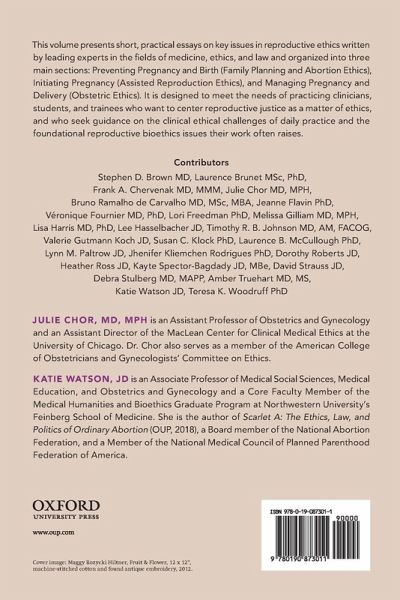
Reproductive health care professionals in fields such as Obstetrics and Gynecology, Family Medicine, and Pediatrics face difficult ethical issues because they work at the crossroads of patient decision-making, scientific advancement, political controversy, legal regulation, and profound moral considerations. The dilemmas these professionals face expose big-picture bioethics questions of interest to everyone. Yet for clinicians striving to deliver excellent patient care, the ethical questions that make daily practice challenging can be just as nuanced. This volume presents a carefully curated compilation of essays written by leading experts in the fields of medicine, ethics, and law, who address key issues at the forefront of reproductive ethics. It is organized into three main sections: I. Contraception and Abortion Ethics - Preventing Pregnancy and Birth, II. Assisted Reproduction Ethics - Initiating Pregnancy, and III. Obstetric Ethics - Managing Pregnancy and Delivery. Each section begins with a short introduction by the editors providing an overview of the area and contextualizing the essays that follow. This volume's primary aim is to be useful to practicing clinicians, students, and trainees by providing short and practical essays covering urgent topics--from race, religion and abortion, to legal liability, violations of confidentiality and maternal choices that risk future children's health. This collection provides clinicians at all levels of training with frameworks they need to approach the intimate and high-stakes encounters central to their profession.
Julie Chor, MD, MPH is an Assistant Professor of Obstetrics and Gynecology and an Assistant Director of the MacLean Center for Clinical Medical Ethics at the University of Chicago. After completing medical school at the University of Chicago's Pritzker School of Medicine, Dr. Chor completed her Obstetrics and Gynecology residency, Fellowship in Family Planning, and MPH at the University of Illinois at Chicago. Her academic and clinical work focus on understanding and addressing barriers that adolescents and young adults face in seeking and obtaining reproductive health care. Dr. Chor also serves as a member of the American College of Obstetricians and Gynecologists' Committee on Ethics. Katie Watson, JD is Associate Professor of Medical Social Sciences, Medical Education, and Obstetrics & Gynecology, and a Core Faculty Member of the Medical Humanities and Bioethics Graduate Program at Northwestern University's Feinberg School of Medicine. She clerked in the federal judiciary and worked in public interest law before completing Fellowships in Clinical Medical Ethics at the MacLean Center at the University of Chicago, and in Medical Humanities at NU-FSM. Her work focuses on women's health and reproductive ethics, and she is the author of Scarlet A: The Ethics, Law, and Politics of Ordinary Abortion (OUP, 2018). She is currently a Board member and Chair of the Ethics Committee of the National Abortion Federation, a Member of and the Bioethics Advisor to the National Medical Council of Planned Parenthood Federation of America, a member of the Editorial Board of the AMA Journal of Ethics, and a former Board member of the American Society for Bioethics and Humanities.
Inhaltsangabe
* Chapter 1. Introduction: Julie Chor MD MPH and Katie Watson JD * I. Family Planning and Abortion: Preventing Pregnancy and Birth * Chapter 2. Orienting Essay: Julie Chor MD MPH and Katie Watson JD * Chapter 3. Why Reproductive Justice Matters to Reproductive Ethics Melissa Gilliam MD MPH and Dorothy Roberts JD * Chapter 4. Religiously Affiliated Healthcare Institutions: An Ethical Analysis of What They Mean for Patients Clinicians and Our Health System Lori Freedman PhD and Debra Stulberg MD MA * Chapter 5. Contemporary Challenges to Providing Confidential Reproductive Health Care to Minors Amber Truehart MD MSc Lee Hasselbacher JD Julie Chor MD MPH * Chapter 6. Legal History of Contraception and Abortion in the United States David Strauss JD * II. Assisted Reproduction: Getting Pregnant * Chapter 7. Orienting Essay: Julie Chor MD MPH and Katie Watson JD * Chapter 8. Ethics and Stratified (Assisted) Reproduction Lisa Harris MD PhD * Chapter 9. Preimplantation Genetics: Liabilities and Limitations Valerie Koch JD * Chapter 10. Who are Your Patients and What Happens when They Disagree? Conflicts in Treating Multiple Parties Engaging In Third Party Reproduction Heather Ross JD * Chapter 11. Controversial Issues Surrounding Oocyte Donation Susan Klock PhD * Chapter 12. Onco-Fertility: Ethics and Hope After Cancer Bruno Ramalho de Carvalho MD MSc MBA Jhenifer Kliemchen Rodrigues BSc MSc PhD and Teresa K. Woodruff MD PhD. * Chapter 13. Accessing Reproductive Technology in France: Strengths and Limits of a model that privileges "Just reproduction" above Respect for autonomy Laurence Brunet et Véronique Fournier * III. Obstetric Ethics: Managing Pregnancy and Delivery * Chapter 14. Orienting Essay: Julie Chor MD MPH and Katie Watson JD * Chapter 15. The fallacy of forced treatment: Reconciling the law and ethics of post-viability treatment refusals and post-viability abortion prohibitions Katie Watson JD * Chapter 16. Professional Ethics in Obstetrics Practice and Research Frank A. Chervenak MD and Laurence McCullough PhD * Chapter 17. Doing Harm: When Health Care Providers Report their Pregnant Patients to the Police and Other Authorities Jeanne Flavin PhD and Lynn M. Paltrow J.D * Chapter 18. Prenatal counseling for maternal-fetal surgery: Potential biases competing interests and undue practice variation in the world of Fetal Care Stephen D. Brown MD * Chapter 19. Ethical Issues in Academic Global Reproductive Health Kayte Spector-Bagdady JD MBE and Timothy R. B. Johnson MD
* Chapter 1. Introduction: Julie Chor MD MPH and Katie Watson JD * I. Family Planning and Abortion: Preventing Pregnancy and Birth * Chapter 2. Orienting Essay: Julie Chor MD MPH and Katie Watson JD * Chapter 3. Why Reproductive Justice Matters to Reproductive Ethics Melissa Gilliam MD MPH and Dorothy Roberts JD * Chapter 4. Religiously Affiliated Healthcare Institutions: An Ethical Analysis of What They Mean for Patients Clinicians and Our Health System Lori Freedman PhD and Debra Stulberg MD MA * Chapter 5. Contemporary Challenges to Providing Confidential Reproductive Health Care to Minors Amber Truehart MD MSc Lee Hasselbacher JD Julie Chor MD MPH * Chapter 6. Legal History of Contraception and Abortion in the United States David Strauss JD * II. Assisted Reproduction: Getting Pregnant * Chapter 7. Orienting Essay: Julie Chor MD MPH and Katie Watson JD * Chapter 8. Ethics and Stratified (Assisted) Reproduction Lisa Harris MD PhD * Chapter 9. Preimplantation Genetics: Liabilities and Limitations Valerie Koch JD * Chapter 10. Who are Your Patients and What Happens when They Disagree? Conflicts in Treating Multiple Parties Engaging In Third Party Reproduction Heather Ross JD * Chapter 11. Controversial Issues Surrounding Oocyte Donation Susan Klock PhD * Chapter 12. Onco-Fertility: Ethics and Hope After Cancer Bruno Ramalho de Carvalho MD MSc MBA Jhenifer Kliemchen Rodrigues BSc MSc PhD and Teresa K. Woodruff MD PhD. * Chapter 13. Accessing Reproductive Technology in France: Strengths and Limits of a model that privileges "Just reproduction" above Respect for autonomy Laurence Brunet et Véronique Fournier * III. Obstetric Ethics: Managing Pregnancy and Delivery * Chapter 14. Orienting Essay: Julie Chor MD MPH and Katie Watson JD * Chapter 15. The fallacy of forced treatment: Reconciling the law and ethics of post-viability treatment refusals and post-viability abortion prohibitions Katie Watson JD * Chapter 16. Professional Ethics in Obstetrics Practice and Research Frank A. Chervenak MD and Laurence McCullough PhD * Chapter 17. Doing Harm: When Health Care Providers Report their Pregnant Patients to the Police and Other Authorities Jeanne Flavin PhD and Lynn M. Paltrow J.D * Chapter 18. Prenatal counseling for maternal-fetal surgery: Potential biases competing interests and undue practice variation in the world of Fetal Care Stephen D. Brown MD * Chapter 19. Ethical Issues in Academic Global Reproductive Health Kayte Spector-Bagdady JD MBE and Timothy R. B. Johnson MD
Es gelten unsere Allgemeinen Geschäftsbedingungen: www.buecher.de/agb
Impressum
www.buecher.de ist ein Internetauftritt der buecher.de internetstores GmbH
Geschäftsführung: Monica Sawhney | Roland Kölbl | Günter Hilger
Sitz der Gesellschaft: Batheyer Straße 115 - 117, 58099 Hagen
Postanschrift: Bürgermeister-Wegele-Str. 12, 86167 Augsburg
Amtsgericht Hagen HRB 13257
Steuernummer: 321/5800/1497
USt-IdNr: DE450055826