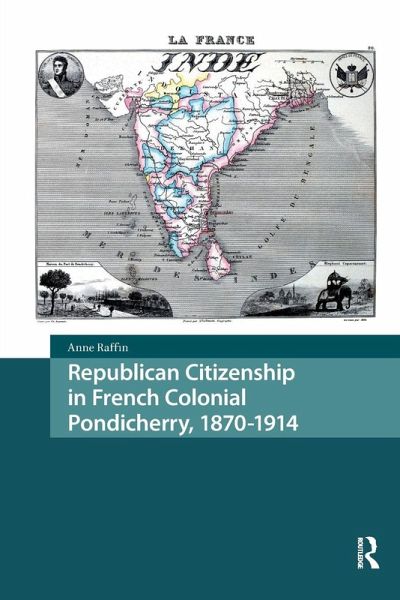
Republican Citizenship in French Colonial Pondicherry, 1870-1914 revisits and analyses the earlier part of the Third Republic, when France granted citizenship rights to Indians in Pondicherry. This work of historical sociology explores the nature of this colonial citizenship and enables comparisons with British India, especially the Madras Presidency, as well as the rest of the French empire, as a means of demonstrating how unique the practice of granting such rights was. The difficulties of implementing a new political culture based on the language of rights and participatory political…mehr
Republican Citizenship in French Colonial Pondicherry, 1870-1914 revisits and analyses the earlier part of the Third Republic, when France granted citizenship rights to Indians in Pondicherry. This work of historical sociology explores the nature of this colonial citizenship and enables comparisons with British India, especially the Madras Presidency, as well as the rest of the French empire, as a means of demonstrating how unique the practice of granting such rights was. The difficulties of implementing a new political culture based on the language of rights and participatory political institutions were not so much rooted in a lack of assimilation into the French culture on the part of the Indian population. Rather, they were the result of political infighting and long-term conflicts over status, both in relation to caste and class, and between inclusive and exclusive visions of French citizenship.
Anne Raffin is an associate professor in the sociology department at the National University of Singapore. She specializes in historical sociology, focusing on French colonialism in Asia and its legacies. Her research has concentrated on French Indochina and colonial Pondicherry, India.
Inhaltsangabe
List of Diagrams Graphs Images Maps and Tables Acknowledgements 1. Pondicherry in the French Empire during the Nineteenth and Twentieth Centuries Between Colonial Subjects and French Citizens I. Overview and General Concepts II. Analytical Framework 2. Contextualizing Pondicherry within the French Empire and the Indian Subcontinent I. Pondicherry within the French Empire II. Pondicherry within the Indian Subcontinent III. Pondicherry during the Nineteenth and Early Twentieth Centuries 3. Inclusive and Exclusive Visions of Citizenship in French India I. Colonial Pondicherry and Its Entanglement with Imperial Citizenship II. The Topas the Renouncers and the Catholics III. Institutions IV. Conclusion 4. Education and Army Attempts to Institutionalize Republican Ideals in French India I. The State of Education in Pondicherry before the Third Republic Education in Third Republic Pondicherry: A Secular Primary Education for All III. Civic Education and the Language Policies IV. Hindrances to the Republican School Project: Race and Caste V. Hindrances to the Republican School Project: Gender Issues and Budget Constraints VI. The Armed Forces in Pondicherry VII. Military Laws Citizenship and Indochina VIII. Conclusion 5. The Art of Petitioning in a Colonial Setting I. Law Order and a Bureaucracy of Petitions II. A Deficient Electoral System III. Attempts to Prevent Electoral Frauds and Appeals on the Ground IV. Partisan Political Fraud Under the Three-List System (1884-1899) V. Partisan Political Fraud under The Two-List System (1900-1913) VI. Conclusion 6. From Electoral Politics to Expansion of Rights and National Independence I. What Conclusions Can We Draw from Republican Citizenship in Pondicherry? II. How Far Was the Civilizing Mission Applied? III. From Contestations to Nationalism and the Impact of British India IV. New Forms of Political Participation in a Comparative Perspective V. Situating Pondicherry within a Larger Theoretical Reflection on the Relationship between Empire and Citizenship Bibliography Index.
List of Diagrams Graphs Images Maps and Tables Acknowledgements 1. Pondicherry in the French Empire during the Nineteenth and Twentieth Centuries Between Colonial Subjects and French Citizens I. Overview and General Concepts II. Analytical Framework 2. Contextualizing Pondicherry within the French Empire and the Indian Subcontinent I. Pondicherry within the French Empire II. Pondicherry within the Indian Subcontinent III. Pondicherry during the Nineteenth and Early Twentieth Centuries 3. Inclusive and Exclusive Visions of Citizenship in French India I. Colonial Pondicherry and Its Entanglement with Imperial Citizenship II. The Topas the Renouncers and the Catholics III. Institutions IV. Conclusion 4. Education and Army Attempts to Institutionalize Republican Ideals in French India I. The State of Education in Pondicherry before the Third Republic Education in Third Republic Pondicherry: A Secular Primary Education for All III. Civic Education and the Language Policies IV. Hindrances to the Republican School Project: Race and Caste V. Hindrances to the Republican School Project: Gender Issues and Budget Constraints VI. The Armed Forces in Pondicherry VII. Military Laws Citizenship and Indochina VIII. Conclusion 5. The Art of Petitioning in a Colonial Setting I. Law Order and a Bureaucracy of Petitions II. A Deficient Electoral System III. Attempts to Prevent Electoral Frauds and Appeals on the Ground IV. Partisan Political Fraud Under the Three-List System (1884-1899) V. Partisan Political Fraud under The Two-List System (1900-1913) VI. Conclusion 6. From Electoral Politics to Expansion of Rights and National Independence I. What Conclusions Can We Draw from Republican Citizenship in Pondicherry? II. How Far Was the Civilizing Mission Applied? III. From Contestations to Nationalism and the Impact of British India IV. New Forms of Political Participation in a Comparative Perspective V. Situating Pondicherry within a Larger Theoretical Reflection on the Relationship between Empire and Citizenship Bibliography Index.
Es gelten unsere Allgemeinen Geschäftsbedingungen: www.buecher.de/agb
Impressum
www.buecher.de ist ein Internetauftritt der buecher.de internetstores GmbH
Geschäftsführung: Monica Sawhney | Roland Kölbl | Günter Hilger
Sitz der Gesellschaft: Batheyer Straße 115 - 117, 58099 Hagen
Postanschrift: Bürgermeister-Wegele-Str. 12, 86167 Augsburg
Amtsgericht Hagen HRB 13257
Steuernummer: 321/5800/1497
USt-IdNr: DE450055826