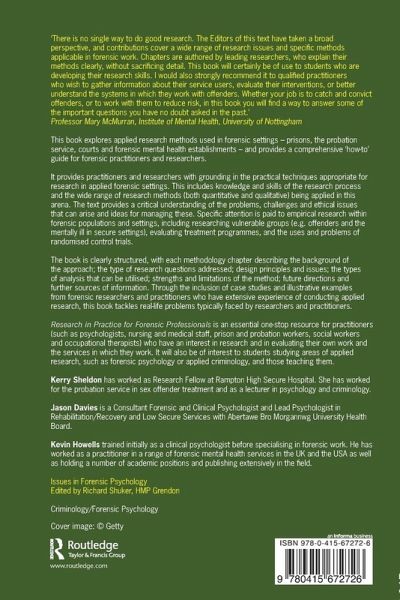
This book explores the use of applied research methods used in forensic settings and provides a 'how-to' book for forensic practitioners and researchers. Editors have backgrounds as both practitioners and researchers.
This book explores the use of applied research methods used in forensic settings and provides a 'how-to' book for forensic practitioners and researchers. Editors have backgrounds as both practitioners and researchers.
Kerry Sheldon is Research Fellow at Rampton High Secure Hospital. She has worked for the probation service in sex offender treatment and as a lecturer in psychology and criminology. Jason Davies is a Consultant Forensic and Clinical Psychologist and Lead Psychologist in Rehabilitation/Recovery and Low Secure Services with Abertawe Bro Morgannwg University Health Board Kevin Howells trained initially as a clinical psychologist before specialising in forensic work. He has worked as a practitioner in a range of forensic mental health services in the UK and the USA as well as holding a number of academic positions and publishing extensively in the field.
Inhaltsangabe
Part 1: Introduction to Forensic Research 1. Conducting Research in Forensic Settings: Philosophical and Practical Issues 2. Ethical Problems Arising in Forensic and Correctional Research Part 2: Risk, Investigative and Criminal Justice Research 3. Risk Research 4. Facet Theory and Multi-Dimensional Scaling Methods in Forensic Research 5. Court Relevant Research Methods Part 3: Approaches at the Qualitative Level 6. Qualitative Research With Staff In Forensic Settings: A Grounded Theory Example 7. Using Qualitative Methods to Research Offenders and Forensic Patients Part 4: Assessing Individual Change 8. Single Case Methodologies 9. The Idiographic Measurement of Change 10. Functional Analysis Part 5: Approaches at the Group Level 10. Strengths and Weaknesses of Randomised Control Trials 11. Evaluation of Regimes and Environments 12. Evaluating the quality of criminal justice programmes 13. Treatment and Rehabilitation Evaluation and Large Scale Outcomes 14. Systematic Reviews and Meta-Analysis 15. Conclusion
Part 1: Introduction to Forensic Research 1. Conducting Research in Forensic Settings: Philosophical and Practical Issues 2. Ethical Problems Arising in Forensic and Correctional Research Part 2: Risk, Investigative and Criminal Justice Research 3. Risk Research 4. Facet Theory and Multi-Dimensional Scaling Methods in Forensic Research 5. Court Relevant Research Methods Part 3: Approaches at the Qualitative Level 6. Qualitative Research With Staff In Forensic Settings: A Grounded Theory Example 7. Using Qualitative Methods to Research Offenders and Forensic Patients Part 4: Assessing Individual Change 8. Single Case Methodologies 9. The Idiographic Measurement of Change 10. Functional Analysis Part 5: Approaches at the Group Level 10. Strengths and Weaknesses of Randomised Control Trials 11. Evaluation of Regimes and Environments 12. Evaluating the quality of criminal justice programmes 13. Treatment and Rehabilitation Evaluation and Large Scale Outcomes 14. Systematic Reviews and Meta-Analysis 15. Conclusion
Es gelten unsere Allgemeinen Geschäftsbedingungen: www.buecher.de/agb
Impressum
www.buecher.de ist ein Internetauftritt der buecher.de internetstores GmbH
Geschäftsführung: Monica Sawhney | Roland Kölbl | Günter Hilger
Sitz der Gesellschaft: Batheyer Straße 115 - 117, 58099 Hagen
Postanschrift: Bürgermeister-Wegele-Str. 12, 86167 Augsburg
Amtsgericht Hagen HRB 13257
Steuernummer: 321/5800/1497
USt-IdNr: DE450055826