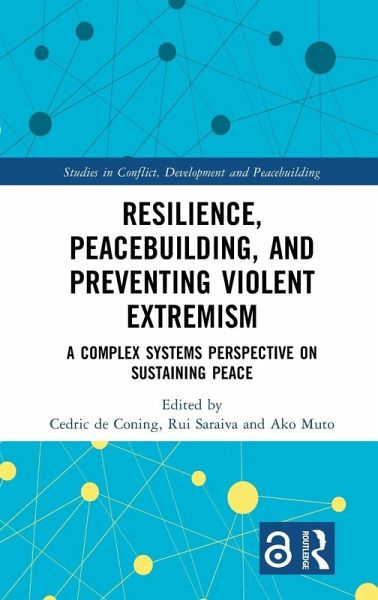
This book offers a comprehensive analysis of the complex drivers of violent extremism, along with recommendations for strengthening social and institutional resilience through peacebuilding and development efforts. By presenting a theoretical and empirical argument that places the emphasis on social cohesion, resilience, and adaptive peacebuilding, this book challenges the conventional security-led approach to countering violent extremism. Through a range of case studies from Africa, Asia, and the Middle East, including Syria, Iraq, Mozambique, Niger, Sri Lanka, and the Philippines, it…mehr
This book offers a comprehensive analysis of the complex drivers of violent extremism, along with recommendations for strengthening social and institutional resilience through peacebuilding and development efforts.
By presenting a theoretical and empirical argument that places the emphasis on social cohesion, resilience, and adaptive peacebuilding, this book challenges the conventional security-led approach to countering violent extremism. Through a range of case studies from Africa, Asia, and the Middle East, including Syria, Iraq, Mozambique, Niger, Sri Lanka, and the Philippines, it explores the complex dynamics of violent extremism and the ways in which it can be prevented and countered. Drawing on complexity theory and adaptive peacebuilding, the volume provides insights into how complex social systems adapt and respond to stress, and how peacebuilders can support societies in uncertain, volatile, and unpredictable contexts by improving their resilience and their adaptive capacity to sustain peace.
This book will be of much interest to students of peacebuilding, security studies and countering violent extremism, and professional practitioners.
The Open Access version of this book, available at www.taylorfrancis.com, has been made available under a Creative Commons Attribution-Non Commercial-No Derivatives (CC-BY-NC-ND) 4.0 license.
Produktdetails
Produktdetails
Studies in Conflict, Development and Peacebuilding
Cedric de Coning is a Research Professor with the Norwegian Institute of International Affairs (NUPI), based in Oslo, Norway. He is also a Senior Advisor for the African Centre for the Constructive Resolution of Disputes (ACCORD) in South Africa. Rui Saraiva is an Associate Professor at the School of International Liberal Arts, Miyazaki International University (Japan), and a Visiting Fellow at the Japan International Cooperation Agency (JICA) Ogata Sadako Research Institute for Peace and Development. His current research focuses on conflict resolution, peacebuilding, and preventing violent extremism in Africa. Ako Muto is a Specially Appointed Research Fellow at the Japan International Cooperation Agency (JICA) Ogata Sadako Research Institute for Peace and Development and Specially Appointed Professor at Rikkyo University, based in Tokyo. She has been involved in research for peacebuilding, humanitarian crises, and human security, bridging aid practices and academics.
Inhaltsangabe
1 Introduction: Linking Resilience, Peacebuilding, and Preventing Violent Extremism 2 Preventing and Countering Violent Extremism by Strengthening Social Cohesion and Resilience: An Adaptive Peacebuilding Approach 3 Building Resilience amid Fear: From State to Community-Embedded Prevention in Cabo Delgado, Mozambique 4 Preventing and Countering Violent Extremism in the Complex Context of the Syrian Conflict 5 Reconciliation and Social Cohesion in the Prevention of Violent Extremism in Complex Systems: Iraq as a Case Study 6 Intersecting Gender in Community Resilience to Violent Extremism: Local Actors' Perspectives in Niger 7 "When There Are Many Saying the Same Thing That I Am Saying, I Feel Less Afraid to Speak Up": Emotions, Resilience, and Peacebuilding in Sri Lanka 8 The Role of Development Agencies in Fostering Resilience to Violent Extremism: The Case of Mindanao, the Philippines 9 Climate Change, Environmental Peacebuilding and Preventing and Countering Violent Extremism 10 Conclusion: Preventing Violent Extremism Requires Community-orientated, Holistic, Comprehensive and Adaptive Solutions
1 Introduction: Linking Resilience, Peacebuilding, and Preventing Violent Extremism 2 Preventing and Countering Violent Extremism by Strengthening Social Cohesion and Resilience: An Adaptive Peacebuilding Approach 3 Building Resilience amid Fear: From State to Community-Embedded Prevention in Cabo Delgado, Mozambique 4 Preventing and Countering Violent Extremism in the Complex Context of the Syrian Conflict 5 Reconciliation and Social Cohesion in the Prevention of Violent Extremism in Complex Systems: Iraq as a Case Study 6 Intersecting Gender in Community Resilience to Violent Extremism: Local Actors' Perspectives in Niger 7 "When There Are Many Saying the Same Thing That I Am Saying, I Feel Less Afraid to Speak Up": Emotions, Resilience, and Peacebuilding in Sri Lanka 8 The Role of Development Agencies in Fostering Resilience to Violent Extremism: The Case of Mindanao, the Philippines 9 Climate Change, Environmental Peacebuilding and Preventing and Countering Violent Extremism 10 Conclusion: Preventing Violent Extremism Requires Community-orientated, Holistic, Comprehensive and Adaptive Solutions
Es gelten unsere Allgemeinen Geschäftsbedingungen: www.buecher.de/agb
Impressum
www.buecher.de ist ein Internetauftritt der buecher.de internetstores GmbH
Geschäftsführung: Monica Sawhney | Roland Kölbl | Günter Hilger
Sitz der Gesellschaft: Batheyer Straße 115 - 117, 58099 Hagen
Postanschrift: Bürgermeister-Wegele-Str. 12, 86167 Augsburg
Amtsgericht Hagen HRB 13257
Steuernummer: 321/5800/1497
USt-IdNr: DE450055826