
Andere Kunden interessierten sich auch für
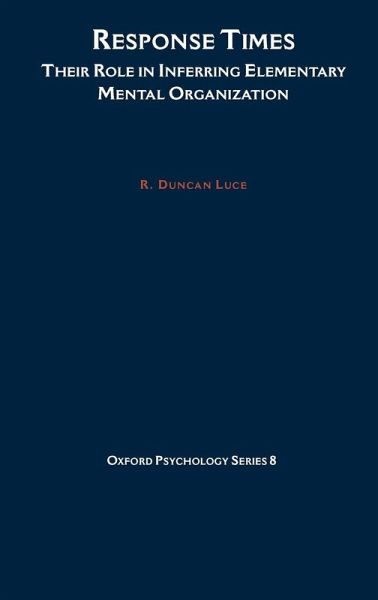
 Response Times242,99 €
 Item Response Theory55,99 €
 Student Dies, A School Mourns160,99 €
 The Orienting Response in Information Processing168,99 €
 Constructing Measures168,99 €
 Negotiating Adolescence in Times of Social Change112,99 €
 Implementing Response-to-Intervention in Elementary and Secondary Schools149,99 €


Response times are a fascinating source of information on how the mind is organized - the time taken to carry out an action tells us something about the choice process involved. This is a critical but even-handed treatment of the major themes of how response times play a role in our thinking about the mind. Professor Luce provides a comprehensive, clear review of the experimental data, and puts forward the idea of the hazard function - a novel and important approach that he and his colleagues have developed. This function, based on the probability that an reaction is about to occur given that no reaction has occurred so far during a trial, exaggerates the differences that normal analysis methods often obscure. This enables the researcher to rule out more confidently known mechanisms of time delay in human performance. Since measurements of response times are widely used by experimental psychologists as one approach to distinguishing between theories of intellectual functioning, the conceptual arguments that Professor Luce brings to bear on mathematical models of response time are of great relevance to mathematical and experimental psychologists.
Written by a distinguished psychologist, this book is an integrated treatment of the mathematical theory of human response times. Professor Luce provides a comprehensive, well-balanced, and clear review of the experimental data and puts forth the relevance of the hazard function, a novel and important approach he and his colleagues have developed. Since measurements of response times are widely used by experimental psychologists as one approach to distinguishing among theories of intellectual functioning, the conceptual arguments Professor Luce brings to bear on mathematical models of response time are of great relevance to mathematical and experimental psychologists.
Written by a distinguished psychologist, this book is an integrated treatment of the mathematical theory of human response times. Professor Luce provides a comprehensive, well-balanced, and clear review of the experimental data and puts forth the relevance of the hazard function, a novel and important approach he and his colleagues have developed. Since measurements of response times are widely used by experimental psychologists as one approach to distinguishing among theories of intellectual functioning, the conceptual arguments Professor Luce brings to bear on mathematical models of response time are of great relevance to mathematical and experimental psychologists.