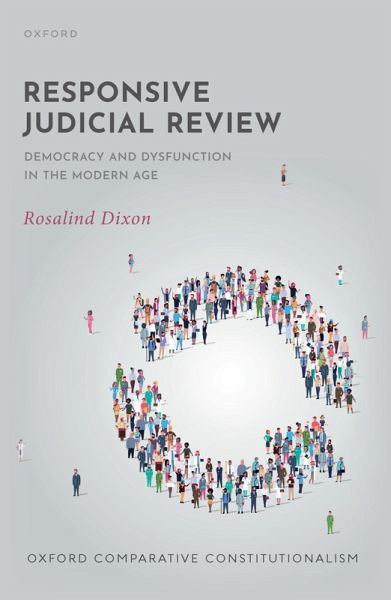
Democratic dysfunction can arise in both 'at risk' and well-functioning constitutional systems. It can threaten a system's responsiveness to both minority rights claims and majoritarian constitutional understandings. Responsive Judicial Review aims to counter this dysfunction.
Democratic dysfunction can arise in both 'at risk' and well-functioning constitutional systems. It can threaten a system's responsiveness to both minority rights claims and majoritarian constitutional understandings. Responsive Judicial Review aims to counter this dysfunction.
Rosalind Dixon is a leading global expert on comparative constitutional law, design, and democracy. She is Scientia Professor of Law at UNSW Sydney, and a former assistant professor at the University of Chicago Law School, visiting professor at Columbia Law School, Harvard Law School, and the National University of Singapore. She has served as co-president of the International Society of Public Law, and is a member of the Australian Academy of Law and Academy of Arts and Social Sciences.
Inhaltsangabe
1: Introduction 2: Constitutions and Constructional Choice 3: Defining Democracy and Democratic Dysfunction 4: The Scope and Intensity of Responsive Judical Review 5: Democratic Dsyfunction and the Effectiveness of Responsive Review 6: Risks to Democracy: Reverse Inertia, Democratic Backlash, and Debilitation 7: Towards Strong-Weak - Weak-Strong Judical Review and Remedies 8: A Responsive Judical Voice: Building a Court's Legitimacy 9: Conclusion: Towards a New Comparative Political Process Theory
1: Introduction 2: Constitutions and Constructional Choice 3: Defining Democracy and Democratic Dysfunction 4: The Scope and Intensity of Responsive Judical Review 5: Democratic Dsyfunction and the Effectiveness of Responsive Review 6: Risks to Democracy: Reverse Inertia, Democratic Backlash, and Debilitation 7: Towards Strong-Weak - Weak-Strong Judical Review and Remedies 8: A Responsive Judical Voice: Building a Court's Legitimacy 9: Conclusion: Towards a New Comparative Political Process Theory
Es gelten unsere Allgemeinen Geschäftsbedingungen: www.buecher.de/agb
Impressum
www.buecher.de ist ein Internetauftritt der buecher.de internetstores GmbH
Geschäftsführung: Monica Sawhney | Roland Kölbl | Günter Hilger
Sitz der Gesellschaft: Batheyer Straße 115 - 117, 58099 Hagen
Postanschrift: Bürgermeister-Wegele-Str. 12, 86167 Augsburg
Amtsgericht Hagen HRB 13257
Steuernummer: 321/5800/1497
USt-IdNr: DE450055826