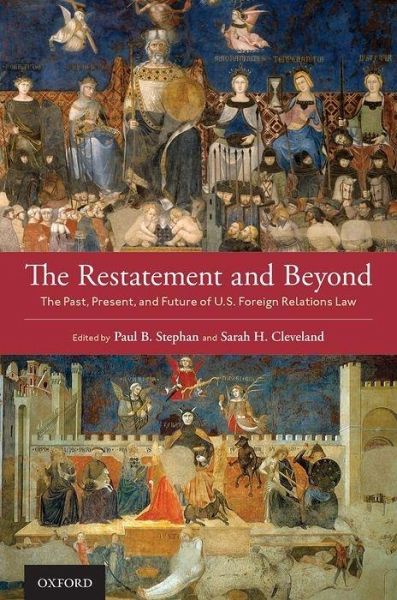
Reflecting on the Fourth Restatement of the Foreign Relations Law, these essays provide a comprehensive survey of the most significant issues in contemporary U.S. foreign relations law. They review the context and assumptions on which that work relied, critique its analysis and conclusions, and explore topics left out of the published work that need research and development. Collectively the essays provide an authoritative study of the issues generating controversy today as well as those most likely to emerge in the coming decade. The book is organized in three parts. The first provides a…mehr
Reflecting on the Fourth Restatement of the Foreign Relations Law, these essays provide a comprehensive survey of the most significant issues in contemporary U.S. foreign relations law. They review the context and assumptions on which that work relied, critique its analysis and conclusions, and explore topics left out of the published work that need research and development. Collectively the essays provide an authoritative study of the issues generating controversy today as well as those most likely to emerge in the coming decade. The book is organized in three parts. The first provides a historical context for the law of foreign relations from the beginning of the twentieth century to the present. The second and largest part looks at contested issues in foreign relations law today, from the status of international law as federal domestic law to presidential authority to make, unmake, and apply international agreements; and to the immunity of international organizations and foreign government officials from domestic lawsuits. The last part considers how foreign relations law might develop in the future as well as the difficulties raised by using the Restatement process as a way of contributing to the law's development. These essays for the most part concentrate on U.S. law, but the problems they face are common to all democratic republics that seek to reconcile international relations with the rule of law.
Paul B. Stephan is the John C. Jeffries, Jr., Distinguished Professor, University of Virginia School of Law; Counselor on International Law to the Legal Adviser, U.S. Department of State (2006-07). He was a Coordinating Reporter for the Fourth Restatement. Sarah H. Cleveland is the Louis Henkin Professor of Human and Constitutional Rights and Faculty Co-Director of the Human Rights Institute, Columbia University Law School; Member of the Venice Commission of the Council of Europe (2010-2019; Vice Chair and Member of the UN Human Rights Committee (2015-2018); Counselor on International Law to the Legal Adviser, U.S. Department of State (2009-11). She was a Coordinating Reporter for the Fourth Restatement.
Inhaltsangabe
* Introduction - The Role of the Restatements in U.S. Foreign Relations * Sarah H. Cleveland and Paul B. Stephan * I. The Fourth Restatement and The Past * Chapter 1: From the Third to the Fourth Restatement of Foreign Relations: The Rise and Potential Fall of Foreign Affairs Exceptionalism * G.E. White * II. The Fourth Restatement and the Law of Treaties * Chapter 2: Could the President Unilaterally Terminate All International Agreements? Questioning Section 313 * Harold Hongju Koh * Chapter 3: Taking Treaty Implementing Statutes Seriously * Samuel Estreicher * Chapter 4: The Fourth Restatement's Treatment of International Law and Administrative Law * Jean Galbraith * Chapter 5: Article II Treaties and Signaling Theory * Curtis A. Bradley * III. The Fourth Restatement, International Law, and Domestic Courts * Chapter 6: Federalizing International Law * Gary Born * Chapter 7: The Waning of the Federal Common Law of Foreign Relations * Paul B. Stephan * Chapter 8: Restating The Charming Betsy as A Canon of Avoidance * Anthony J. Bellia, Jr. and Bradford R. Clark * Chapter 9: Personal Jurisdiction and Fifth Amendment Due Process Revisited * Chimène I. Keitner * Chapter 10: Customary International Law and U.S. Judicial Power: From the Third to the Fourth Restatements * Thomas H. Lee * Chapter 11: International Law in U.S. Courts Within the Limits of the Constitution * John Harrison * IV. The Restatement and International Law's Limits on Domestic Jurisdiction * Chapter 12: Reasonableness as a Limitation on the Extraterritorial Application of U.S. Law: From 403 to 405 (via 404) * Hannah Buxbaum and Ralf Michaels * Chapter 13: Adjudicatory Jurisdiction and Public International Law: The Fourth Restatement's New Approach * Austen Parrish * Chapter 14: International Comity in the Fourth Restatement * William S. Dodge * Chapter 15: Toward the Fifth Restatement of U.S. Foreign Relations Law: The Future of Adjudicative Jurisdiction under International Law * Pamela K. Bookman * Chapter 16: Forum Non Conveniens in the Fourth Restatement * Donald E. Childress III * Chapter 17: Territoriality and Its Troubles * George Rutherglen * V. The Restatement and Immunity * Chapter 18: The Fourth Restatement, International Law, and the "Terrorism" Exception to the Foreign Sovereign Immunities Act * Beth Stephens * Chapter 19: The Jurisdictional Immunities of International Organizations: Recent Developments and the Challenges of the Future * David P. Stewart and Ingrid Wuerth * Chapter 20: Foreign-Official Immunity under the Common Law * John B. Bellinger III and Stephen K. Wirth * VII. The Restatement's Futures * Chapter 21: Constitutional Authority for the Transboundary Deployment of Armed Force * Bakhtiyar Tuzmukhamedov * Chapter 22: Sleeping Dogs: The Fourth Restatement and International Humanitarian Law * Ashley Deeks * Chapter 23: Consider the Source: Evidence and Authority in the Fourth Restatement * Edward Swaine * Chapter 24: The Restatements of Foreign Relations and the Rule of Law * Kristina Daugirdas * Chapter 25: Can the Fourth Restatement of Foreign Relations Law Foster Legal Stability? * Jide Nzelibe
* Introduction - The Role of the Restatements in U.S. Foreign Relations * Sarah H. Cleveland and Paul B. Stephan * I. The Fourth Restatement and The Past * Chapter 1: From the Third to the Fourth Restatement of Foreign Relations: The Rise and Potential Fall of Foreign Affairs Exceptionalism * G.E. White * II. The Fourth Restatement and the Law of Treaties * Chapter 2: Could the President Unilaterally Terminate All International Agreements? Questioning Section 313 * Harold Hongju Koh * Chapter 3: Taking Treaty Implementing Statutes Seriously * Samuel Estreicher * Chapter 4: The Fourth Restatement's Treatment of International Law and Administrative Law * Jean Galbraith * Chapter 5: Article II Treaties and Signaling Theory * Curtis A. Bradley * III. The Fourth Restatement, International Law, and Domestic Courts * Chapter 6: Federalizing International Law * Gary Born * Chapter 7: The Waning of the Federal Common Law of Foreign Relations * Paul B. Stephan * Chapter 8: Restating The Charming Betsy as A Canon of Avoidance * Anthony J. Bellia, Jr. and Bradford R. Clark * Chapter 9: Personal Jurisdiction and Fifth Amendment Due Process Revisited * Chimène I. Keitner * Chapter 10: Customary International Law and U.S. Judicial Power: From the Third to the Fourth Restatements * Thomas H. Lee * Chapter 11: International Law in U.S. Courts Within the Limits of the Constitution * John Harrison * IV. The Restatement and International Law's Limits on Domestic Jurisdiction * Chapter 12: Reasonableness as a Limitation on the Extraterritorial Application of U.S. Law: From 403 to 405 (via 404) * Hannah Buxbaum and Ralf Michaels * Chapter 13: Adjudicatory Jurisdiction and Public International Law: The Fourth Restatement's New Approach * Austen Parrish * Chapter 14: International Comity in the Fourth Restatement * William S. Dodge * Chapter 15: Toward the Fifth Restatement of U.S. Foreign Relations Law: The Future of Adjudicative Jurisdiction under International Law * Pamela K. Bookman * Chapter 16: Forum Non Conveniens in the Fourth Restatement * Donald E. Childress III * Chapter 17: Territoriality and Its Troubles * George Rutherglen * V. The Restatement and Immunity * Chapter 18: The Fourth Restatement, International Law, and the "Terrorism" Exception to the Foreign Sovereign Immunities Act * Beth Stephens * Chapter 19: The Jurisdictional Immunities of International Organizations: Recent Developments and the Challenges of the Future * David P. Stewart and Ingrid Wuerth * Chapter 20: Foreign-Official Immunity under the Common Law * John B. Bellinger III and Stephen K. Wirth * VII. The Restatement's Futures * Chapter 21: Constitutional Authority for the Transboundary Deployment of Armed Force * Bakhtiyar Tuzmukhamedov * Chapter 22: Sleeping Dogs: The Fourth Restatement and International Humanitarian Law * Ashley Deeks * Chapter 23: Consider the Source: Evidence and Authority in the Fourth Restatement * Edward Swaine * Chapter 24: The Restatements of Foreign Relations and the Rule of Law * Kristina Daugirdas * Chapter 25: Can the Fourth Restatement of Foreign Relations Law Foster Legal Stability? * Jide Nzelibe
Es gelten unsere Allgemeinen Geschäftsbedingungen: www.buecher.de/agb
Impressum
www.buecher.de ist ein Internetauftritt der buecher.de internetstores GmbH
Geschäftsführung: Monica Sawhney | Roland Kölbl | Günter Hilger
Sitz der Gesellschaft: Batheyer Straße 115 - 117, 58099 Hagen
Postanschrift: Bürgermeister-Wegele-Str. 12, 86167 Augsburg
Amtsgericht Hagen HRB 13257
Steuernummer: 321/5800/1497
USt-IdNr: DE450055826