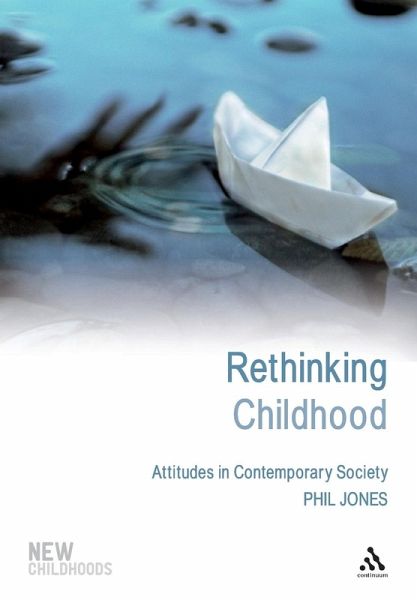
Rethinking Childhood examines attitudes towards, and experiences of, childhood. Focus is placed on opposing the processes by which children are made to be 'other': the ways in which children are separated and segregated by adults. Phil Jones explores different aspects of childhood: from education to health, from national policies to home life. A wide range of thought, research and practice from different fields and countries is used to debate, challenge and re-appraise long held beliefs, attitudes and ways of working and living with children. Children's own perspectives on their lives and on…mehr
Rethinking Childhood examines attitudes towards, and experiences of, childhood. Focus is placed on opposing the processes by which children are made to be 'other': the ways in which children are separated and segregated by adults. Phil Jones explores different aspects of childhood: from education to health, from national policies to home life. A wide range of thought, research and practice from different fields and countries is used to debate, challenge and re-appraise long held beliefs, attitudes and ways of working and living with children. Children's own perspectives on their lives and on adults' attitudes towards them are drawn on throughout the book. The result is a wide-ranging invitation to the reader to become aware of current perspectives on children and childhood, to develop a critical relationship with the content, and to develop their own 'reading' of childhood. Each chapter contains examples of research, reflections on research, activities, key points and guidance on further reading. Areas include: -How is childhood changing? -What is research revealing about attitudes towards children? -Do adults encourage the idea of children as incapable and incompetent? -How do adults fear for, and their fears of, children affect children's lives? -How does the media affect children's lives? -How does a child rights perspective challenge service provision? -In what ways are children's voices and opinions changing our world? Rethinking Childhood is essential for those studying childhood at undergraduate and graduate level and for those working with children in any field, from education to health, from play to law.
Phil Jones is Professor of Children's Rights and Wellbeing at the IOE, UCL's Faculty of Education and Society, University College London, UK. He has published a number of books and articles including Exploring Education and Childhood: From Current Certainties to New Visions (with Wyse, Davis and Rogers 2015) and Rethinking Childhood (2009). He has conducted research funded by the Children's Commissioner for England and by the LankellyChase Foundation.
Inhaltsangabe
Introduction to New Childhoods series Part 1 Debates, Dilemmas and Challenges: An introduction to attitudes towards children Chapter 1 Introduction Introduction and key questions How is childhood changing? What is research revealing about attitudes towards children? What are the uses of looking at attitudes towards children? Summary Part 2 An Interdisciplinary Overview of Recent Research and Scholarship Chapter 2 What are Attitudes towards Children? Introduction and key questions Are children still seen and not heard? Is childhood changing? What are contemporary tensions in childhood? What are emerging ideas about 'new childhoods'? Summary Chapter 3 How are Otherness and Childhood Connected? Introduction and key questions What does being 'other' mean? Childish or childlike: are children the ultimate other? Are children seen primarily in terms of not being adults? How does children's otherness affect their lives? Can othering be challenged? Summary Part 3 Implications for Children's Lives Chapter 4 Incomplete Adults? Decision Making and Autonomy Introduction and key questions What is an incompetent child? Do adults encourage the idea of children as incapable and incompetent? What is a competent child? Maturation, dependency and autonomy: old enough to make a decision? Can children be trusted? Children and adult power What are effective ways of recognizing children's capability? Summary Chapter 5 Babies, Barbies and Blues: Stereotyping and its challengers Introduction and key questions What are adult attitudes towards children's gender? Why do adults pink and blue children? Babies and beyond What is the impact of the ways adults try to gender children's worlds? How do children respond to their gendered world? How do they make their worlds in terms of gender and image? What are the implications of research on living and working with children? Summary Chapter 6 Fear for children and Fear of Children: Protection and projection Introduction and key questions What are adult attitudes concerning fear for, and fear of children? How do adult ideas and practices concerning our fear for children affect children's lives? How can attitudes be challenged and changed? Summary Chapter 7 Unseen and Unheard or Seen and Heard? Participation and exclusion Introduction and key questions How and why do adults make decisions that shape children's worlds for them? What impact does adult decision making have on children's lives? What ideas and practices concerning children's participation have been developed? How has research explored the practice and impact of children's participation in decision making? Summary Chapter 8 Challenging Otherness: Child rights and the child's voice Introduction and key questions How can attitudes be challenged? How can the child's voice be prioritized? What does research reveal about children's voices and their impact? Summary References Index
Introduction to New Childhoods series Part 1 Debates, Dilemmas and Challenges: An introduction to attitudes towards children Chapter 1 Introduction Introduction and key questions How is childhood changing? What is research revealing about attitudes towards children? What are the uses of looking at attitudes towards children? Summary Part 2 An Interdisciplinary Overview of Recent Research and Scholarship Chapter 2 What are Attitudes towards Children? Introduction and key questions Are children still seen and not heard? Is childhood changing? What are contemporary tensions in childhood? What are emerging ideas about 'new childhoods'? Summary Chapter 3 How are Otherness and Childhood Connected? Introduction and key questions What does being 'other' mean? Childish or childlike: are children the ultimate other? Are children seen primarily in terms of not being adults? How does children's otherness affect their lives? Can othering be challenged? Summary Part 3 Implications for Children's Lives Chapter 4 Incomplete Adults? Decision Making and Autonomy Introduction and key questions What is an incompetent child? Do adults encourage the idea of children as incapable and incompetent? What is a competent child? Maturation, dependency and autonomy: old enough to make a decision? Can children be trusted? Children and adult power What are effective ways of recognizing children's capability? Summary Chapter 5 Babies, Barbies and Blues: Stereotyping and its challengers Introduction and key questions What are adult attitudes towards children's gender? Why do adults pink and blue children? Babies and beyond What is the impact of the ways adults try to gender children's worlds? How do children respond to their gendered world? How do they make their worlds in terms of gender and image? What are the implications of research on living and working with children? Summary Chapter 6 Fear for children and Fear of Children: Protection and projection Introduction and key questions What are adult attitudes concerning fear for, and fear of children? How do adult ideas and practices concerning our fear for children affect children's lives? How can attitudes be challenged and changed? Summary Chapter 7 Unseen and Unheard or Seen and Heard? Participation and exclusion Introduction and key questions How and why do adults make decisions that shape children's worlds for them? What impact does adult decision making have on children's lives? What ideas and practices concerning children's participation have been developed? How has research explored the practice and impact of children's participation in decision making? Summary Chapter 8 Challenging Otherness: Child rights and the child's voice Introduction and key questions How can attitudes be challenged? How can the child's voice be prioritized? What does research reveal about children's voices and their impact? Summary References Index
Es gelten unsere Allgemeinen Geschäftsbedingungen: www.buecher.de/agb
Impressum
www.buecher.de ist ein Internetauftritt der buecher.de internetstores GmbH
Geschäftsführung: Monica Sawhney | Roland Kölbl | Günter Hilger
Sitz der Gesellschaft: Batheyer Straße 115 - 117, 58099 Hagen
Postanschrift: Bürgermeister-Wegele-Str. 12, 86167 Augsburg
Amtsgericht Hagen HRB 13257
Steuernummer: 321/5800/1497
USt-IdNr: DE450055826