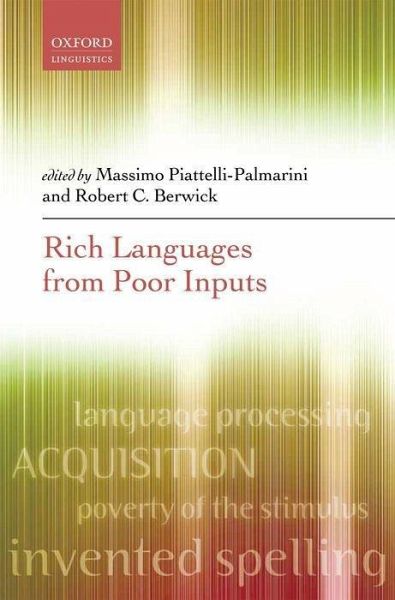
This book addresses one of the most famous and controversial arguments in the study of language and mind, the Poverty of the Stimulus. Presented by Chomsky in 1968, the argument holds that children do not receive enough evidence to infer the existence of core aspects of language, such as the dependence of linguistic rules on hierarchical phrase structure. The argument strikes against empiricist accounts of language acquisition and supports the conclusion that knowledge of some aspects of grammar must be innate. In the first part of Rich Grammars from Poor Inputs, contributors consider the…mehr
This book addresses one of the most famous and controversial arguments in the study of language and mind, the Poverty of the Stimulus. Presented by Chomsky in 1968, the argument holds that children do not receive enough evidence to infer the existence of core aspects of language, such as the dependence of linguistic rules on hierarchical phrase structure. The argument strikes against empiricist accounts of language acquisition and supports the conclusion that knowledge of some aspects of grammar must be innate. In the first part of Rich Grammars from Poor Inputs, contributors consider the general issues around the POS argument, review the empirical data, and offer new and plausible explanations. This is followed by a discussion of the the processes of language acquisition, and observed 'gaps' between adult and child grammar, concentrating on the late spontaneous acquisition by children of some key syntactic principles, basically, though not exclusively, between the ages of 5 to 9. Part 3 widens the horizon beyond language acquisition in the narrow sense, examining the natural development of reading and writing and of the child's growing sensitivity for the fine arts.
Massimo Piattelli-Palmarini is Professor of Cognitive Science at the University of Arizona and a member of the Department of Linguistics, the Cognitive Science Program and the Department of Psychology. In October 1975 he organized the encounter between Jean Piaget and Noam Chomsky and in 1980 edited the proceedings Language and Learning, now translated into 11 languages and the echoes of which still explicitly resonate in the present volume. He is the editor, with Juan Uriagereka and Pello Salaburu, of Of Minds and Language: A Dialogue with Noam Chomsky in the Basque Country (OUP) and author, with Jerry Fodor, of What Darwin Got Wrong. Robert C. Berwick is Professor of Computer Science and Computational Linguistics at the Massachusetts Institute of Technology. He has published more than a half-dozen books on the nature of language, language learnability, and computation, starting from his 1982 dissertation, The Acquisition of Syntactic Knowledge to The Grammatical Basis of Linguistic Performance, Computational Complexity and Natural Language, and Principle-Based Parsing. Most recently, he has focused on the biology of language, particularly the evolution of language.
Inhaltsangabe
* 1: Massimo Piattelli-Palmarini and Robert C Berwick: Introduction * Part 1 Poverty of the Stimulus and Modularity Revisited * 2: Robert C. Berwick, Noam Chomsky, and Massimo Piattelli-Palmarini: Poverty of the Stimulus Stands: Why recent challenges fail * 3: Xuan-Nga Cao Kam and Janet Dean Fodor: Children's Acquisition of Syntax: Simple models are too simple * 4: Noam Chomsky: Poverty of the Stimulus: Willingness to be puzzled * 5: Susan Curtiss: Revisiting Modularity: Using language as a window to the mind * 6: Lila Gleitman and Barbara Landau: Every Child an Isolate: Nature's experiments in language learning * Part 2: Discrepancies Between Child Grammar and Adult Grammar * 7: Jean-RÃ(c)my Hochman and Jacques Mehler: Recent Findings About Language Acquisition * 8: Adriana Belletti and Luigi Rizzi: Ways of Avoiding Intervention: Some thoughts on the development of object relatives, passive, and control * 9: Itziar Laka: Merging From the Temporal Input: On subject-object asymmetries and an ergative language * 10: Ken Wexler: Tough-Movement Developmental Delay: Another effect of phasal computation * 11: Julie Anne Legate and Charles Yang: Assessing Child and Adult Grammar * 12: Thomas G. Bever: Three Aspects of the Relation Between Lexical and Syntactic Knowledge * Part 3: Broadening the Picture: Spelling andRreading * 13: Charles Read and Rebecca Treiman: Children's Invented Spelling: What we have learned in forty years * 14: Stephanie Gottwald and Maryane Wolf: How Insights into Child Language Changed the Development of Written Language * 15: Wayne O'Neil: The Phonology of Invented Spelling * 16: Merryl Goldberg: The Arts as Language: Invention, identity, and learning * References * Index
* 1: Massimo Piattelli-Palmarini and Robert C Berwick: Introduction * Part 1 Poverty of the Stimulus and Modularity Revisited * 2: Robert C. Berwick, Noam Chomsky, and Massimo Piattelli-Palmarini: Poverty of the Stimulus Stands: Why recent challenges fail * 3: Xuan-Nga Cao Kam and Janet Dean Fodor: Children's Acquisition of Syntax: Simple models are too simple * 4: Noam Chomsky: Poverty of the Stimulus: Willingness to be puzzled * 5: Susan Curtiss: Revisiting Modularity: Using language as a window to the mind * 6: Lila Gleitman and Barbara Landau: Every Child an Isolate: Nature's experiments in language learning * Part 2: Discrepancies Between Child Grammar and Adult Grammar * 7: Jean-RÃ(c)my Hochman and Jacques Mehler: Recent Findings About Language Acquisition * 8: Adriana Belletti and Luigi Rizzi: Ways of Avoiding Intervention: Some thoughts on the development of object relatives, passive, and control * 9: Itziar Laka: Merging From the Temporal Input: On subject-object asymmetries and an ergative language * 10: Ken Wexler: Tough-Movement Developmental Delay: Another effect of phasal computation * 11: Julie Anne Legate and Charles Yang: Assessing Child and Adult Grammar * 12: Thomas G. Bever: Three Aspects of the Relation Between Lexical and Syntactic Knowledge * Part 3: Broadening the Picture: Spelling andRreading * 13: Charles Read and Rebecca Treiman: Children's Invented Spelling: What we have learned in forty years * 14: Stephanie Gottwald and Maryane Wolf: How Insights into Child Language Changed the Development of Written Language * 15: Wayne O'Neil: The Phonology of Invented Spelling * 16: Merryl Goldberg: The Arts as Language: Invention, identity, and learning * References * Index
Es gelten unsere Allgemeinen Geschäftsbedingungen: www.buecher.de/agb
Impressum
www.buecher.de ist ein Internetauftritt der buecher.de internetstores GmbH
Geschäftsführung: Monica Sawhney | Roland Kölbl | Günter Hilger
Sitz der Gesellschaft: Batheyer Straße 115 - 117, 58099 Hagen
Postanschrift: Bürgermeister-Wegele-Str. 12, 86167 Augsburg
Amtsgericht Hagen HRB 13257
Steuernummer: 321/5800/1497
USt-IdNr: DE450055826