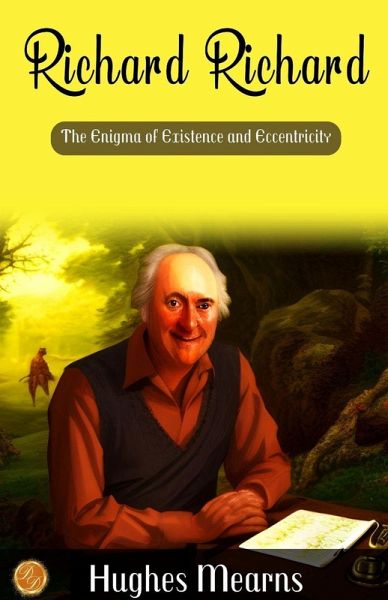
Richard Richard by Hughes Mearns: Dive into the enigmatic world of "Richard Richard," a captivating novel that blurs the lines between reality and imagination. Crafted by the ingenious Hughes Mearns, this narrative unfolds like a hall of mirrors, reflecting the complexities of identity and perception. About "Richard Richard" by Hughes Mearns: Join the enigmatic protagonist, Richard Richard, as he navigates a reality that seems to shift with each turn of the page. Mearns weaves a tale that oscillates between the mundane and the extraordinary, leaving readers questioning the very nature of…mehr
Richard Richard by Hughes Mearns: Dive into the enigmatic world of "Richard Richard," a captivating novel that blurs the lines between reality and imagination. Crafted by the ingenious Hughes Mearns, this narrative unfolds like a hall of mirrors, reflecting the complexities of identity and perception. About "Richard Richard" by Hughes Mearns: Join the enigmatic protagonist, Richard Richard, as he navigates a reality that seems to shift with each turn of the page. Mearns weaves a tale that oscillates between the mundane and the extraordinary, leaving readers questioning the very nature of existence. As Richard Richard grapples with the duality of his name and his self, readers are drawn into a labyrinth of mirrors, metaphors, and mind-bending twists. This novel is more than a narrative; it's a mirror held up to the human psyche, reflecting our eternal search for meaning and identity. Hughes Mearns, a wordsmith and philosopher, constructs a literary marvel that mirrors his fascination with the intricate workings of the mind. As a psychologist and poet, his insights into the human psyche and the dance of perception infuse the narrative with depth. Just as a hall of mirrors distorts reality, Mearns' storytelling distorts conventional narratives, inviting readers to question their assumptions and embrace the enigma of existence.
Hughes Mearns, whose real name was William Hughes Mearns and who lived from 1875 to 1965, was an American teacher and author. Mearns taught at the Philadelphia School of Pedagogy from 1905 to 1920. He had degrees from both Harvard and the University of Pennsylvania. People now know Mearns as the author of "Antigonish" (also called "The Little Man Who Wasn't There"). But his ideas about getting kids, especially those ages 3 to 8, to use their natural imagination were new at the time. It has been stated about him that, "He typed notes of their conversations; he learned how to make them forget there was an adult around; never asked them questions and never showed surprise no matter what they did or said." Creative Youth (1925) and Creative Power (1929) were two important books that Mearns wrote. Gabriel Gudding, an essayist, says that those books "lit a fuse" under the teaching of creative writing and had an impact on a whole group of scholars. He was also in charge of the Lincoln School Teachers College at Columbia University for a while, beginning in 1920. He also supported the work of John Dewey in modern education.
Es gelten unsere Allgemeinen Geschäftsbedingungen: www.buecher.de/agb
Impressum
www.buecher.de ist ein Internetauftritt der buecher.de internetstores GmbH
Geschäftsführung: Monica Sawhney | Roland Kölbl | Günter Hilger
Sitz der Gesellschaft: Batheyer Straße 115 - 117, 58099 Hagen
Postanschrift: Bürgermeister-Wegele-Str. 12, 86167 Augsburg
Amtsgericht Hagen HRB 13257
Steuernummer: 321/5800/1497
USt-IdNr: DE450055826