Charles Dowell Youmans
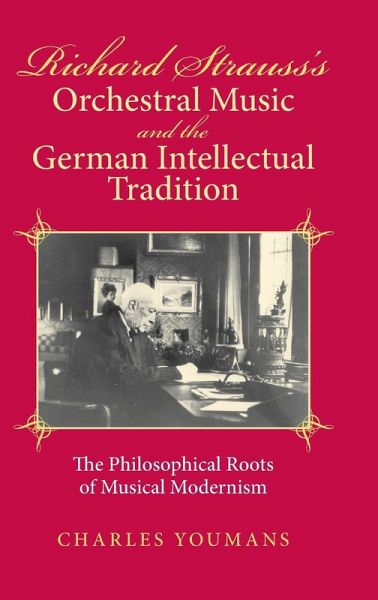
Richard Strauss's Orchestral Music and the German Intellectual Tradition
The Philosophical Roots of Musical Modernism
Charles Dowell Youmans
Richard Strauss's Orchestral Music and the German Intellectual Tradition
The Philosophical Roots of Musical Modernism
- Gebundenes Buch
- Merkliste
- Auf die Merkliste
- Bewerten Bewerten
- Teilen
- Produkt teilen
- Produkterinnerung
- Produkterinnerung
Charles Youmans is Assistant Professor of Musicology at Penn State University.
Andere Kunden interessierten sich auch für
Inna NaroditskayaMusic in the American Diasporic Wedding72,99 €
Stephen MeyerCarl Maria Von Weber and the Search for a German Opera31,99 €
Bob W. WhiteMusic and Globalization26,99 €
Emily I. DolanThe Orchestral Revolution109,99 €
Michael SpitzerMusic as Philosophy65,99 €
Caroline A KitaJewish Difference and the Arts in Vienna41,99 €
Issa BoulosMusic in Arabia94,99 €-
-
-
Produktdetails
- Produktdetails
- Indiana University Press (IPS)
- Verlag: Indiana University Press
- Seitenzahl: 312
- Erscheinungstermin: 1. Juni 2005
- Englisch
- Abmessung: 240mm x 161mm x 21mm
- Gewicht: 636g
- ISBN-13: 9780253345738
- ISBN-10: 0253345731
- Artikelnr.: 21664058
- Herstellerkennzeichnung
- Libri GmbH
- Europaallee 1
- 36244 Bad Hersfeld
- gpsr@libri.de
- Indiana University Press (IPS)
- Verlag: Indiana University Press
- Seitenzahl: 312
- Erscheinungstermin: 1. Juni 2005
- Englisch
- Abmessung: 240mm x 161mm x 21mm
- Gewicht: 636g
- ISBN-13: 9780253345738
- ISBN-10: 0253345731
- Artikelnr.: 21664058
- Herstellerkennzeichnung
- Libri GmbH
- Europaallee 1
- 36244 Bad Hersfeld
- gpsr@libri.de
Charles Youmans is Assistant Professor of Musicology at Penn State University.
Contents
Intellectual History and Artistic Production: The Case of Richard Strauss
Part I. The Private Intellectual Context of Strauss's Early Career
1. "The Conversion": Strauss and Wagnerism
2. Music and the "Denial of the Will": Schopenhauer in Strauss's Life and
Work
3. Strauss's Nietzsche
4. Goethe and the Development of Strauss's Mature Worldview
Part II. Orchestral Composition as Philosophical Critique
5. The First Cycle of Tone Poems: Genesis of a Critical Musical Technique
6. Eulenspiegel, Zarathustra, Quixote, Strauss: Crystallization of a
Persona
7. Absolute Music, Twentieth-Century Aesthetics, and the Symphonies of
Richard Strauss
Notes
Works Cited
Index

Intellectual History and Artistic Production: The Case of Richard Strauss
Part I. The Private Intellectual Context of Strauss's Early Career
1. "The Conversion": Strauss and Wagnerism
2. Music and the "Denial of the Will": Schopenhauer in Strauss's Life and
Work
3. Strauss's Nietzsche
4. Goethe and the Development of Strauss's Mature Worldview
Part II. Orchestral Composition as Philosophical Critique
5. The First Cycle of Tone Poems: Genesis of a Critical Musical Technique
6. Eulenspiegel, Zarathustra, Quixote, Strauss: Crystallization of a
Persona
7. Absolute Music, Twentieth-Century Aesthetics, and the Symphonies of
Richard Strauss
Notes
Works Cited
Index
Contents
Intellectual History and Artistic Production: The Case of Richard Strauss
Part I. The Private Intellectual Context of Strauss's Early Career
1. "The Conversion": Strauss and Wagnerism
2. Music and the "Denial of the Will": Schopenhauer in Strauss's Life and
Work
3. Strauss's Nietzsche
4. Goethe and the Development of Strauss's Mature Worldview
Part II. Orchestral Composition as Philosophical Critique
5. The First Cycle of Tone Poems: Genesis of a Critical Musical Technique
6. Eulenspiegel, Zarathustra, Quixote, Strauss: Crystallization of a
Persona
7. Absolute Music, Twentieth-Century Aesthetics, and the Symphonies of
Richard Strauss
Notes
Works Cited
Index
Intellectual History and Artistic Production: The Case of Richard Strauss
Part I. The Private Intellectual Context of Strauss's Early Career
1. "The Conversion": Strauss and Wagnerism
2. Music and the "Denial of the Will": Schopenhauer in Strauss's Life and
Work
3. Strauss's Nietzsche
4. Goethe and the Development of Strauss's Mature Worldview
Part II. Orchestral Composition as Philosophical Critique
5. The First Cycle of Tone Poems: Genesis of a Critical Musical Technique
6. Eulenspiegel, Zarathustra, Quixote, Strauss: Crystallization of a
Persona
7. Absolute Music, Twentieth-Century Aesthetics, and the Symphonies of
Richard Strauss
Notes
Works Cited
Index