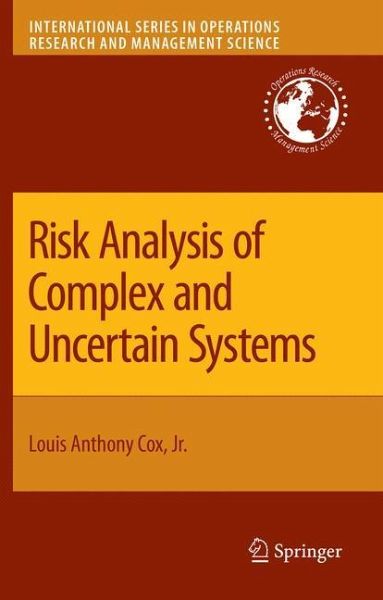
In Risk Analysis of Complex and Uncertain Systems acknowledged risk authority Tony Cox shows all risk practitioners how Quantitative Risk Assessment (QRA) can be used to improve risk management decisions and policies. It develops and illustrates QRA methods for complex and uncertain biological, engineering, and social systems - systems that have behaviors that are just too complex to be modeled accurately in detail with high confidence - and shows how they can be applied to applications including assessing and managing risks from chemical carcinogens, antibiotic resistance, mad cow disease,…mehr
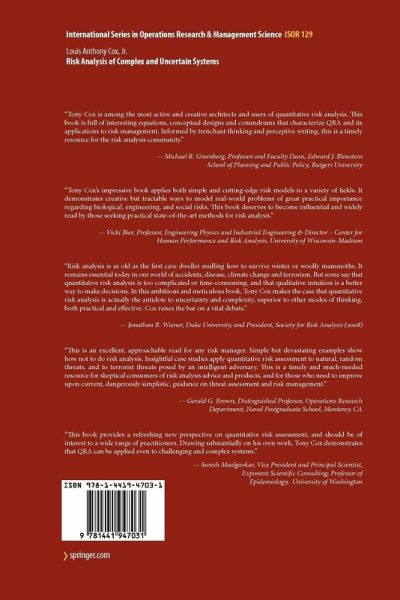
In Risk Analysis of Complex and Uncertain Systems acknowledged risk authority Tony Cox shows all risk practitioners how Quantitative Risk Assessment (QRA) can be used to improve risk management decisions and policies. It develops and illustrates QRA methods for complex and uncertain biological, engineering, and social systems - systems that have behaviors that are just too complex to be modeled accurately in detail with high confidence - and shows how they can be applied to applications including assessing and managing risks from chemical carcinogens, antibiotic resistance, mad cow disease, terrorist attacks, and accidental or deliberate failures in telecommunications network infrastructure. This book was written for a broad range of practitioners, including decision risk analysts, operations researchers and management scientists, quantitative policy analysts, economists, health and safety risk assessors, engineers, and modelers.
Produktdetails
Produktdetails
International Series in Operations Research & Management Science 129
Tony Cox is Professor of Business Analytics at the University of Colorado and President of Cox Associates, a Denver-based applied research company specializing in health, safety, and environmental risk analysis; epidemiology; policy analytics; data science; artificial intelligence; and operations research. Dr. Cox is Editor-in-Chief of Risk Analysis: An International Journal. He is Area Editor for Real World Applications for the Journal of Heuristics, and is on the Editorial Board of the International Journal of Operations Research and Information Systems. He has authored and co-authored over 200 journal articles and book chapters on these fields. His most recent books are Causal Analytics for Risk Analysis (Springer, 2018), Breakthroughs in Decision Science and Risk Analysis (Wiley, 2015), Improving Risk Analysis (Springer, 2013), and the Wiley Encyclopedia of Operations Research and Management Science (Wiley, 2011), which Dr. Cox co-edited. He has over a dozen U.S. patents on applications of artificial intelligence, signal processing, statistics and operations research in telecommunications. His current research interests include computational statistical methods for causal inference in public health risk analysis, data-mining, and advanced analytics for risk management, business, and public policy applications.
Inhaltsangabe
1 INTRODUCTION TO RISK ANALYSIS.- Quantitative Risk Assessment Goals and Challenges.- to Engineering Risk Analysis.- to Health Risk Analysis.- 2 AVOIDING BAD RISK ANALYSIS.- Limitations of Risk Assessment Using Risk Matrices.- Limitations of Quantitative Risk Assessment Using Aggregate Exposure and Risk Models.- 3 PRINCIPLES FOR DOING BETTER.- Identifying Nonlinear Causal Relations in Large Data Sets.- Overcoming Preconceptions and Confirmation Biases Using Data Mining.- Estimating the Fraction of Disease Caused by One Component of a Complex Mixture: Bounds for Lung Cancer.- Bounding Resistance Risks for Penicillin.- Confronting Uncertain Causal Mechanisms - Portfolios of Possibilities.- Determining What Can Be Predicted: Identifiability.- 4 APPLICATIONS AND EXTENSIONS.- Predicting the Effects of Changes: Could Removing Arsenic from Tobacco Smoke Significantly Reduce Smoker Risks of Lung Cancer?.- Simplifying Complex Dynamic Networks: A Model of Protease Imbalance and COPD Dynamic Dose-Response.- Value of Information (VOI) in Risk Management Policies for Tracking and Testing Imported Cattle for BSE.- Improving Antiterrorism Risk Analysis.- Designing Resilient Telecommunications Networks.
1 INTRODUCTION TO RISK ANALYSIS.- Quantitative Risk Assessment Goals and Challenges.- to Engineering Risk Analysis.- to Health Risk Analysis.- 2 AVOIDING BAD RISK ANALYSIS.- Limitations of Risk Assessment Using Risk Matrices.- Limitations of Quantitative Risk Assessment Using Aggregate Exposure and Risk Models.- 3 PRINCIPLES FOR DOING BETTER.- Identifying Nonlinear Causal Relations in Large Data Sets.- Overcoming Preconceptions and Confirmation Biases Using Data Mining.- Estimating the Fraction of Disease Caused by One Component of a Complex Mixture: Bounds for Lung Cancer.- Bounding Resistance Risks for Penicillin.- Confronting Uncertain Causal Mechanisms - Portfolios of Possibilities.- Determining What Can Be Predicted: Identifiability.- 4 APPLICATIONS AND EXTENSIONS.- Predicting the Effects of Changes: Could Removing Arsenic from Tobacco Smoke Significantly Reduce Smoker Risks of Lung Cancer?.- Simplifying Complex Dynamic Networks: A Model of Protease Imbalance and COPD Dynamic Dose-Response.- Value of Information (VOI) in Risk Management Policies for Tracking and Testing Imported Cattle for BSE.- Improving Antiterrorism Risk Analysis.- Designing Resilient Telecommunications Networks.
Rezensionen
From the reviews: "The new results of this book include many real life applications especially in health management. ... More applications to the specialists are given throughout the book. The book is written for practitioners but I think it is quite useful for anyone interested in risk analysis and assessment. ... Concluding, this is one of the best books on quantitative risk assessment. I strongly recommended it to anyone interested in reducing risk in this highly volatile world." (E. Ahmed, Zentralblatt MATH, Vol. 1168, 2009)
Es gelten unsere Allgemeinen Geschäftsbedingungen: www.buecher.de/agb
Impressum
www.buecher.de ist ein Internetauftritt der buecher.de internetstores GmbH
Geschäftsführung: Monica Sawhney | Roland Kölbl | Günter Hilger
Sitz der Gesellschaft: Batheyer Straße 115 - 117, 58099 Hagen
Postanschrift: Bürgermeister-Wegele-Str. 12, 86167 Augsburg
Amtsgericht Hagen HRB 13257
Steuernummer: 321/5800/1497
USt-IdNr: DE450055826