
Robotic Hernia Surgery
Herausgegeben:Kudsi, Omar Yusef; Dietz, Ulrich A.; Fortelny, René; Beldi, Guido; Wiegering, Armin
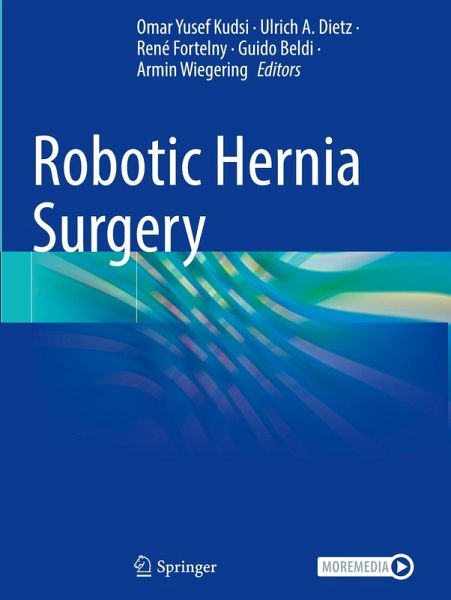
Robotic Hernia Surgery
Herausgegeben:Kudsi, Omar Yusef; Dietz, Ulrich A.; Fortelny, René; Beldi, Guido; Wiegering, Armin
- Gebundenes Buch
- Merkliste
- Auf die Merkliste
- Bewerten Bewerten
- Teilen
- Produkt teilen
- Produkterinnerung
- Produkterinnerung
The possibilities and limitations of robot-assisted hernia surgery are presented in this book by an international team of authors in all their facets. The focus is on step-by-step descriptions of individual procedures for different indications and the detailed description of the anatomical conditions as they appear to the surgeon during the robot-assisted approach. Numerous drawings and surgical photographs, specially created for the book, illustrate the presentation and are complemented by a total of 16 videos of the surgical procedures, which can be accessed from the book using the…mehr
Andere Kunden interessierten sich auch für
 Hernia Repair Sequelae98,99 €
 Robotic Surgery for Abdominal Wall Hernia Repair61,99 €
 Robotic Assisted Hernia Repair83,99 €
 Robotic Assisted Hernia Repair115,99 €
 Hernias and Surgery of the abdominal wall76,99 €
 The Greater OMENTUM78,99 €
 Incisional Hernia76,99 €
-
-
-



The possibilities and limitations of robot-assisted hernia surgery are presented in this book by an international team of authors in all their facets. The focus is on step-by-step descriptions of individual procedures for different indications and the detailed description of the anatomical conditions as they appear to the surgeon during the robot-assisted approach. Numerous drawings and surgical photographs, specially created for the book, illustrate the presentation and are complemented by a total of 16 videos of the surgical procedures, which can be accessed from the book using the publisher's MoreMedia app. Additional chapters address patient-related and scientific foundations and consider the procedures in their social and economic context.
Produktdetails
- Produktdetails
- Verlag: Springer / Springer Berlin Heidelberg / Springer, Berlin
- Artikelnr. des Verlages: 978-3-662-71629-8
- Seitenzahl: 668
- Erscheinungstermin: 29. Oktober 2025
- Englisch
- Abmessung: 285mm x 215mm x 39mm
- Gewicht: 2049g
- ISBN-13: 9783662716298
- ISBN-10: 3662716291
- Artikelnr.: 74304400
- Herstellerkennzeichnung
- Springer-Verlag KG
- Sachsenplatz 4-6
- 1201 Wien, AT
- ProductSafety@springernature.com
- Verlag: Springer / Springer Berlin Heidelberg / Springer, Berlin
- Artikelnr. des Verlages: 978-3-662-71629-8
- Seitenzahl: 668
- Erscheinungstermin: 29. Oktober 2025
- Englisch
- Abmessung: 285mm x 215mm x 39mm
- Gewicht: 2049g
- ISBN-13: 9783662716298
- ISBN-10: 3662716291
- Artikelnr.: 74304400
- Herstellerkennzeichnung
- Springer-Verlag KG
- Sachsenplatz 4-6
- 1201 Wien, AT
- ProductSafety@springernature.com
Dr. Omar Yusef Kudsi, Department of Surgery, Brigham and Women's Hospital, Harvard Medical School, Boston MA, USA Prof. Dr. Dr. Ulrich Andreas Dietz, FEBS-AWS (Hon), Klinik für Viszeral, Gefäss- und Thoraxchirurgie, Kantonsspital Olten, Schweiz Prof. Dr. Guido Beldi, Universitätsklinik für Viszerale Chirurgie und Medizin, Inselspital, Bern, Schweiz Univ.-Prof. Dr. René Fortelny, FEBS-AWS (Hon), Lehrstuhl für Allgemeinchirurgie, Sigmund-Freud Privat-Universität, Wien, Österreich Univ.-Prof. Dr. Armin Wiegering, Klinik und Poliklinik für Allgemein-, Viszeral-, Transplantations-, Gefäß- und Kinderchirurgie, Universitätsklinikum Würzburg, Deutschland
What is a hernia? Explaining hernia to the patient.- The importance of comorbidities in the planning of hernia surgery.- The patient with hernia and morbid obesity: When and what to operate on first?.- When sarcopenia becomes a problem in hernia patients.- Perioperative handling of oral anticoagulants.- Hernias in women of childbearing age: special patient counseling.- ACNES: A pain syndrome of the abdominal wall that simulates visceral pain.- Chronic pain in hernia surgery: Preoperative risk assessment and recommendations.- Tranversus abdominis plane block.- Operation indication yes or no: watchful waiting in hernia patients.- The patient with recurrent hernia.- Botulinum toxin A for the prehabilitation of complex hernias.- Knowing and fulfilling expectations - surgical information on hernia surgery.- Biocompatibility and cellular mechanisms of mesh incorporation.- What do fibroblasts think about synthetic meshes? A tissue engineering neofascia model.- Adhesions, incorporation and material fatigue: findings from mesh explantations.- Hernia meshes in the contaminated field.- Does getting older mean getting a recurrence? Assessing aging correctly.- Principles of mesh overlap and hernia gap closure.- Mesh fixation.- Planning of robotic hernia repair.- Learning curves of robotics in hernia surgery.- Abdominal Wall Surgery Education in Europe.- EPAs: when can what be entrusted in continuing education?.- Models for robotic hernia surgery.- Introduction: Ventral hernias.- Guidelines and classification: Ventral hernias.- Anatomy of the navel.- Anatomy of the linea alba.- Robotic primary ventral hernia repair (r-vTAPP).- Robotic eTEP for umbilical and epigastric hernias.- Robotic transabdominal retromuscular umbilical patchplasty (r-TARUP).- Robotic treatment of rectus diastasis.- The Inan-inverting plication in rectus diastasis.- Robotic-assisted repair of Spieghel hernias.- Robotic-assisted repair of lumbar hernias.- Introduction: Inguinal and femoral hernia.- Guidelines and classification: Inguinal and femoral hernia.- Endoscopic anatomy of the posterior groin.- Robotic transabdominal inguinal and femoral hernia repair (r-TAPP 2.0).- Robotic total extraperitoneal inguinal and femoral hernia repair (r-TEP).- Robotic-assisted retroperitoneal triple neurectomy.- Robotic-assisted mesh explantation from the groin.- Guest commentary: The robotic TAPP from the perspective of the laparoscopist
Introduction: Incisional hernias.- Guidelines and classification: Incisional hernias.- Anatomy of the anterior abdominal wall.- Anatomy of the anterior abdominal wall in MRI and CT imaging.- Anatomy, embryology and pathophysiology of the peritoneum.- Pathophysiology of the abdominal wall and its scars (alt_59_Petter-Puchner/Austria).- Solutions and hazards in the retrorectus space.- Anatomy of the diaphragm and the subxiphoidal region.- Robotic-assisted transversus abdominis release (r-TAR) of large midline incisional hernias.- Robotic-assisted repair of combined median-paramedian incisional hernias with intraperitoneal mesh (r-IPeM).- C-section hernia.- Internal hernias.- Introduction: parastomal hernias.-
Guidelines and classification: parastomal hernias.- Anatomy of the anterolateral abdominal wall with regard to stomas.- Anatomy of intestinal and urological stomas.- Robotic treatment of the parastomal hernia.- Robotic implantation of prophylactic meshes for the creation of permanent stomas.- Introduction: Hiatal hernias.- Guidelines and classification: Hiatal hernias.- Determination of esophageal motility prior to planned antireflux surgery.- Robotic-assisted hiatal hernia repair.- Meshes for the esophageal hiatus.- Complications, outcomes and quality of life after hiatal hernia repair.- Robotic-assisted treatment of perineal hernias and mesh reconstruction of the pelvis after abdominoperineal rectal extirpation.- Detection of complications after hernia operations in the context of outpatient surgery.- When is it time for competitive sports again after hernia surgery?.- Diagnosis and treatment of seroma.- Prolongated postoperative pain after hernia surgery.- PROM's and PREM's? How patients perceive hernia operations.- Cost optimization in robotic surgery.- The reluctance of the ignorant and the enthusiasm of console artists.- Correlation, causality and robotic surgery: the future has begun.- Scientific progress, economic growth and the utopia of falling care costs in hernia surgery.- Economic considerations on the use of surgical robots.- Robotic platforms for surgery.- Virtual, extended and augmented reality: robotic surgery of the future.- Applications of artificial intelligence (AI) in minimally invasive surgery.- Data-driven technologies: Digitizing hernia surgery.- Dark side of robotic abdominal wall reconstruction.
Introduction: Incisional hernias.- Guidelines and classification: Incisional hernias.- Anatomy of the anterior abdominal wall.- Anatomy of the anterior abdominal wall in MRI and CT imaging.- Anatomy, embryology and pathophysiology of the peritoneum.- Pathophysiology of the abdominal wall and its scars (alt_59_Petter-Puchner/Austria).- Solutions and hazards in the retrorectus space.- Anatomy of the diaphragm and the subxiphoidal region.- Robotic-assisted transversus abdominis release (r-TAR) of large midline incisional hernias.- Robotic-assisted repair of combined median-paramedian incisional hernias with intraperitoneal mesh (r-IPeM).- C-section hernia.- Internal hernias.- Introduction: parastomal hernias.-
Guidelines and classification: parastomal hernias.- Anatomy of the anterolateral abdominal wall with regard to stomas.- Anatomy of intestinal and urological stomas.- Robotic treatment of the parastomal hernia.- Robotic implantation of prophylactic meshes for the creation of permanent stomas.- Introduction: Hiatal hernias.- Guidelines and classification: Hiatal hernias.- Determination of esophageal motility prior to planned antireflux surgery.- Robotic-assisted hiatal hernia repair.- Meshes for the esophageal hiatus.- Complications, outcomes and quality of life after hiatal hernia repair.- Robotic-assisted treatment of perineal hernias and mesh reconstruction of the pelvis after abdominoperineal rectal extirpation.- Detection of complications after hernia operations in the context of outpatient surgery.- When is it time for competitive sports again after hernia surgery?.- Diagnosis and treatment of seroma.- Prolongated postoperative pain after hernia surgery.- PROM's and PREM's? How patients perceive hernia operations.- Cost optimization in robotic surgery.- The reluctance of the ignorant and the enthusiasm of console artists.- Correlation, causality and robotic surgery: the future has begun.- Scientific progress, economic growth and the utopia of falling care costs in hernia surgery.- Economic considerations on the use of surgical robots.- Robotic platforms for surgery.- Virtual, extended and augmented reality: robotic surgery of the future.- Applications of artificial intelligence (AI) in minimally invasive surgery.- Data-driven technologies: Digitizing hernia surgery.- Dark side of robotic abdominal wall reconstruction.
What is a hernia? Explaining hernia to the patient.- The importance of comorbidities in the planning of hernia surgery.- The patient with hernia and morbid obesity: When and what to operate on first?.- When sarcopenia becomes a problem in hernia patients.- Perioperative handling of oral anticoagulants.- Hernias in women of childbearing age: special patient counseling.- ACNES: A pain syndrome of the abdominal wall that simulates visceral pain.- Chronic pain in hernia surgery: Preoperative risk assessment and recommendations.- Tranversus abdominis plane block.- Operation indication yes or no: watchful waiting in hernia patients.- The patient with recurrent hernia.- Botulinum toxin A for the prehabilitation of complex hernias.- Knowing and fulfilling expectations - surgical information on hernia surgery.- Biocompatibility and cellular mechanisms of mesh incorporation.- What do fibroblasts think about synthetic meshes? A tissue engineering neofascia model.- Adhesions, incorporation and material fatigue: findings from mesh explantations.- Hernia meshes in the contaminated field.- Does getting older mean getting a recurrence? Assessing aging correctly.- Principles of mesh overlap and hernia gap closure.- Mesh fixation.- Planning of robotic hernia repair.- Learning curves of robotics in hernia surgery.- Abdominal Wall Surgery Education in Europe.- EPAs: when can what be entrusted in continuing education?.- Models for robotic hernia surgery.- Introduction: Ventral hernias.- Guidelines and classification: Ventral hernias.- Anatomy of the navel.- Anatomy of the linea alba.- Robotic primary ventral hernia repair (r-vTAPP).- Robotic eTEP for umbilical and epigastric hernias.- Robotic transabdominal retromuscular umbilical patchplasty (r-TARUP).- Robotic treatment of rectus diastasis.- The Inan-inverting plication in rectus diastasis.- Robotic-assisted repair of Spieghel hernias.- Robotic-assisted repair of lumbar hernias.- Introduction: Inguinal and femoral hernia.- Guidelines and classification: Inguinal and femoral hernia.- Endoscopic anatomy of the posterior groin.- Robotic transabdominal inguinal and femoral hernia repair (r-TAPP 2.0).- Robotic total extraperitoneal inguinal and femoral hernia repair (r-TEP).- Robotic-assisted retroperitoneal triple neurectomy.- Robotic-assisted mesh explantation from the groin.- Guest commentary: The robotic TAPP from the perspective of the laparoscopist
Introduction: Incisional hernias.- Guidelines and classification: Incisional hernias.- Anatomy of the anterior abdominal wall.- Anatomy of the anterior abdominal wall in MRI and CT imaging.- Anatomy, embryology and pathophysiology of the peritoneum.- Pathophysiology of the abdominal wall and its scars (alt_59_Petter-Puchner/Austria).- Solutions and hazards in the retrorectus space.- Anatomy of the diaphragm and the subxiphoidal region.- Robotic-assisted transversus abdominis release (r-TAR) of large midline incisional hernias.- Robotic-assisted repair of combined median-paramedian incisional hernias with intraperitoneal mesh (r-IPeM).- C-section hernia.- Internal hernias.- Introduction: parastomal hernias.-
Guidelines and classification: parastomal hernias.- Anatomy of the anterolateral abdominal wall with regard to stomas.- Anatomy of intestinal and urological stomas.- Robotic treatment of the parastomal hernia.- Robotic implantation of prophylactic meshes for the creation of permanent stomas.- Introduction: Hiatal hernias.- Guidelines and classification: Hiatal hernias.- Determination of esophageal motility prior to planned antireflux surgery.- Robotic-assisted hiatal hernia repair.- Meshes for the esophageal hiatus.- Complications, outcomes and quality of life after hiatal hernia repair.- Robotic-assisted treatment of perineal hernias and mesh reconstruction of the pelvis after abdominoperineal rectal extirpation.- Detection of complications after hernia operations in the context of outpatient surgery.- When is it time for competitive sports again after hernia surgery?.- Diagnosis and treatment of seroma.- Prolongated postoperative pain after hernia surgery.- PROM's and PREM's? How patients perceive hernia operations.- Cost optimization in robotic surgery.- The reluctance of the ignorant and the enthusiasm of console artists.- Correlation, causality and robotic surgery: the future has begun.- Scientific progress, economic growth and the utopia of falling care costs in hernia surgery.- Economic considerations on the use of surgical robots.- Robotic platforms for surgery.- Virtual, extended and augmented reality: robotic surgery of the future.- Applications of artificial intelligence (AI) in minimally invasive surgery.- Data-driven technologies: Digitizing hernia surgery.- Dark side of robotic abdominal wall reconstruction.
Introduction: Incisional hernias.- Guidelines and classification: Incisional hernias.- Anatomy of the anterior abdominal wall.- Anatomy of the anterior abdominal wall in MRI and CT imaging.- Anatomy, embryology and pathophysiology of the peritoneum.- Pathophysiology of the abdominal wall and its scars (alt_59_Petter-Puchner/Austria).- Solutions and hazards in the retrorectus space.- Anatomy of the diaphragm and the subxiphoidal region.- Robotic-assisted transversus abdominis release (r-TAR) of large midline incisional hernias.- Robotic-assisted repair of combined median-paramedian incisional hernias with intraperitoneal mesh (r-IPeM).- C-section hernia.- Internal hernias.- Introduction: parastomal hernias.-
Guidelines and classification: parastomal hernias.- Anatomy of the anterolateral abdominal wall with regard to stomas.- Anatomy of intestinal and urological stomas.- Robotic treatment of the parastomal hernia.- Robotic implantation of prophylactic meshes for the creation of permanent stomas.- Introduction: Hiatal hernias.- Guidelines and classification: Hiatal hernias.- Determination of esophageal motility prior to planned antireflux surgery.- Robotic-assisted hiatal hernia repair.- Meshes for the esophageal hiatus.- Complications, outcomes and quality of life after hiatal hernia repair.- Robotic-assisted treatment of perineal hernias and mesh reconstruction of the pelvis after abdominoperineal rectal extirpation.- Detection of complications after hernia operations in the context of outpatient surgery.- When is it time for competitive sports again after hernia surgery?.- Diagnosis and treatment of seroma.- Prolongated postoperative pain after hernia surgery.- PROM's and PREM's? How patients perceive hernia operations.- Cost optimization in robotic surgery.- The reluctance of the ignorant and the enthusiasm of console artists.- Correlation, causality and robotic surgery: the future has begun.- Scientific progress, economic growth and the utopia of falling care costs in hernia surgery.- Economic considerations on the use of surgical robots.- Robotic platforms for surgery.- Virtual, extended and augmented reality: robotic surgery of the future.- Applications of artificial intelligence (AI) in minimally invasive surgery.- Data-driven technologies: Digitizing hernia surgery.- Dark side of robotic abdominal wall reconstruction.