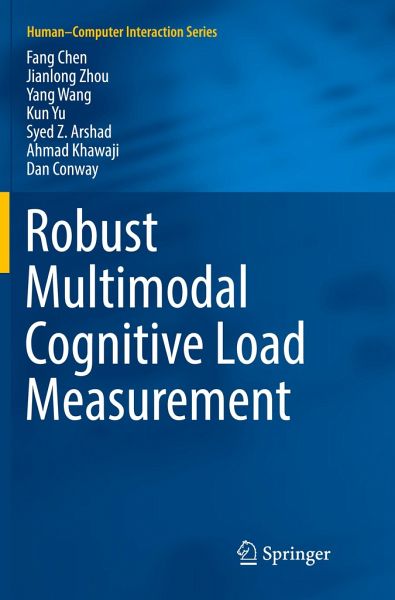
This book explores robust multimodal cognitive load measurement with physiological and behavioural modalities, which involve the eye, Galvanic Skin Response, speech, language, pen input, mouse movement and multimodality fusions. Factors including stress, trust, and environmental factors such as illumination are discussed regarding their implications for cognitive load measurement. Furthermore, dynamic workload adjustment and real-time cognitive load measurement with data streaming are presented in order to make cognitive load measurement accessible by more widespread applications and users.…mehr
This book explores robust multimodal cognitive load measurement with physiological and behavioural modalities, which involve the eye, Galvanic Skin Response, speech, language, pen input, mouse movement and multimodality fusions. Factors including stress, trust, and environmental factors such as illumination are discussed regarding their implications for cognitive load measurement. Furthermore, dynamic workload adjustment and real-time cognitive load measurement with data streaming are presented in order to make cognitive load measurement accessible by more widespread applications and users. Finally, application examples are reviewed demonstrating the feasibility of multimodal cognitive load measurement in practical applications. This is the first book of its kind to systematically introduce various computational methods for automatic and real-time cognitive load measurement and by doing so moves the practical application of cognitive load measurement from the domain of the computerscientist and psychologist to more general end-users, ready for widespread implementation.
Robust Multimodal Cognitive Load Measurement is intended for researchers and practitioners involved with cognitive load studies and communities within the computer, cognitive, and social sciences. The book will especially benefit researchers in areas like behaviour analysis, social analytics, human-computer interaction (HCI), intelligent information processing, and decision support systems.
Dr. Fang Chen's main research area includes cognitive science, interaction design and human-machine interaction, with theoretical background involving physiology, behavioural psychology, visual and auditory interaction. Her researches were widely applied in multimedia system usability, automatic control, aviation and automobile driving control, public safety and crisis management and were adopted by the EU as the basis for the formulation of relevant standards for transportation and vehicles. As an expert in interaction design, she serves as a member and consultant to several international academic research institutions, and published hundreds of papers in international journals and conferences. Dr. Fang Chen is a tenure professor of Chalmers University of Technology, Sweden. She has been PhD student supervisor at Tsinghua University and cooperated with Tongji University and Zhejiang University. She was employed as senior consultant for Huawei for three years. She currently works for the Department of Product and Project Management, First Automobile Work, as Senior Director. Dr. Jacques Terken was an associate professor in the Department for Industrial Design at Technische Universiteit Eindhoven, the Netherlands, until his retirement in 2018. He graduated from Utrecht University in 1979, specializing in Cognitive Psychology/Psycholinguistics, and holds a PhD from Leyden University (1985). He worked at the Institute for Perception Research at Eindhoven University of Technology. In 2001 he joined the Department for Industrial Design of Eindhoven University of Technology. He has worked in the area of speech technology and human-technology interaction. Since a number of years, his research focuses on automotive human factors. His research interests include the user experience for autonomous vehicles, and methods for evaluating design concepts in the early phases of the design process. He has supervised a number of PhD projects inthe area of human-human and human-machine communication, and in the area of automotive human factors. He is the (co-)author of over 160 scientific papers covering topics such as the use of speech in the interface, user-centred design and evaluation, and automotive human factors, (including several best paper awards), covering topics such as the use of speech in the interface, user-centred design and evaluation, and automotive human factors.
Inhaltsangabe
Preface.- Part I: Preliminaries.- Introduction.- The State-of-The-Art.- Theoretical Aspects of Multimodal Cognitive Load Measures.- Part II: Physiological Measurement.- Eye Based Measures. Galvanic Skin Response Based Measures.- Part III: Behavioural Measurement.- Linguistic Feature Based Measures.- Speech Signal Based Measures.- Pen Input Based Measures.- Mouse Based Measures.- Part IV: Multimodal Measures and Affecting Factors.- Multimodal Measures and Data Fusion.- Emotion and Cognitive Load.- Stress and Cognitive Load.- Trust and Cognitive Load.- Part V: Making Cognitive Load Measurement Accessible.- Dynamic Cognitive Load Adjustments in A Feedback Loop.- Real-Time Cognitive Load Measurement: Data Streaming Approach.- Applications of Cognitive Load Measurement.- Part VI: Conclusions.- Cognitive Load Measurement in Perspectives.
Preface.- Part I: Preliminaries.- Introduction.- The State-of-The-Art.- Theoretical Aspects of Multimodal Cognitive Load Measures.- Part II: Physiological Measurement.- Eye Based Measures. Galvanic Skin Response Based Measures.- Part III: Behavioural Measurement.- Linguistic Feature Based Measures.- Speech Signal Based Measures.- Pen Input Based Measures.- Mouse Based Measures.- Part IV: Multimodal Measures and Affecting Factors.- Multimodal Measures and Data Fusion.- Emotion and Cognitive Load.- Stress and Cognitive Load.- Trust and Cognitive Load.- Part V: Making Cognitive Load Measurement Accessible.- Dynamic Cognitive Load Adjustments in A Feedback Loop.- Real-Time Cognitive Load Measurement: Data Streaming Approach.- Applications of Cognitive Load Measurement.- Part VI: Conclusions.- Cognitive Load Measurement in Perspectives.
Rezensionen
"The content of this volume is a fair reference source for researchers and stakeholders interested in the investigation and application of the construct of cognitive load. ... this is a good reference for those who are interested in the application of cognitive load and its measurement, with the aim of designing multimodal human-computer interactive systems better aligned with limited mental capacities of humans." (Luca Longo, Computing Reviews, March, 2017)
Es gelten unsere Allgemeinen Geschäftsbedingungen: www.buecher.de/agb
Impressum
www.buecher.de ist ein Internetauftritt der buecher.de internetstores GmbH
Geschäftsführung: Monica Sawhney | Roland Kölbl | Günter Hilger
Sitz der Gesellschaft: Batheyer Straße 115 - 117, 58099 Hagen
Postanschrift: Bürgermeister-Wegele-Str. 12, 86167 Augsburg
Amtsgericht Hagen HRB 13257
Steuernummer: 321/5800/1497
USt-IdNr: DE450055826