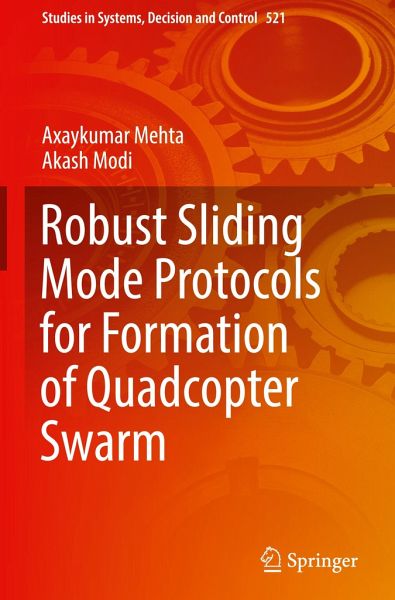
This book presents several robust sliding mode protocols for achieving the formation and tracking of Quadcopter swarm for a given pattern. In entire book, the concept of leader-follower formation control of a multi-agent system is exploited for deriving the protocols and the graph theory is used to represent the communication between the Quadcopters. The book covers two types of formation protocols of the Quadcopter swarm namely, continuous-time sliding mode protocols and discrete-time sliding mode protocols. First, the continuous-time higher order sliding mode protocols using super-twisting…mehr
This book presents several robust sliding mode protocols for achieving the formation and tracking of Quadcopter swarm for a given pattern. In entire book, the concept of leader-follower formation control of a multi-agent system is exploited for deriving the protocols and the graph theory is used to represent the communication between the Quadcopters. The book covers two types of formation protocols of the Quadcopter swarm namely, continuous-time sliding mode protocols and discrete-time sliding mode protocols. First, the continuous-time higher order sliding mode protocols using super-twisting algorithm are designed for formation using linear and non-linear models of Quadcopter. Then, the discrete-time sliding mode protocols using power rate reaching law, discrete-time super twisting algorithm, and exponential reaching law are presented. The protocols are thoroughly analysed for robustness, chattering, control effort, and convergence time for achieving the formation. Also, the stability conditions using the Lyapunov function are derived to ensure the stability of the swarm with each protocol. Further, each chapter includes extensive simulation and comparative studies to show the efficacy of each protocol. The book will be useful to graduate students, research scholars, and professionals working in the domain of civilian and military usage of the drone technology.
Keyurkumar Patel obtained his M.Tech. degree from Nirma University, Ahmedabad, in 2014. Currently, he is pursuing his Ph.D. degree at Institute of Infrastructure Technology Research and Management (IITRAM), Ahmedabad in the broad area of control and robotics. Prior to joining IITRAM, he has worked as an Assistant Professor at the SVBIT, Gujarat Technological University, from 2014 to 2016. He has also worked as an Engineer at Instrumentation Ltd., a PSU under the Ministry of Heavy Industry. His research interests include co-operative control of multi-agent systems, nonlinear sliding mode controls and observers, sliding mode control applications in electrical engineering, and networked control of multi-agent systems. He has published several research papers in peer-reviewed international journals and conference proceedings, and is an active student member of the IEEE.Axaykumar Mehta received the Ph.D. degree in 2009 from Indian Institute of Technology Bombay. He is currently an Associate Professor in Electrical Engineering at the Institute of Infrastructure Technology Research and Management, Ahmedabad. Prior to that, he was Director of Gujarat Power Engineering and Research Institute, Mehsana, Gujarat. He has published more than 88 research articles and book chapters in reputed journals, conference proceedings, and books. He has authored 3 monographs on sliding mode control and edited 3 conference proceedings with Springer Nature Singapore. He has also published 5 patents at the Indian Patent Office Mumbai. He is an advisor for the Design Lab project and Robotics museum at Gujarat Council on Science and Technology, Government of Gujarat. His research interests include networked sliding mode control, control of multi-agent systems and its applications. Dr. Mehta received the Pedagogical Innovation Award from Gujarat Technological University (GTU) in 2014, and Dewang Mehta National Education Award in 2018. He is a senior member of the IEEE, memberof the IEEE Industrial Electronics Society (IES) and Control System Society (CSS), and a life member of the Indian Society for Technical Education (ISTE), Institute of Engineers India (IEI), and Systems Society of India (SSI).
Inhaltsangabe
Introduction.- Preliminaries of Sliding Mode Control, Graph Theory, and Multi-agent System.- Design of Continuous-time Sliding Mode Protocol for Formation of 6-DOF Quadcopter Swarm.- Design of Discrete-time Sliding Mode Protocol for Formation of 6-DOF Quadcopter Swarm.- Design of Discrete-time Higher-order Sliding Mode Protocol for Formation of 6-DOF Quadcopter Swarm.
Introduction.- Preliminaries of Sliding Mode Control, Graph Theory, and Multi-agent System.- Design of Continuous-time Sliding Mode Protocol for Formation of 6-DOF Quadcopter Swarm.- Design of Discrete-time Sliding Mode Protocol for Formation of 6-DOF Quadcopter Swarm.- Design of Discrete-time Higher-order Sliding Mode Protocol for Formation of 6-DOF Quadcopter Swarm.
Es gelten unsere Allgemeinen Geschäftsbedingungen: www.buecher.de/agb
Impressum
www.buecher.de ist ein Internetauftritt der buecher.de internetstores GmbH
Geschäftsführung: Monica Sawhney | Roland Kölbl | Günter Hilger
Sitz der Gesellschaft: Batheyer Straße 115 - 117, 58099 Hagen
Postanschrift: Bürgermeister-Wegele-Str. 12, 86167 Augsburg
Amtsgericht Hagen HRB 13257
Steuernummer: 321/5800/1497
USt-IdNr: DE450055826