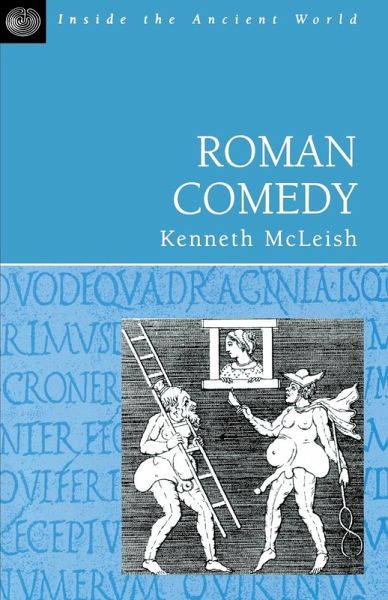
The greater part of Roman Comedy is concerned with the plays of Plautus and Terence, which apart from being well worth reading in their own right, also tell us a great deal about daily life in Ancient Rome. There are chapters dealing with the two playwrights' sources in Greece and Italy, and also with the kind of production, theatre and actors they were writing for. The comedy routines of pantomime, Punch and Judy, music hall, television and films can often be related to the works of Plautus and Terence and as the author shows, some of the greatest European writers (Shakespeare, Moliere,…mehr
The greater part of Roman Comedy is concerned with the plays of Plautus and Terence, which apart from being well worth reading in their own right, also tell us a great deal about daily life in Ancient Rome. There are chapters dealing with the two playwrights' sources in Greece and Italy, and also with the kind of production, theatre and actors they were writing for. The comedy routines of pantomime, Punch and Judy, music hall, television and films can often be related to the works of Plautus and Terence and as the author shows, some of the greatest European writers (Shakespeare, Moliere, Jonson) studied the plays, and translated and adapted them for their own purpose. Roman Comedy, as a clear accessible introduction to the subject, will have a wide appeal, to those following Classical Civilisation courses at secondary school at GCSE or A-level, and also to those studying European literature at a more advanced level.
Kenneth McLeish studied Classics and Music at Worcester College, University of Oxford, UK. After starting as a schoolteacher, he became a full-time translator, author and dramatist. His original plays and his translations from ancient drama, as well as from Strindberg, Ibsen and Feydeau, have been widely performed, most notably by the National Theatre and the Royal Shakespeare Company.
Inhaltsangabe
List Of Illustrations Acknowledgements General Editor's Preface Author's Note I The Beginnings 2 The Performers 3 Plautus 4 Terence 5 The Aftermath Contents Appendix: Dates And Sources Of Plays Index
List Of Illustrations Acknowledgements General Editor's Preface Author's Note I The Beginnings 2 The Performers 3 Plautus 4 Terence 5 The Aftermath Contents Appendix: Dates And Sources Of Plays Index
Es gelten unsere Allgemeinen Geschäftsbedingungen: www.buecher.de/agb
Impressum
www.buecher.de ist ein Internetauftritt der buecher.de internetstores GmbH
Geschäftsführung: Monica Sawhney | Roland Kölbl | Günter Hilger
Sitz der Gesellschaft: Batheyer Straße 115 - 117, 58099 Hagen
Postanschrift: Bürgermeister-Wegele-Str. 12, 86167 Augsburg
Amtsgericht Hagen HRB 13257
Steuernummer: 321/5800/1497
USt-IdNr: DE450055826