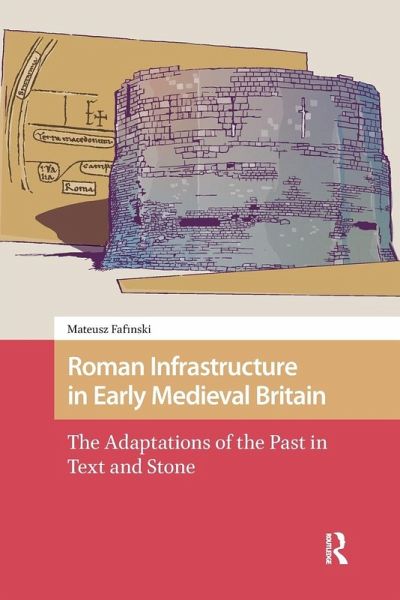
Early Medieval Britain was more Roman than we think. The Roman Empire left vast infrastructural resources on the island. These resources lay buried not only in dirt and soil, but also in texts, laws, chronicles, charters, even churches and landscapes. This book uncovers them and shows how they shaped Early Medieval Britain. Infrastructures, material and symbolic, can work in ways that are not immediately obvious and exert an influence long after their creators have gone. Infrastructure can also rest dormant and be reactivated with a changed function, role and appearance. This is not a simple…mehr
Early Medieval Britain was more Roman than we think. The Roman Empire left vast infrastructural resources on the island. These resources lay buried not only in dirt and soil, but also in texts, laws, chronicles, charters, even churches and landscapes. This book uncovers them and shows how they shaped Early Medieval Britain. Infrastructures, material and symbolic, can work in ways that are not immediately obvious and exert an influence long after their creators have gone. Infrastructure can also rest dormant and be reactivated with a changed function, role and appearance. This is not a simple story of continuity and discontinuity: It is a story of adaptation and transformation, of how the Roman infrastructural past was used and re-used, and also how it influenced the later societies of Britain.
Mateusz Fafinski is a medievalist, digital humanist, and translator. His PhD thesis at Freie Universität Berlin focused on the uses of the material past in early medieval Britain. He is a Postdoctoral Fellow at Stanford Text Technologies and teaches medieval history at Freie Universität Berlin.
Inhaltsangabe
List of Abbreviations List of Maps List of Figures Acknowledgements Prologue Chapter I: Frameworks: From Historiography to the Principal Terms 1. Infrastructure 2. Governance Resource 3. Continuity 4. Re-Use 5. City Chapter II: Movements: The Charters and Roman Transport Infrastructure 1. Writing Roads Down: Roman Roads in Documentary Practice 2. The Eastern Charters 2.1 Source Introduction 2.2 Roads and Bridges in Boundary Clauses 2.3 State of Maintenance 2.4 Obligations and Burdens 3. The Western Charters 3.1 Source Introduction 3.2 Roads in Western Charters 3.3 Alienation 4. Conclusions Chapter III: Adaptations: Roman Urban Spaces in Post-Roman and Early Medieval Britain 1. A Very Long Goodbye: Recognising Roman Urbanism in Britain 2. Urban Spaces in the Sub-Roman Period (c. 382-c. 442) 2.1 Transformations of Roman Towns in Britain 2.2 409/410 - the Year(s) Nothing Happened? 2.3 Candidates for Limited Urban Survival 2.4 Coins and Urban Spaces 2.5 Problematising the Shift 3. Urban Spaces in the Pre-Conversion Period (c. 442-597) 3.1 Tax-Gathering and Re-Use of Roman Towns 3.2 Limited Town Functions the Idea of Multifocal Governance 4. Urban Spaces in the Conversion Period and the Times of Bede (597-735) 4.1 The Strategies of Activation 4.2 Sources of Authority 4.3 Between Continuity of Place and Urban Continuity 4.4 Perceiving Roman Urban Spaces 5. Conclusions Chapter IV: Spaces: The Church and What Rome Left 1. Tinkering with the Past: Church and the Inheritance of Rome 2. Lawand Space 2.1 Regulating the Role of the Church 2.2 Acquiring and Granting Space 3. Symbolical Geographies 3.1 The Christian Foundation Legend and Roman Remains 3.2 Recreating Rome 3.3 Reoccupying Urban Spaces as Ecclesiastical Capitals 4. Memory and Infrastructure 4.1 Whithorn and Remembering Rome 4.2 Wilfrid and the Importing of Memory 5. Conclusions Epilogue Bibliography Index.
List of Abbreviations List of Maps List of Figures Acknowledgements Prologue Chapter I: Frameworks: From Historiography to the Principal Terms 1. Infrastructure 2. Governance Resource 3. Continuity 4. Re-Use 5. City Chapter II: Movements: The Charters and Roman Transport Infrastructure 1. Writing Roads Down: Roman Roads in Documentary Practice 2. The Eastern Charters 2.1 Source Introduction 2.2 Roads and Bridges in Boundary Clauses 2.3 State of Maintenance 2.4 Obligations and Burdens 3. The Western Charters 3.1 Source Introduction 3.2 Roads in Western Charters 3.3 Alienation 4. Conclusions Chapter III: Adaptations: Roman Urban Spaces in Post-Roman and Early Medieval Britain 1. A Very Long Goodbye: Recognising Roman Urbanism in Britain 2. Urban Spaces in the Sub-Roman Period (c. 382-c. 442) 2.1 Transformations of Roman Towns in Britain 2.2 409/410 - the Year(s) Nothing Happened? 2.3 Candidates for Limited Urban Survival 2.4 Coins and Urban Spaces 2.5 Problematising the Shift 3. Urban Spaces in the Pre-Conversion Period (c. 442-597) 3.1 Tax-Gathering and Re-Use of Roman Towns 3.2 Limited Town Functions the Idea of Multifocal Governance 4. Urban Spaces in the Conversion Period and the Times of Bede (597-735) 4.1 The Strategies of Activation 4.2 Sources of Authority 4.3 Between Continuity of Place and Urban Continuity 4.4 Perceiving Roman Urban Spaces 5. Conclusions Chapter IV: Spaces: The Church and What Rome Left 1. Tinkering with the Past: Church and the Inheritance of Rome 2. Lawand Space 2.1 Regulating the Role of the Church 2.2 Acquiring and Granting Space 3. Symbolical Geographies 3.1 The Christian Foundation Legend and Roman Remains 3.2 Recreating Rome 3.3 Reoccupying Urban Spaces as Ecclesiastical Capitals 4. Memory and Infrastructure 4.1 Whithorn and Remembering Rome 4.2 Wilfrid and the Importing of Memory 5. Conclusions Epilogue Bibliography Index.
Es gelten unsere Allgemeinen Geschäftsbedingungen: www.buecher.de/agb
Impressum
www.buecher.de ist ein Internetauftritt der buecher.de internetstores GmbH
Geschäftsführung: Monica Sawhney | Roland Kölbl | Günter Hilger
Sitz der Gesellschaft: Batheyer Straße 115 - 117, 58099 Hagen
Postanschrift: Bürgermeister-Wegele-Str. 12, 86167 Augsburg
Amtsgericht Hagen HRB 13257
Steuernummer: 321/5800/1497
USt-IdNr: DE450055826