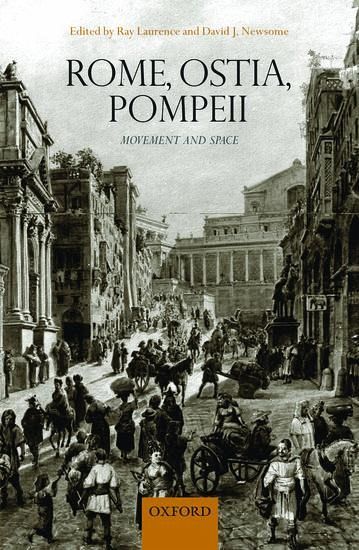
Rome, Ostia, Pompeii: Movement and Space demonstrates how studies of the Roman city are shifting focus from static architecture to activities and motion within urban spaces. This volume provides detailed case studies from the three best-known cities from Roman Italy, revealing how movement contributes to our understanding of the ways different elements of society interacted in space, and how the movement of people and materials shaped urban development. The chapters in this book examine the impressions left by the movement of people and vehicles as indentations in the archaeological and…mehr
Rome, Ostia, Pompeii: Movement and Space demonstrates how studies of the Roman city are shifting focus from static architecture to activities and motion within urban spaces. This volume provides detailed case studies from the three best-known cities from Roman Italy, revealing how movement contributes to our understanding of the ways different elements of society interacted in space, and how the movement of people and materials shaped urban development. The chapters in this book examine the impressions left by the movement of people and vehicles as indentations in the archaeological and historical record, and as impressions upon the Roman urban consciousness. Through a broad range of historical issues, this volume studies movement as it is found at the city gate, in public squares and on the street, and as it is represented in texts. Its broad objective is to make movement meaningful for understanding the economic, cultural, political, religious, and infrastructural behaviours that produced different types and rhythms of interaction in the Roman city. This volume's interdisciplinary approach will inform the understanding of the city in classics, ancient history, archaeology and architectural history, as well as cultural studies, town planning, urban geography, and sociology.
Ray Laurence is Professor of Ancient History at Macquarie University. In 2006 he won the 'Longman-History Today New Generation Prize for book most likely to inspire the young to study history' for his volume Pompeii The Living City. David J. Newsome was awarded his PhD in 2010 from the University of Birmingham. He won the BABESCH-Byvanck Award in 2008 for his innovative research on traffic and urban change at Pompeii. Both have published widely on the Roman city.
Inhaltsangabe
* Dedication * Table of contents * Preface * Acknowledgments * Notes on Contributors * Introduction * Making Movement Meaningful * Part I: Articulating Movement and Space * 1: Diana Spencer: Movement and the Linguistic Turn: Reading Varro s de Lingua Latina * 2: Ray Laurence: Literature and the Spatial Turn: Movement and Space in Martial s Epigrams * 3: Akkelies van Nes: Measuring spatial visibility, adjacency, permeability and degrees of street life in Pompeii * 4: Eleanor Betts: Towards a Multisensory Experience of Movement in the City of Rome * Part II: Movement in the Roman city: infrastructure and organisation * 5: Jeremy Hartnett: The Power of Nuisances on the Roman Street * 6: Steven Ellis: Pes dexter: Superstition and the state in the shaping of shop-fronts and street activity in the Roman world * 7: Alan Kaiser: Cart Traffic Flow in Pompeii and Rome * 8: Eric E. Poehler: Where to Park? Carts, Stables and the Economics of Transport in Pompeii * 9: Hanna Stöger: The Spatial Organisation of the Movement Economy: The Analysis of Ostia s scholae * Part III: Movement and the Metropolis * 10: Claire Holleran: The Street Life of Ancient Rome * 11: Elizabeth Macaulay-Lewis: The City in Motion: Walking for transport and leisure in the city of Rome * 12: David J. Newsome: Movement and Fora in Rome (the Late Republic to the first century CE) * 13: Francesco Trifilò: Movement, gaming and the use of space in the forum * 14: Diane Favro: Construction Traffic in Imperial Rome: Building the Arch of Septimius Severus * 15: Simon Malmberg and Hans Bjur: Movement and urban development at two city gates in Rome: the Porta Esquilina and Porta Tiburtina * Endpiece * From Movement to Mobility: Future Directions * Bibliography
Es gelten unsere Allgemeinen Geschäftsbedingungen: www.buecher.de/agb
Impressum
www.buecher.de ist ein Internetauftritt der buecher.de internetstores GmbH
Geschäftsführung: Monica Sawhney | Roland Kölbl | Günter Hilger
Sitz der Gesellschaft: Batheyer Straße 115 - 117, 58099 Hagen
Postanschrift: Bürgermeister-Wegele-Str. 12, 86167 Augsburg
Amtsgericht Hagen HRB 13257
Steuernummer: 321/5800/1497
USt-IdNr: DE450055826