
Andere Kunden interessierten sich auch für
 Barcelona and Its Rulers, 1096 1291144,99 €
 Northern Antiquities: Or, a Description of the Manners, Customs, Religion, and Laws of the Ancient Danes Including Those of Our Own Saxon An34,99 €
 The History of the Ancient Town and Borough of Uxbridge, by G. Redford and T.H. Riches34,99 €
 The Present State Of The Ottoman Empire: Containing A More Accurate And Interesting Account Of The Religion, Government, Military Est Ablishment ... O37,99 €
 Lectures on the Philosophy of Religion, Together With a Work on the Proofs of the Existence of God. Translated From the 2d German ed. by E.B. Speirs,34,99 €
 The Compendium Explained; a Popular Exposition of the Abridgement of the Heidelberg Catechism, Known as the "Compendium of the Christian Religion," of31,99 €
 Lectures on the Philosophy of Religion, Together With a Work on the Proofs of the Existence of God. Translated From the 2d German ed. by E.B. Speirs,34,99 €






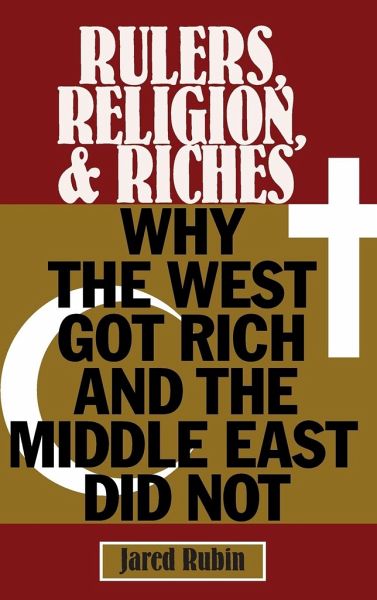
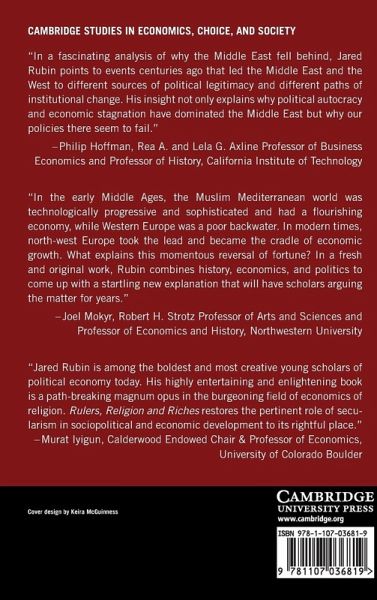
For centuries following the spread of Islam, the Middle East was far ahead of Europe. Yet, the modern economy was born in Europe. Why was it not born in the Middle East? In this book Jared Rubin examines the role that Islam played in this reversal of fortunes. It argues that the religion itself is not to blame; the importance of religious legitimacy in Middle Eastern politics was the primary culprit. Muslim religious authorities were given an important seat at the political bargaining table, which they used to block important advancements such as the printing press and lending at interest. In Europe, however, the Church played a weaker role in legitimizing rule, especially where Protestantism spread (indeed, the Reformation was successful due to the spread of printing, which was blocked in the Middle East). It was precisely in those Protestant nations, especially England and the Dutch Republic, where the modern economy was born.