Russian Literature and Cognitive Science applies the newest insights from cognitive psychology to the study of Russian literature. Chapters focus on writers and cultural figures from the Golden to the Internet Age including: Pushkin, Dostoevsky, Tolstoy, Sologub, Bely, Akhmatova, Nabokov, Baranskaya, and contemporary online discourse. The authors draw on a wide array of cognitively-informed fields within psychology and related disciplines and approaches such as social psychology, visual processing, conceptual blending, cognitive narratology, the study of autism, cognitive approaches to…mehr
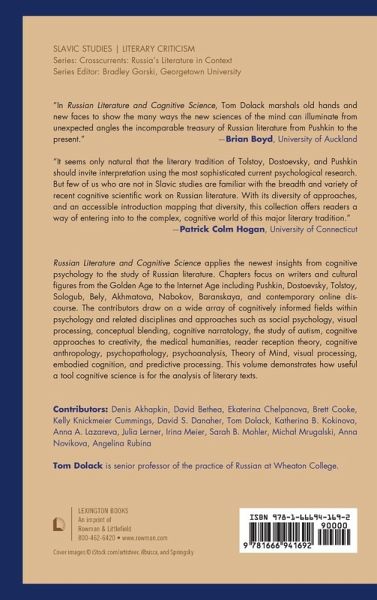
Russian Literature and Cognitive Science applies the newest insights from cognitive psychology to the study of Russian literature. Chapters focus on writers and cultural figures from the Golden to the Internet Age including: Pushkin, Dostoevsky, Tolstoy, Sologub, Bely, Akhmatova, Nabokov, Baranskaya, and contemporary online discourse. The authors draw on a wide array of cognitively-informed fields within psychology and related disciplines and approaches such as social psychology, visual processing, conceptual blending, cognitive narratology, the study of autism, cognitive approaches to creativity, the medical humanities, reader reception theory, cognitive anthropology, psychopathology, psychoanalysis, Theory of Mind, visual processing, embodied cognition, and predictive processing. This volume demonstrates how useful a tool cognitive science is for the analysis of literary texts.
Tom Dolack is senior professor of the Practice of Russian at Wheaton College.
Inhaltsangabe
Preface Introduction Tom Dolack Chapter 1: Pushkin's "The Stationmaster": Morality Meets Sexual Selection David Bethea Chapter 2: Flow and Selfhood in Leo Tolstoy's Anna Karenina: A Case Study of the Mowing Scene David S. Danaher Chapter 3: Facial Imagery, Reader Visualization, and the Visual Ethics of War and Peace Sarah B. Mohler Chapter 4: A Multilevel Cognitive Approach to Pushkin Tom Dolack Chapter 5: Staying Imperturbable in the Face of Fate: Alexander Pushkin's Gothic Stories Conveying the Code of Honor in the Face of the Supernatural Ekaterina Chelpanova Chapter 6: (Un)Reading and the "Gappiness" of Context: Towards a New Cognitive Reception Theory Katherina B. Kokinova Chapter 7: Re-Visioning Despair: The Medical Gaze in Sologub's The Petty Demon Kelly Knickmeier Cummings Chapter 8: Autism in Nabokov's The Defense Brett Cooke Chapter 9: Provocation and Pre-Diction: Terrorist Realism as a Narrative Mode in the Russian Imperium's Prose 1862-1914 (Particularly in Andrei Bely's Petersburg, 1913) Michal Mrugalski Chapter 10: Mass Shooters as Underground Men of the 21st Century Irina Meier Chapter 11: Russian Cognitive Approaches for Studying Genres of Contemporary Electronic Communication: Interpreting "Sincere Conversations" in New Media Anna Novikova and Julia Lerner Chapter 12: Dream (Re)Interpretation: Metaphors and Story Schemas in Meaning Creation Anna A. Lazareva Chapter 13: Intersections between Language, Social Norms, and Individual Cognition in Natalya Baranskaya's A Week like Any Other Angelina Rubina Chapter 14: Cognitive Aspects of Deixis and Semantic Poetics of Anna Akhmatova and Joseph Brodsky Denis Akhapkin About the Contributors
Es gelten unsere Allgemeinen Geschäftsbedingungen: www.buecher.de/agb
Impressum
www.buecher.de ist ein Internetauftritt der buecher.de internetstores GmbH
Geschäftsführung: Monica Sawhney | Roland Kölbl | Günter Hilger
Sitz der Gesellschaft: Batheyer Straße 115 - 117, 58099 Hagen
Postanschrift: Bürgermeister-Wegele-Str. 12, 86167 Augsburg
Amtsgericht Hagen HRB 13257
Steuernummer: 321/5800/1497
USt-IdNr: DE450055826