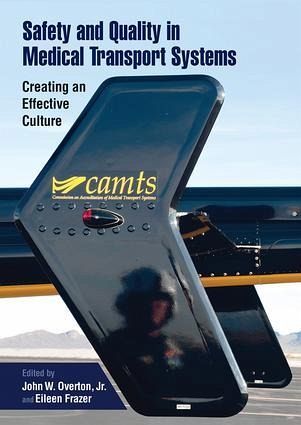
You can attribute most helicopter EMS (emergency medical service) accidents and many ground ambulance accidents to human factors and systems designs that lead to poor decision-making. Management commitment is vital to maintain a culture that supports risk assessment, accountability, professionalism and organizational dynamics. This volume by The Commission on Accreditation of Medical Transport Systems (CAMTS) addresses this need. It offers insights and solutions that can be used by EMS, Fire and Rescue, public and private services, and professional emergency and transport professionals worldwide.…mehr
You can attribute most helicopter EMS (emergency medical service) accidents and many ground ambulance accidents to human factors and systems designs that lead to poor decision-making. Management commitment is vital to maintain a culture that supports risk assessment, accountability, professionalism and organizational dynamics. This volume by The Commission on Accreditation of Medical Transport Systems (CAMTS) addresses this need. It offers insights and solutions that can be used by EMS, Fire and Rescue, public and private services, and professional emergency and transport professionals worldwide.
John W. Overton, Jr. earned a Bachelor of Science degree from Virginia Polytechnic Institute and State University and his Medical Doctor degree from the University of Virginia. After initial years in residency training, followed by six years of full-time inner-city emergency medicine that fostered interest in trauma care, Dr. Overton returned to residency training, completing general and cardiothoracic surgical residencies. His interests in trauma consulting and improving trauma care have continued throughout his career. He was one of the earliest adopters of a regional trauma database in the 1980s and contributed to the development of the National Cardiac Surgical Database in the late 1980s and early 1990s. Over a two-year period in the late 1990s Dr. Overton led a team that focused on reducing mortality following cardiac surgery in conjunction with the Institute for Healthcare Improvement. Significant and sustained process improvement and reduction in post-operative cardiac surgical death followed completion of the team endeavor. Dr. Overton's surgical career has been influenced by his life-long interest in aviation and safety, employing aviation safety principles he learned as a pilot to improve surgical care. He has been a general aviation pilot for over three decades. Following his retirement from clinical surgery, Dr. Overton remains an active pilot and teaches medical and surgical colleagues principles of safety and risk management. He is a former member of the board of directors for the Commission on Accreditation of Medical Transport Systems, and in 2011 he was appointed to serve as the interim medical officer for the National Transportation Safety Board. He is a proponent of a just culture and teaches the subjects of Just Culture and Threat and Error Management to medical, surgical and transport teams. Eileen Frazer, R.N., Certified Medical Transport Executive; former chief flight nurse, chairperson for the Association of Air Medical Services' (A
Inhaltsangabe
Contents: Foreword; A tribute to Robert L. Helmreich PhD; Preface; Section I The Foundations of Organizational Culture: A brief overview of the foundations of organizational culture Ralph N. Rogers; Achieving optimal outcomes through just culture K. Scott Griffith; Safety climate and safety culture Terry L. von Thaden; The financial perspective of safety Clive Adams. Section II The Current Medical Transport Environment: The current status of air medical transport Terry L. von Thaden; The current status of ground medical transport Nadine Levick. Section III Safety and Risk Management: An overview of the risk-management process Kimberly Turner; Safety management systems Kimberly Turner; Operations safety: developing executing and upgrading the operations plan Bruce A. Tesmer; Improving communications to improve safety Robin Graham; Training to improve operational safety Terry Palmer; Operational safety training: learning from the mistakes of others Roger Coleman; Adjuncts to safety in ground medical transport Nadine Levick; Medical error - recognition reporting managing response and limiting harm Gregory H. Botz and John W. Crommett; Fatigue challenges in emergency medical services operations Melissa M. Mallis; Individual provider wellness and self-care John W. Overton Jr Laurie Shiparski and Philip D. Authier; Post traumatic stress disorder in emergency medical services Eileen Frazer. Section IV Methods and Tools for Improvement: Measurement and data Donna York Clark Kate Moore and David F.E. Stuhlmiller; Essentials of learning and improvement Donna York Clark Jacqueline Stocking and David F.E. Stuhlmiller; Practical applications of methodologies: LEAN Jennifer Hardcastle Six Sigmaâ"¢ Sandra Kinkade Hutton; Teamwork and integration Patricia Corbett. Section V Workforce Challenges: Organizational challenges within medical transport services Eileen Frazer; The role of associations in safety and quality Dawn M. Mancuso; Safety and war-fighting: taking action to shape the safety culture of naval aviation Kenneth P. Neubauer; Ethical challenges David P. Thomson. A postscript: the next steps Eileen Frazer; Index.
Contents: Foreword; A tribute to Robert L. Helmreich PhD; Preface; Section I The Foundations of Organizational Culture: A brief overview of the foundations of organizational culture Ralph N. Rogers; Achieving optimal outcomes through just culture K. Scott Griffith; Safety climate and safety culture Terry L. von Thaden; The financial perspective of safety Clive Adams. Section II The Current Medical Transport Environment: The current status of air medical transport Terry L. von Thaden; The current status of ground medical transport Nadine Levick. Section III Safety and Risk Management: An overview of the risk-management process Kimberly Turner; Safety management systems Kimberly Turner; Operations safety: developing executing and upgrading the operations plan Bruce A. Tesmer; Improving communications to improve safety Robin Graham; Training to improve operational safety Terry Palmer; Operational safety training: learning from the mistakes of others Roger Coleman; Adjuncts to safety in ground medical transport Nadine Levick; Medical error - recognition reporting managing response and limiting harm Gregory H. Botz and John W. Crommett; Fatigue challenges in emergency medical services operations Melissa M. Mallis; Individual provider wellness and self-care John W. Overton Jr Laurie Shiparski and Philip D. Authier; Post traumatic stress disorder in emergency medical services Eileen Frazer. Section IV Methods and Tools for Improvement: Measurement and data Donna York Clark Kate Moore and David F.E. Stuhlmiller; Essentials of learning and improvement Donna York Clark Jacqueline Stocking and David F.E. Stuhlmiller; Practical applications of methodologies: LEAN Jennifer Hardcastle Six Sigmaâ"¢ Sandra Kinkade Hutton; Teamwork and integration Patricia Corbett. Section V Workforce Challenges: Organizational challenges within medical transport services Eileen Frazer; The role of associations in safety and quality Dawn M. Mancuso; Safety and war-fighting: taking action to shape the safety culture of naval aviation Kenneth P. Neubauer; Ethical challenges David P. Thomson. A postscript: the next steps Eileen Frazer; Index.
Es gelten unsere Allgemeinen Geschäftsbedingungen: www.buecher.de/agb
Impressum
www.buecher.de ist ein Internetauftritt der buecher.de internetstores GmbH
Geschäftsführung: Monica Sawhney | Roland Kölbl | Günter Hilger
Sitz der Gesellschaft: Batheyer Straße 115 - 117, 58099 Hagen
Postanschrift: Bürgermeister-Wegele-Str. 12, 86167 Augsburg
Amtsgericht Hagen HRB 13257
Steuernummer: 321/5800/1497
USt-IdNr: DE450055826