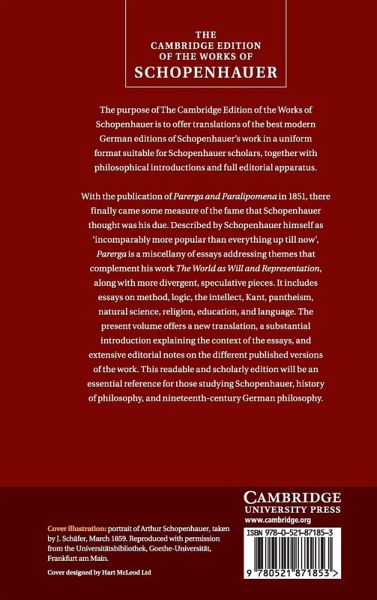
With the publication of Parerga and Paralipomena in 1851, there finally came some measure of the fame that Schopenhauer thought was his due. Described by Schopenhauer himself as 'incomparably more popular than everything up till now', Parerga is a miscellany of essays addressing themes that complement his work The World as Will and Representation, along with more divergent, speculative pieces. It includes essays on method, logic, the intellect, Kant, pantheism, natural science, religion, education, and language. The present volume offers a new translation, a substantial introduction explaining…mehr
With the publication of Parerga and Paralipomena in 1851, there finally came some measure of the fame that Schopenhauer thought was his due. Described by Schopenhauer himself as 'incomparably more popular than everything up till now', Parerga is a miscellany of essays addressing themes that complement his work The World as Will and Representation, along with more divergent, speculative pieces. It includes essays on method, logic, the intellect, Kant, pantheism, natural science, religion, education, and language. The present volume offers a new translation, a substantial introduction explaining the context of the essays, and extensive editorial notes on the different published versions of the work. This readable and scholarly edition will be an essential reference for those studying Schopenhauer, the history of philosophy, and nineteenth-century German philosophy.
Arthur Schopenhauer was among the first 19th century philosophers to contend that at its core, the universe is not a rational place. Inspired by Plato and Kant, both of whom regarded the world as being more amenable to reason, Schopenhauer developed their philosophies into an instinct-recognizing and ultimately ascetic outlook, emphasizing that in the face of a world filled with endless strife, we ought to minimize our natural desires for the sake of achieving a more tranquil frame of mind and a disposition towards universal beneficence. Often considered to be a thoroughgoing pessimist, Schopenhauer in fact advocated ways - via artistic, moral and ascetic forms of awareness - to overcome a frustration-filled and fundamentally painful human condition. Since his death in 1860, his philosophy has had a special attraction for those who wonder about life's meaning, along with those engaged in music, literature, and the visual arts.
Inhaltsangabe
General editor's preface Editorial notes and references Introduction Notes on text and translation Chronology Bibliography Parerga and Paralipomena, Volume 2: Sporadic yet systematically ordered thoughts on multifarious topics 1. On philosophy and its method 2. On logic and dialectic 3. Some thoughts concerning the intellect in general and in every respect 4. Some observations on the antithesis of the thing in itself and the appearance 5. Some words on pantheism 6. On philosophy and natural science 7. On colour theory 8. On ethics 9. On jurisprudence and politics 10. On the doctrine of the indestructibility of our true essence by death 11. Additional remarks on the doctrine of the nothingness of existence 12. Additional remarks on the doctrine of the suffering of the world 13. On suicide 14. Additional remarks on the doctrine of the affirmation and negation of the will to life 15. On religion 16. Some remarks on Sanskrit literature 17. Some archaeological observations 18. Some mythological observations 19. On the metaphysics of the beautiful and aesthetics 20. On judgment, criticism, approbation and fame 21. On learning and the learned 22. Thinking for oneself 23. On writing and style 24. On reading and books 25. On language and words 26. Psychological remarks 27. On women 28. On education 29. On physiognomy 30. On noise and sounds 31. Similes, parables and fables Some verses Versions of Schopenhauer's text Glossary of names Index.
General editor's preface Editorial notes and references Introduction Notes on text and translation Chronology Bibliography Parerga and Paralipomena, Volume 2: Sporadic yet systematically ordered thoughts on multifarious topics 1. On philosophy and its method 2. On logic and dialectic 3. Some thoughts concerning the intellect in general and in every respect 4. Some observations on the antithesis of the thing in itself and the appearance 5. Some words on pantheism 6. On philosophy and natural science 7. On colour theory 8. On ethics 9. On jurisprudence and politics 10. On the doctrine of the indestructibility of our true essence by death 11. Additional remarks on the doctrine of the nothingness of existence 12. Additional remarks on the doctrine of the suffering of the world 13. On suicide 14. Additional remarks on the doctrine of the affirmation and negation of the will to life 15. On religion 16. Some remarks on Sanskrit literature 17. Some archaeological observations 18. Some mythological observations 19. On the metaphysics of the beautiful and aesthetics 20. On judgment, criticism, approbation and fame 21. On learning and the learned 22. Thinking for oneself 23. On writing and style 24. On reading and books 25. On language and words 26. Psychological remarks 27. On women 28. On education 29. On physiognomy 30. On noise and sounds 31. Similes, parables and fables Some verses Versions of Schopenhauer's text Glossary of names Index.
Es gelten unsere Allgemeinen Geschäftsbedingungen: www.buecher.de/agb
Impressum
www.buecher.de ist ein Internetauftritt der buecher.de internetstores GmbH
Geschäftsführung: Monica Sawhney | Roland Kölbl | Günter Hilger
Sitz der Gesellschaft: Batheyer Straße 115 - 117, 58099 Hagen
Postanschrift: Bürgermeister-Wegele-Str. 12, 86167 Augsburg
Amtsgericht Hagen HRB 13257
Steuernummer: 321/5800/1497
USt-IdNr: DE450055826