
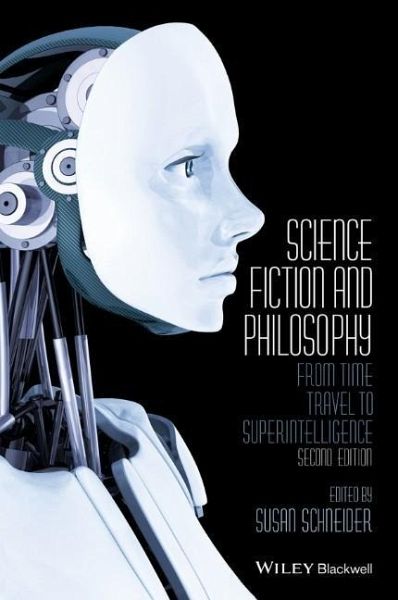
Featuring numerous updates and enhancements, Science Fiction and Philosophy, 2nd Edition, presents a collection of readings that utilize concepts developed from science fiction to explore a variety of classic and contemporary philosophical issues.
_ Uses science fiction to address a series of classic and contemporary philosophical issues, including many raised by recent scientific developments
_ Explores questions relating to transhumanism, brain enhancement, time travel, the nature of the self, and the ethics of artificial intelligence
_ Features numerous updates to the popular and highly acclaimed first edition, including new chapters addressing the cutting-edge topic of the technological singularity
_ Draws on a broad range of science fiction's more familiar novels, films, and TV series, including I, Robot, The Hunger Games, The Matrix, Star Trek, Blade Runner, and Brave New World
_ Provides a gateway into classic philosophical puzzles and topics informed by thelatest technology
_ Uses science fiction to address a series of classic and contemporary philosophical issues, including many raised by recent scientific developments
_ Explores questions relating to transhumanism, brain enhancement, time travel, the nature of the self, and the ethics of artificial intelligence
_ Features numerous updates to the popular and highly acclaimed first edition, including new chapters addressing the cutting-edge topic of the technological singularity
_ Draws on a broad range of science fiction's more familiar novels, films, and TV series, including I, Robot, The Hunger Games, The Matrix, Star Trek, Blade Runner, and Brave New World
_ Provides a gateway into classic philosophical puzzles and topics informed by thelatest technology
"What are consciousness and free will? Will artificial beings have them? Do we? And do we owe an ethical debt to future generations, even if they wear quite different bodies, or minds? These, and countless other questions first raised by a century's worth of canonical science fiction, are now ambitiously appraised by Susan Schneider in a volume that explores our philosophical frontier."
David Brin, astrophysicist and Times best-selling author of The Postman and Earth
"Susan Schneider has assembled an incredibly wide range of stimulating and accessible thoughts in these pages. The second edition of Science Fiction and Philosophy will fascinate anyone who enjoys thinking 'outside of the box'--though it might leave their minds in a whirl!"
Martin Rees, 'UK Astronomer Royal'
David Brin, astrophysicist and Times best-selling author of The Postman and Earth
"Susan Schneider has assembled an incredibly wide range of stimulating and accessible thoughts in these pages. The second edition of Science Fiction and Philosophy will fascinate anyone who enjoys thinking 'outside of the box'--though it might leave their minds in a whirl!"
Martin Rees, 'UK Astronomer Royal'
"Looking over the pages one can see Schneider's attention to detail ... .Schneider has obviously made her choices for their accessibility and we should applaud her for this ... .The collection stands as an important and provocative dialogue between two very rich areas of contemporary cultures and societies. Science Fiction and Philosophy gives us a chance to redeem science fiction ... and take the questions it poses seriously and with a critical gaze. This volume will be of interest to audiences read in science fiction, philosophy of science, philosophy of time, philosophy of mind, consciousness studies, epistemology, robot ethics and bio-ethics and biotechnology and general audiences alike." (Metapsychology)
"I highly recommend Schneider's collection, whether for use as a reader in a course on philosophy and science fiction, or simply for those interested in engaging the issues raised in much science fiction at a higher degree of abstraction, in conversation not only with the works of fiction themselves but also the philosophers and physicists who tackle many of the same questions from other angles." (Exploring Our Matrix, June 2009)
"I highly recommend Schneider's collection, whether for use as a reader in a course on philosophy and science fiction, or simply for those interested in engaging the issues raised in much science fiction at a higher degree of abstraction, in conversation not only with the works of fiction themselves but also the philosophers and physicists who tackle many of the same questions from other angles." (Exploring Our Matrix, June 2009)
"Despite its rather uneven balance between philosophy and literary criticism, the volume is a valuable pedagogical resource which will benefit tutors and students who are seeking to engage proactively with modern technology and its fictional representation." (Forum for Modern Language Studies, 3 June 2012)
"If science fiction and philosophy give you pleasure, you may enjoy reading this book immensely. " (Minds & Machines, 2010)
"Science Fiction and Philosophy brings two areas together and into a dialogue: philosophy holds the fantasmatic enjoyment of science fiction to account for its illusions and awesome possibilities while science fiction reminds philosophy that all reason and no play makes thought a very dull thing indeed. Hopefully, this volume will find its way into the hands of those who wish to discover something about the highly technological world-view and horizon of meaning of our current epoch." (Discover Magazine, November 2010)"Science Fiction and Philosophy: From Time Travel to Superintelligence (Wiley-Blackwell Publishing, 2009), Schneider mines time travel, artificial intelligence, robot rights, teleportation, and genetic modification to discuss the nature of space and time, free will, transhumanism, the self, neuroethics, and reality." (Discover, December 2010)
"Looking over the pages one can see Schneider's attention to detail ... .Schneider has obviously made her choices for their accessibility and we should applaud her for this ... .The collection stands as an important and provocative dialogue between two very rich areas of contemporary cultures and societies. Science Fiction and Philosophy gives us a chance to redeem science fiction ... and take the questions it poses seriously and with a critical gaze. This volume will be of interest to audiences read in science fiction, philosophy of science, philosophy of time, philosophy of mind, consciousness studies, epistemology, robot ethics and bio-ethics and biotechnology and general audiences alike." (Metapsychology)
"I highly recommend Schneider's collection, whether for use as a reader in a course on philosophy and science fiction, or simply for those interested in engaging the issues raised in much science fiction at a higher degree of abstraction, in conversation not only with the works of fiction themselves but also the philosophers and physicists who tackle many of the same questions from other angles." (Exploring Our Matrix, June 2009)
"If science fiction and philosophy give you pleasure, you may enjoy reading this book immensely. " (Minds & Machines, 2010)
"Science Fiction and Philosophy brings two areas together and into a dialogue: philosophy holds the fantasmatic enjoyment of science fiction to account for its illusions and awesome possibilities while science fiction reminds philosophy that all reason and no play makes thought a very dull thing indeed. Hopefully, this volume will find its way into the hands of those who wish to discover something about the highly technological world-view and horizon of meaning of our current epoch." (Discover Magazine, November 2010)"Science Fiction and Philosophy: From Time Travel to Superintelligence (Wiley-Blackwell Publishing, 2009), Schneider mines time travel, artificial intelligence, robot rights, teleportation, and genetic modification to discuss the nature of space and time, free will, transhumanism, the self, neuroethics, and reality." (Discover, December 2010)
"Looking over the pages one can see Schneider's attention to detail ... .Schneider has obviously made her choices for their accessibility and we should applaud her for this ... .The collection stands as an important and provocative dialogue between two very rich areas of contemporary cultures and societies. Science Fiction and Philosophy gives us a chance to redeem science fiction ... and take the questions it poses seriously and with a critical gaze. This volume will be of interest to audiences read in science fiction, philosophy of science, philosophy of time, philosophy of mind, consciousness studies, epistemology, robot ethics and bio-ethics and biotechnology and general audiences alike." (Metapsychology)
"I highly recommend Schneider's collection, whether for use as a reader in a course on philosophy and science fiction, or simply for those interested in engaging the issues raised in much science fiction at a higher degree of abstraction, in conversation not only with the works of fiction themselves but also the philosophers and physicists who tackle many of the same questions from other angles." (Exploring Our Matrix, June 2009)