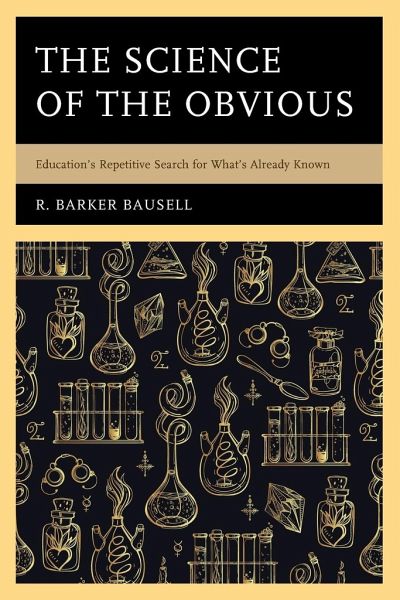
This book poses and ultimately answers the question of whether the public schools would have been affected if no educational research had been conducted during this century.
This book poses and ultimately answers the question of whether the public schools would have been affected if no educational research had been conducted during this century.
R. Barker Bausell was the first educational researcher to demonstrate the learning superiority of both tutoring and small group instruction when the curriculum, teacher differences, instructional time, and student differences were rigorously controlled. He served as a biostatistician, research methodologist, and the Director of Research in two departments within the University of Maryland over a 35+ year career and was the founding editor/editor-in-chief of the peer reviewed, Evaluation and the Health Profession for 33 of those years. He has authored 12 other books including: Conducting Meaningful Experiments: 40 Steps to Becoming a Scientist, Too Simple to Fail: A Case for Educational Change, and Snake Oil Science: The Truth about Complementary and Alternative Medicine.
Inhaltsangabe
Introduction Chapter One: Some Examples of Educational Research that Aren't Chapter Two: Contributors to this Sad State of Affairs Chapter Three: Four Once Useful Influential Genres That We Probably No Longer Need Genre #1: Classic Learning Research Genre #2: Secondary Analyses of Test Scores Genre #3: Preschool or Extra-School Descriptive/Correlational Educational Studies. Genre #4: School-Based, Descriptive/Observational Studies. Chapter Four: Three Research Genres That Were Never Useful and Should Be Abandoned Research Genre #5: Psychometric research: Research Genre #6: Meta-Analysis: Genre #7: Scale-up experiments. Chapter Five: Three Genres that Could Have Some Potential for Creating a Meaningful Science Genre #8: Experiments Conducted under Veridical Schooling Conditions. Genre #9: Natural Experiments (Evaluations) Conducted within Schools. Genre #10: Experiments Conducted in Schools under Laboratory Conditions Chapter Six: Genre #11 - Programmatic Educational Research Conducted by a Single Investigator Chapter Seven: Genre #12 - Recent, Well-Designed Genre-Crossing Research Considered Important Enough to Garner Media Attention Final Thoughts References
Introduction Chapter One: Some Examples of Educational Research that Aren't Chapter Two: Contributors to this Sad State of Affairs Chapter Three: Four Once Useful Influential Genres That We Probably No Longer Need Genre #1: Classic Learning Research Genre #2: Secondary Analyses of Test Scores Genre #3: Preschool or Extra-School Descriptive/Correlational Educational Studies. Genre #4: School-Based, Descriptive/Observational Studies. Chapter Four: Three Research Genres That Were Never Useful and Should Be Abandoned Research Genre #5: Psychometric research: Research Genre #6: Meta-Analysis: Genre #7: Scale-up experiments. Chapter Five: Three Genres that Could Have Some Potential for Creating a Meaningful Science Genre #8: Experiments Conducted under Veridical Schooling Conditions. Genre #9: Natural Experiments (Evaluations) Conducted within Schools. Genre #10: Experiments Conducted in Schools under Laboratory Conditions Chapter Six: Genre #11 - Programmatic Educational Research Conducted by a Single Investigator Chapter Seven: Genre #12 - Recent, Well-Designed Genre-Crossing Research Considered Important Enough to Garner Media Attention Final Thoughts References
Es gelten unsere Allgemeinen Geschäftsbedingungen: www.buecher.de/agb
Impressum
www.buecher.de ist ein Internetauftritt der buecher.de internetstores GmbH
Geschäftsführung: Monica Sawhney | Roland Kölbl | Günter Hilger
Sitz der Gesellschaft: Batheyer Straße 115 - 117, 58099 Hagen
Postanschrift: Bürgermeister-Wegele-Str. 12, 86167 Augsburg
Amtsgericht Hagen HRB 13257
Steuernummer: 321/5800/1497
USt-IdNr: DE450055826