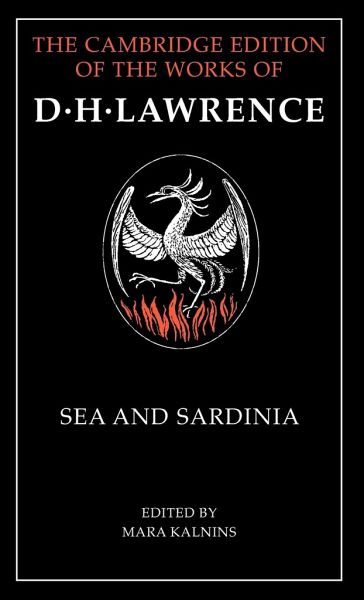
Written after the First World War when he was living in Sicily, Sea and Sardinia records Lawrence's journey to Sardinia and back in January 1921. It reveals his response to a new landscape and people and his ability to transmute the spirit of place into literary art. Like his other travel writings the book is also a shrewd inquiry into the political and social values of an era which saw the rise of communism and fascism. On one level an indictment of contemporary materialism, Sea and Sardinia is nevertheless an optimistic book, celebrating the creativity of the human spirit and seeking in the…mehr
Written after the First World War when he was living in Sicily, Sea and Sardinia records Lawrence's journey to Sardinia and back in January 1921. It reveals his response to a new landscape and people and his ability to transmute the spirit of place into literary art. Like his other travel writings the book is also a shrewd inquiry into the political and social values of an era which saw the rise of communism and fascism. On one level an indictment of contemporary materialism, Sea and Sardinia is nevertheless an optimistic book, celebrating the creativity of the human spirit and seeking in the fundamental laws which governed human nature in the past fresh inspiration for the present. This 1997 edition restores censored passages and corrects corrupt textual readings to reveal for the first time the book Lawrence himself called 'a marvel of veracity'.
Born on September 11, 1885, in Eastwood, Nottinghamshire, England, David Herbert Lawrence was the fourth child of a coal miner and a former schoolteacher. His upbringing in a working-class family deeply influenced his literary themes, particularly the tensions between industrialization and nature. Lawrence's early education and experiences in his hometown laid the foundation for his future works.In 1912, Lawrence met Frieda Weekley, with whom he eloped to Europe, marking the beginning of his extensive travels. This period saw the creation of some of his most significant novels, including Sons and Lovers (1913) and The Rainbow (1915), which explored complex human relationships and societal constraints. His candid portrayal of sexuality and critique of industrial society often led to controversy and censorship.Despite facing persecution and public misrepresentation, Lawrence continued to produce influential works across various genres. His final novel, Lady Chatterley's Lover (1928), was notorious for its explicit content and faced numerous legal challenges. Lawrence's relentless exploration of human emotions and social norms has solidified his legacy as a pivotal figure in modernist literature.
Inhaltsangabe
General editor's preface Acknowledgements Chronology Cue-titles Introduction Sea and Sardinia Appendix Explanatory notes Glossary of selected Italian terms Textual apparatus A note on pounds, shillings and pence.
General editor's preface Acknowledgements Chronology Cue-titles Introduction Sea and Sardinia Appendix Explanatory notes Glossary of selected Italian terms Textual apparatus A note on pounds, shillings and pence.
Es gelten unsere Allgemeinen Geschäftsbedingungen: www.buecher.de/agb
Impressum
www.buecher.de ist ein Internetauftritt der buecher.de internetstores GmbH
Geschäftsführung: Monica Sawhney | Roland Kölbl | Günter Hilger
Sitz der Gesellschaft: Batheyer Straße 115 - 117, 58099 Hagen
Postanschrift: Bürgermeister-Wegele-Str. 12, 86167 Augsburg
Amtsgericht Hagen HRB 13257
Steuernummer: 321/5800/1497
USt-IdNr: DE450055826