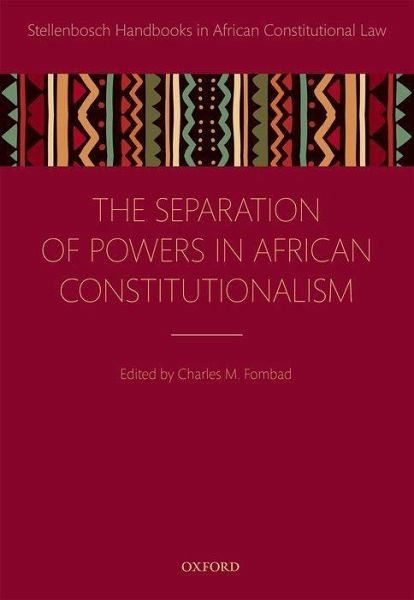
FombadSEPARATION POWERS AFRICAN CONST SHACL C
Andere Kunden interessierten sich auch für
Produktdetails
- Verlag: ACADEMIC
- Seitenzahl: 446
- Erscheinungstermin: 3. März 2016
- Englisch
- Abmessung: 250mm x 175mm x 28mm
- Gewicht: 944g
- ISBN-13: 9780198759799
- ISBN-10: 0198759797
- Artikelnr.: 47865308
- Libri GmbH
- Europaallee 1
- 36244 Bad Hersfeld
- gpsr@libri.de
Professor Charles Manga Fombad is presently a Professor of law and the head of the African Comparative Constitutional Law Unit of the Institute for International and Comparative Law in Africa (ICLA), based at the Faculty of Law of the University of Pretoria. He has taught in the University of Botswana, the University of Yaounde at Soa, and was visiting Professor in the Universities of Dschang and Buea in Cameroon. He was also a Professor Extraordinarius of the Department of Jurisprudence, School of Law, University of South Africa from 2003-2007. Professor Fombad is the author/editor of numerous books and articles, and has been awarded the Bobbert Association Prize and the Wedderburn Prize for his work. His research interests are in comparative constitutional law, delict (tort law), media law, international law, and legal history, especially issues of legal harmonization.
* General Introduction
* Part I: Overview
* 1: Charles M. Fombad: The evolution of modern African constitutions:
A retrospective perspective
* 2: Charles M. Fombad: An overview of the separation of powers under
modern African constitutions
* Part II: The Relationship between the Legislature and the Executive
* 3: Francois Venter: Parliamentary sovereignty or presidential
imperialism? The difficulties of identifying the source of
constitutional power from the interaction between legislatures and
executives in Anglophone Africa
* 4: Conrad Bosire: The context of Kenya's budding bicameralism and
legislative-executive relations
* 5: Sylvester Shikyil: Legislative-executive relations in presidential
democracies: The case of Nigeria
* Part III: The Relationship between the Judiciary and the Political
Branches
* 6: Fernando Bastos: An overview of judicial and executive relations
in Lusophone Africa
* 7: James Fowkes: Re-imagining judicial/executive relationships and
their future in Africa
* 8: Andre Thomashaussen: Super-presidentialism in Angola and the
Angolan judiciary
* 9: Kofi Quashigah: An overview of approaches to judicial and
executive relations: Case study on Ghana
* 10: Ameze Guobadia: Judicial/executive relations in Nigeria's
constitutional development: Clear patterns or confusing signals?
* 11: Assefa Fiseha: Relations between the legislature and the
judiciary in Ethiopia
* 12: Walter Ochieng: Separation of powers in judicial enforcement of
governmental ethics in Kenya and South Africa
* 13: Nico Horn: Judicial and executive relations in Namibia: A review
of four cases
* Part IV: Independent Constitutional Institutions
* 14: Charles M. Fombad: The role of emerging hybrid institutions of
accountability in the separation of powers scheme in Africa
* 15: Jeffrey Jowell: The public prosecutor in the Commonwealth:
Separation of powers and the rule of law
* 16: Horace Adjolohoun and Charles M. Fombad: Separation of powers and
the role of the public prosecutor in Francophone Africa
* Conclusion
* General Introduction
* Part I: Overview
* 1: Charles M. Fombad: The evolution of modern African constitutions:
A retrospective perspective
* 2: Charles M. Fombad: An overview of the separation of powers under
modern African constitutions
* Part II: The Relationship between the Legislature and the Executive
* 3: Francois Venter: Parliamentary sovereignty or presidential
imperialism? The difficulties of identifying the source of
constitutional power from the interaction between legislatures and
executives in Anglophone Africa
* 4: Conrad Bosire: The context of Kenya's budding bicameralism and
legislative-executive relations
* 5: Sylvester Shikyil: Legislative-executive relations in presidential
democracies: The case of Nigeria
* Part III: The Relationship between the Judiciary and the Political
Branches
* 6: Fernando Bastos: An overview of judicial and executive relations
in Lusophone Africa
* 7: James Fowkes: Re-imagining judicial/executive relationships and
their future in Africa
* 8: Andre Thomashaussen: Super-presidentialism in Angola and the
Angolan judiciary
* 9: Kofi Quashigah: An overview of approaches to judicial and
executive relations: Case study on Ghana
* 10: Ameze Guobadia: Judicial/executive relations in Nigeria's
constitutional development: Clear patterns or confusing signals?
* 11: Assefa Fiseha: Relations between the legislature and the
judiciary in Ethiopia
* 12: Walter Ochieng: Separation of powers in judicial enforcement of
governmental ethics in Kenya and South Africa
* 13: Nico Horn: Judicial and executive relations in Namibia: A review
of four cases
* Part IV: Independent Constitutional Institutions
* 14: Charles M. Fombad: The role of emerging hybrid institutions of
accountability in the separation of powers scheme in Africa
* 15: Jeffrey Jowell: The public prosecutor in the Commonwealth:
Separation of powers and the rule of law
* 16: Horace Adjolohoun and Charles M. Fombad: Separation of powers and
the role of the public prosecutor in Francophone Africa
* Conclusion