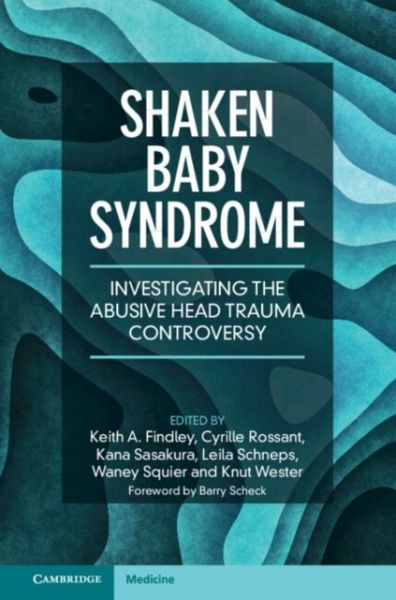
Tackling a highly controversial subject at the intersection of medicine, science, and law, this landmark book presents evidence-based analyses from a multidisciplinary panel of 32 specialists across 8 countries to investigate the claim that certain intracranial findings can alone be used as proof of shaking and an intentional abusive act.
Tackling a highly controversial subject at the intersection of medicine, science, and law, this landmark book presents evidence-based analyses from a multidisciplinary panel of 32 specialists across 8 countries to investigate the claim that certain intracranial findings can alone be used as proof of shaking and an intentional abusive act.
Preface Barry Scheck; Part I. Prolog: 1. Maintaining the orthodoxy and silencing dissent Chris Brook; 2. The history of SBS Randy Papetti; Part II. Medicine: 3. The neuropathology of SBS or retinodural haemorrhage of infancy Waney Squier and Tommie Olofsson; 4. The importance of the correlation between radiology and pathology in SBS Waney Squier and Julie Mack; 5. SBS, AHT - or just a type of hydrocephalus? Knut Wester and Johan Wikström; 6. SBS or benign external hydrocephalus - how is AHT depicted in the scientific literature? Knut Wester and Johan Wikström, Jose; 7. Are some cases of sudden infant death syndrome incorrectly diagnosed as SBS? Marta Cohen; 8. AHT: the importance of predisposing factors Bernard Echenne; 9. How I became a SBS skeptic paediatrician Marvin Miller; Part III. Science: 10. The Swedish systematic literature review on suspected traumatic shaking (SBS) and its aftermath Niels Lynoe and Anders Eriksson; 11. Interrogation and the infanticide suspect: mechanisms of vulnerability to false confession Deborah Davis and Richard Leo; 12. Can confession substitute for science in SBS/AHT? Keith Findley; 13. Cognitive bias in medicolegal judgments Jeff Kukucka and Keith Findley; 14. Biomechanical forensic analysis of shaking and short fall head injury mechanisms in infants and young children Kirk Thibault; 15. When lack of information leads to apparent paradoxes and wrong conclusions: analysis of a seminal article on short falls Leila Schneps; 16. Epidemiology of findings claimed to be highly specific for SBS/AHT, a prerequisite to improve diagnosis of child abuse Ulf Högberg; 17. SBS: exploring concerns about the 'triad' diagnosis and its statistical validation using a causal Bayesian network Norman Fenton and Scott McLachlan; Part IV. Law: 18. Mandatory reporting of child maltreatment Felicity Goodyear-Smith; 19. SBS/AHT opinion evidence in US Courts Kathleen Pakes; 20. Undoing wrongful convictions: exonerating the innocent in SBS/AHT cases Keith Findley; Part V. International: 21. Ptolemy rather than Copernicus - the state of SBS in the British legal system Clive Stafford Smith; 22. SBS in France Cyrille Rossant and Grégoire Etrillard; 23. Sweden and SBS/AHT Ulf Högberg and Goran Högberg; 24. SBS/AHT in Japan Kana Sasakura; 25. SBS in Australia Chris Brook and Michael Nott; 26. SBS around the world; Part VI. Postface: 27. Conclusion.
Preface Barry Scheck; Part I. Prolog: 1. Maintaining the orthodoxy and silencing dissent Chris Brook; 2. The history of SBS Randy Papetti; Part II. Medicine: 3. The neuropathology of SBS or retinodural haemorrhage of infancy Waney Squier and Tommie Olofsson; 4. The importance of the correlation between radiology and pathology in SBS Waney Squier and Julie Mack; 5. SBS, AHT - or just a type of hydrocephalus? Knut Wester and Johan Wikström; 6. SBS or benign external hydrocephalus - how is AHT depicted in the scientific literature? Knut Wester and Johan Wikström, Jose; 7. Are some cases of sudden infant death syndrome incorrectly diagnosed as SBS? Marta Cohen; 8. AHT: the importance of predisposing factors Bernard Echenne; 9. How I became a SBS skeptic paediatrician Marvin Miller; Part III. Science: 10. The Swedish systematic literature review on suspected traumatic shaking (SBS) and its aftermath Niels Lynoe and Anders Eriksson; 11. Interrogation and the infanticide suspect: mechanisms of vulnerability to false confession Deborah Davis and Richard Leo; 12. Can confession substitute for science in SBS/AHT? Keith Findley; 13. Cognitive bias in medicolegal judgments Jeff Kukucka and Keith Findley; 14. Biomechanical forensic analysis of shaking and short fall head injury mechanisms in infants and young children Kirk Thibault; 15. When lack of information leads to apparent paradoxes and wrong conclusions: analysis of a seminal article on short falls Leila Schneps; 16. Epidemiology of findings claimed to be highly specific for SBS/AHT, a prerequisite to improve diagnosis of child abuse Ulf Högberg; 17. SBS: exploring concerns about the 'triad' diagnosis and its statistical validation using a causal Bayesian network Norman Fenton and Scott McLachlan; Part IV. Law: 18. Mandatory reporting of child maltreatment Felicity Goodyear-Smith; 19. SBS/AHT opinion evidence in US Courts Kathleen Pakes; 20. Undoing wrongful convictions: exonerating the innocent in SBS/AHT cases Keith Findley; Part V. International: 21. Ptolemy rather than Copernicus - the state of SBS in the British legal system Clive Stafford Smith; 22. SBS in France Cyrille Rossant and Grégoire Etrillard; 23. Sweden and SBS/AHT Ulf Högberg and Goran Högberg; 24. SBS/AHT in Japan Kana Sasakura; 25. SBS in Australia Chris Brook and Michael Nott; 26. SBS around the world; Part VI. Postface: 27. Conclusion.
Es gelten unsere Allgemeinen Geschäftsbedingungen: www.buecher.de/agb
Impressum
www.buecher.de ist ein Internetauftritt der buecher.de internetstores GmbH
Geschäftsführung: Monica Sawhney | Roland Kölbl | Günter Hilger
Sitz der Gesellschaft: Batheyer Straße 115 - 117, 58099 Hagen
Postanschrift: Bürgermeister-Wegele-Str. 12, 86167 Augsburg
Amtsgericht Hagen HRB 13257
Steuernummer: 321/5800/1497
USt-IdNr: DE450055826