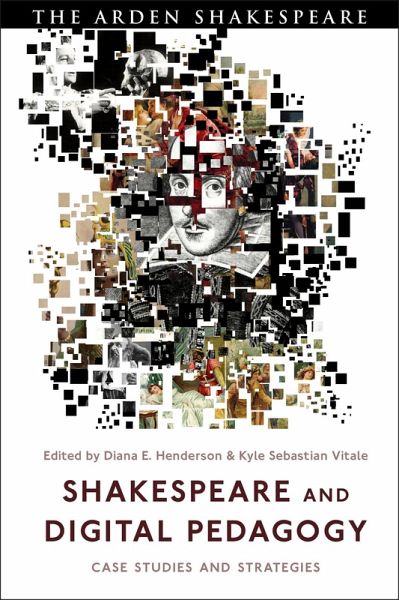
"How can digital resources and tools be used to improve student engagement and learning in their study of Shakespeare? What solutions can digital approaches offer to some of the key challenges for higher education today -- including improving digital literacy, issues of diversity, equity and inclusion, and teaching in hybrid, distance and online learning environments? What are the limitations and obstacles faced by instructors in the use of new technologies in the classroom? These are just some of the questions addressed by Shakespeare and Digital Pedagogy -- an international collection of…mehr
"How can digital resources and tools be used to improve student engagement and learning in their study of Shakespeare? What solutions can digital approaches offer to some of the key challenges for higher education today -- including improving digital literacy, issues of diversity, equity and inclusion, and teaching in hybrid, distance and online learning environments? What are the limitations and obstacles faced by instructors in the use of new technologies in the classroom? These are just some of the questions addressed by Shakespeare and Digital Pedagogy -- an international collection of fresh digital approaches for teaching Shakespeare to undergraduates. It describes 16 methodologies, resources and tools recently developed, updated and used by a diverse range of contributors in Great Britain, Asia and the United States. Contributors explore how these digital resources meet classroom needs and help facilitate conversations about academic literacy, race and identity, local and global cultures, performance, and interdisciplinary thought. Chapters describe each case study in depth, recounting needs, collaborations and challenges during design, as well as sharing effective classroom uses and offering accessible, usable content for both teachers and learners. The book will appeal to a broad range of readers. College and high school instructors will find a rich trove of usable teaching content and suggestions for mounting digital units in the classroom, while Digital Humanities and education specialists will find a snapshot of and theories about the field itself. With access to exciting new content from local archives and global networks and global networks, the collection aids teaching, research, and reflection on Shakespeare for the 21st century"--
Diana E. Henderson is the Arthur J. Connor Professor of Literature at MIT, USA. She teaches, publishes and edits widely in the fields of Shakespeare, media studies and early modern studies, and is a dramaturg, designer of online educational modules and documentary producer. Kyle Sebastian Vitale is Associate Director at Temple University's Center for the Advancement of Teaching, USA.
Inhaltsangabe
List of figures Notes on contributors Foreword Michael Witmore (Folger Shakespeare Library, USA) Introduction Diana E. Henderson (MIT, USA) and Kyle Sebastian Vitale (Temple University USA) Part One Teaching Academic and Digital Literacy 1. Shakespeare Students as Scribes: Documenting the Classroom through Collaborative Digital Note-taking Cyrus Mulready (SUNY New Paltz, USA) 2. The Shakespeare CoLab: a Digital Learning Environment for Shakespeare Studies Rachael Deagman Simonetta, with Melanie Lo (both University of Colorado, Boulder, USA) 3. 'Reading Strange Matters': Digital Approaches to Early Modern Transnational Print History Kathryn Vomero Santos (Trinity University, USA) Part Two Teaching Diversity, Equity, and Inclusion 4. (Early) Modern Literature: Crossing the 'Sonic Color Line' David Sterling Brown (Binghamton University USA) 5. Diversifying Shakespeare: Intersections of Technology and Identity Meg Lota Brown and Kyle DiRoberto (both University of Arizona, USA) 6. The British Black and Asian Shakespeare Performance Database: Reclaiming Theatre History Jami Rogers (University of Warwick, UK) 7. Reading Interculturality in Class: Contextualising Global Shakespeares in and through A S I A Eleine Ng-Gagneux (National University of Singapore, Singapore) Part Three. Teaching with Traditional and Modern Archives 8. Shakespeare at Basecamp Kristen Poole with Jake Cohen (University of Delaware, USA) 9. The Victorian Illustrated Shakespeare Archive: Art to Enchant Michael John Goodman (Cardiff University, UK) 10. Student-Curated Archives and the Digital Design of Shakespeare in Performance Marcia McDonald, Joel Overall, and Jayme M. Yeo (all Belmont University, USA) Part Four Teaching in Hybrid and Online Learning Environments 11. Performance and Pedagogy: The Global Shakespeares Online Merchant of Venice Course Sarah Connell (Northeastern University, USA) 12. Translating Shakespeare from Scene to Screen, and Back Again: Digital Tools for Teaching Richard III Loreen Giese (Ohio University, USA) 13. Dividing the Kingdoms: Interdisciplinary Methods for Teaching Shakespeare to Undergraduates Jaime Goodrich (Wayne State University, USA), with Sarah Noble (Berkley, Michigan, USA) Part Five Teaching in Web 3.0 14. Mapping the Global Absent in Shakespeare: Lessons Learned from a Student-Faculty Collaboration John S. Garrison with Ahon Gooptu (both Grinnell College, USA) 15. Shakespeare Reloaded's Shakeserendipity Game: Pedagogy at the Edge of Chaos Liam E. Semler (University of Sydney, Australia) A Closing Note Diana E. Henderson and Kyle Sebastian Vitale
Es gelten unsere Allgemeinen Geschäftsbedingungen: www.buecher.de/agb
Impressum
www.buecher.de ist ein Internetauftritt der buecher.de internetstores GmbH
Geschäftsführung: Monica Sawhney | Roland Kölbl | Günter Hilger
Sitz der Gesellschaft: Batheyer Straße 115 - 117, 58099 Hagen
Postanschrift: Bürgermeister-Wegele-Str. 12, 86167 Augsburg
Amtsgericht Hagen HRB 13257
Steuernummer: 321/5800/1497
USt-IdNr: DE450055826