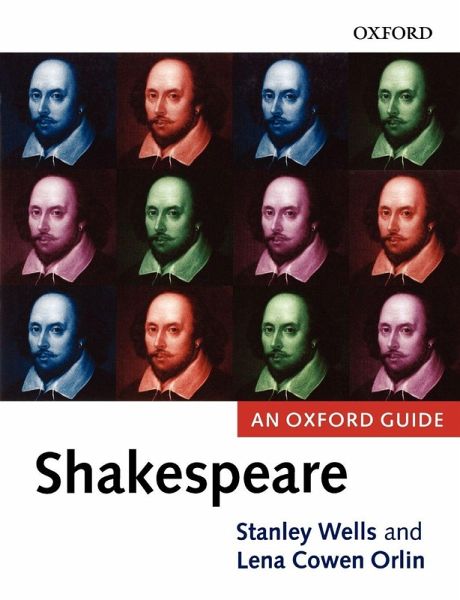
Edited by Stanley Wells and Lena Cowen Orlin, Shakespeare: An Oxford Guide provides a practical and stimulating guide to all aspects of Shakespeare studies. The volume comprises over 40 specially commissioned essays by an outstanding team of Shakespeare scholars; each essay is written in an accessible and engaging style, and is followed by annotated suggestions for further reading. The volume is divided into four key parts, which as a whole offer a valuable balance of factual and critical content. In the first Part, chapters provide information about and discuss Shakespeare, the theatres of…mehr
Edited by Stanley Wells and Lena Cowen Orlin, Shakespeare: An Oxford Guide provides a practical and stimulating guide to all aspects of Shakespeare studies. The volume comprises over 40 specially commissioned essays by an outstanding team of Shakespeare scholars; each essay is written in an accessible and engaging style, and is followed by annotated suggestions for further reading.
The volume is divided into four key parts, which as a whole offer a valuable balance of factual and critical content. In the first Part, chapters provide information about and discuss Shakespeare, the theatres of his time, the society in which he lived, the language of his period, the conventions of playwriting, and his contemporary impact. The second Part offers critical overviews of Shakespeare's achievement in the principal genres, and each overview is followed by a practical reading exploring Shakespeare's use of the traditions, scope and boundaries of that genre in one of his key works. Part Three offers guidance to the principal current critical approaches in the study of Shakespeare: each chapter outlines a particular critical approach, and is followed by a reading applying that approach to one of Shakespeare's works; and Part Four offers chapters on topics relating to Shakespeare's intellectual and cultural impact over the ages.
Stanley Wells is Honorary President of the Shakespeare Birthplace Trust in Stratford, and was Professor of Shakespeare Studies, and Director of the Shakespeare Institute at the University of Birmingham from 1988 to 97, where he is now Emeritus Professor. He is the general editor of the Oxford Shakespeare, and co-editor of the Oxford Shakespeare: The Complete Works. With Peter Holland he is general editor of the Oxford Shakespeare Topics, and, with Michael Dobson, he recently edited the best-selling Oxford Companion to Shakespeare. Lena Cowen Orlin is Professor of English at the University of Maryland, Baltimore County, and Executive Director of the Shakespeare Association of America. Her publications include Material London, Ca. 1600 (University of Pennsylvania Press, 2000), Elizabethan Households (University of Washington Press, 1995), and Private Matters and Public Cultures in Post-Reformation England (Cornell University Press, 1994).
Inhaltsangabe
I. Shakespeare's life and times 1: Stanley Wells: Why study Shakespeare? 2: Lois Potter: Shakespeare's life and career 3: Gabriel Egan: Theatre in London 4: Margaret Jane Kidnie: Shakespeare's audiences 5: Peter Thomson: Conventions of playwrighting 6: A. R. Braunmuller: Shakespeare's fellow dramatists 7: David Crystal: The language of Shakespeare 8: Russ McDonald: Shakespeare's verse 9: Carole Levin: The Society of Shakespeare's England 10: Joan Thirsk: Daily life in town and country 11: Martin Ingram: Love, sex, and marriage 12: Peter Lake: Changing attitudes towards religion 13: Lena Cowen Orlin: Ideas of order 14: Emily C. Bartels: Shakespeare's view of the world II. Shakespearian Genres 15: Lena Cowen Orlin: Introduction 16: William C. Carroll: Romantic comedies Reading: Twelfth Night, or What You Will 17: Phyllis Rackin: English history plays Reading: Henry V 18: Linda Woodbridge: Tragedies Reading: Macbeth 19: Alexander Leggatt: Roman plays Reading: Julius Caesar 20: Reginald Foakes: Romances Reading: The Winter's Tale 21: Paul Edmondson: Comical and tragical Reading: Measure for Measure 22: Lynne Magnusson: Non-dramatic poetry Reading: Shakespeare's sonnets 23: Alan Armstrong: Unfamiliar Shakespeare III. Shakespeare criticism 24: Michael Taylor: The critical tradition 25: Michael D. Bristol: Humanist interpretations Reading: King Lear 26: Christy Desmet: Character criticism Reading: Hamlet 27: Leah Scragg: Source study Reading: As You Like It 28: Inga-Stina Ewbank: Close reading Reading: Richard III 29: Jean E. Howard: Feminist criticism Reading: Othello 30: Bruce R. Smith: Studies in sexuality Reading: The Merchant of Venice 31: Lynne Enterline: Psychoanalytic criticisms Reading: Venus and Adonis 32: Jonathan Gil Harris: Materialist criticisms Reading: Henry IV, Part One 33: Jyotsna Singh: Postcolonial criticisms Reading: The Tempest 34: Kiernan Ryan: Deconstruction Reading: Romeo and Juliet 35: Patricia Tatspaugh: Performance history: Shakespeare on the stage: 1660-2001 Reading: A Midsummer Night's Dream 36: Miriam Gilbert: Performance criticism Reading: The Taming of the Shrew IV. Shakespeare's afterlife 37: Terence Hawkes: Introduction 38: Laurie Maguire: Shakespeare published 39: Michael Billington: Shakespeare and the modern British theatre 40: Tony Howard: Shakespeare on film and video 41: David Kathman: The question of authorship 42: John Gross: Shakespeare's influence 43: Ton Hoenselaars: Shakespeare and translation 44: Georgiana Ziegler: Commemorating Shakespeare 45: Michael Best: Internet and CD-Rom resources
I. Shakespeare's life and times 1: Stanley Wells: Why study Shakespeare? 2: Lois Potter: Shakespeare's life and career 3: Gabriel Egan: Theatre in London 4: Margaret Jane Kidnie: Shakespeare's audiences 5: Peter Thomson: Conventions of playwrighting 6: A. R. Braunmuller: Shakespeare's fellow dramatists 7: David Crystal: The language of Shakespeare 8: Russ McDonald: Shakespeare's verse 9: Carole Levin: The Society of Shakespeare's England 10: Joan Thirsk: Daily life in town and country 11: Martin Ingram: Love, sex, and marriage 12: Peter Lake: Changing attitudes towards religion 13: Lena Cowen Orlin: Ideas of order 14: Emily C. Bartels: Shakespeare's view of the world II. Shakespearian Genres 15: Lena Cowen Orlin: Introduction 16: William C. Carroll: Romantic comedies Reading: Twelfth Night, or What You Will 17: Phyllis Rackin: English history plays Reading: Henry V 18: Linda Woodbridge: Tragedies Reading: Macbeth 19: Alexander Leggatt: Roman plays Reading: Julius Caesar 20: Reginald Foakes: Romances Reading: The Winter's Tale 21: Paul Edmondson: Comical and tragical Reading: Measure for Measure 22: Lynne Magnusson: Non-dramatic poetry Reading: Shakespeare's sonnets 23: Alan Armstrong: Unfamiliar Shakespeare III. Shakespeare criticism 24: Michael Taylor: The critical tradition 25: Michael D. Bristol: Humanist interpretations Reading: King Lear 26: Christy Desmet: Character criticism Reading: Hamlet 27: Leah Scragg: Source study Reading: As You Like It 28: Inga-Stina Ewbank: Close reading Reading: Richard III 29: Jean E. Howard: Feminist criticism Reading: Othello 30: Bruce R. Smith: Studies in sexuality Reading: The Merchant of Venice 31: Lynne Enterline: Psychoanalytic criticisms Reading: Venus and Adonis 32: Jonathan Gil Harris: Materialist criticisms Reading: Henry IV, Part One 33: Jyotsna Singh: Postcolonial criticisms Reading: The Tempest 34: Kiernan Ryan: Deconstruction Reading: Romeo and Juliet 35: Patricia Tatspaugh: Performance history: Shakespeare on the stage: 1660-2001 Reading: A Midsummer Night's Dream 36: Miriam Gilbert: Performance criticism Reading: The Taming of the Shrew IV. Shakespeare's afterlife 37: Terence Hawkes: Introduction 38: Laurie Maguire: Shakespeare published 39: Michael Billington: Shakespeare and the modern British theatre 40: Tony Howard: Shakespeare on film and video 41: David Kathman: The question of authorship 42: John Gross: Shakespeare's influence 43: Ton Hoenselaars: Shakespeare and translation 44: Georgiana Ziegler: Commemorating Shakespeare 45: Michael Best: Internet and CD-Rom resources
Es gelten unsere Allgemeinen Geschäftsbedingungen: www.buecher.de/agb
Impressum
www.buecher.de ist ein Internetauftritt der buecher.de internetstores GmbH
Geschäftsführung: Monica Sawhney | Roland Kölbl | Günter Hilger
Sitz der Gesellschaft: Batheyer Straße 115 - 117, 58099 Hagen
Postanschrift: Bürgermeister-Wegele-Str. 12, 86167 Augsburg
Amtsgericht Hagen HRB 13257
Steuernummer: 321/5800/1497
USt-IdNr: DE450055826