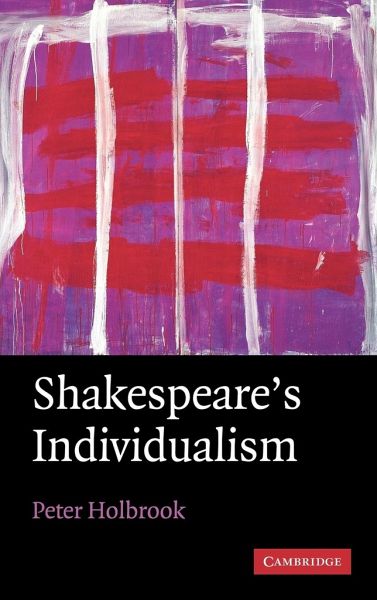
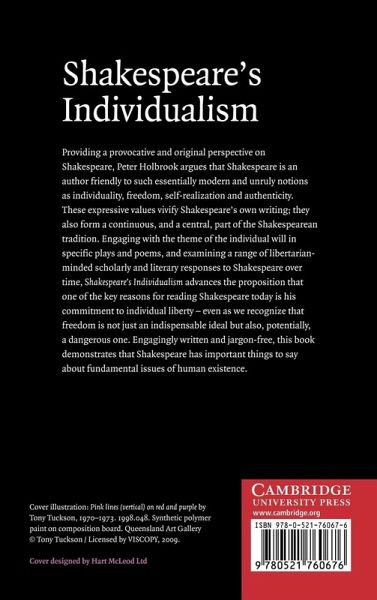
Peter Holbrook teaches English Literature at the University of Queensland.
Inhaltsangabe
Introduction Part I. Shakespeare, Hamlet, Selfhood: 1. Hamlet and failure 2. 'A room...at the back of the shop' 3. Egyptianism (our fascist future) 4. 'Become who you are!' 5. Hamlet and self-love 6. 'To thine own self be true' 7. Listening to ghosts 8. Shakespeare's self Part II. Shakespeare and Evil: 9. 'Old lad, I am thine own': authenticity and Titus Andronicus 10. Evil and self-creation 11. Libertarian Shakespeare: Mill, Bradley 12. Shakespearean immoral individualism: Gide 13. Strange Shakespeare: Symons and others 14. Eliot's rejection of Shakespeare 15. Shakespearean immoralism: Antony and Cleopatra 16. Making oneself known: Montaigne and the Sonnets Part III. Shakespeare and Self-Government: 17. Freedom and self-government: The Tempest 18. Calibanism Conclusion: Shakespeare's 'beauteous freedom'.
Introduction; Part I. Shakespeare, Hamlet, Selfhood: 1. Hamlet and failure; 2. 'A room...at the back of the shop'; 3. Egyptianism (our fascist future); 4. 'Become who you are!'; 5. Hamlet and self-love; 6. 'To thine own self be true'; 7. Listening to ghosts; 8. Shakespeare's self; Part II. Shakespeare and Evil: 9. 'Old lad, I am thine own': authenticity and Titus Andronicus; 10. Evil and self-creation; 11. Libertarian Shakespeare: Mill, Bradley; 12. Shakespearean immoral individualism: Gide; 13. Strange Shakespeare: Symons and others; 14. Eliot's rejection of Shakespeare; 15. Shakespearean immoralism: Antony and Cleopatra; 16. Making oneself known: Montaigne and the Sonnets; Part III. Shakespeare and Self-Government: 17. Freedom and self-government: The Tempest; 18. Calibanism; Conclusion: Shakespeare's 'beauteous freedom'.
Introduction Part I. Shakespeare, Hamlet, Selfhood: 1. Hamlet and failure 2. 'A room...at the back of the shop' 3. Egyptianism (our fascist future) 4. 'Become who you are!' 5. Hamlet and self-love 6. 'To thine own self be true' 7. Listening to ghosts 8. Shakespeare's self Part II. Shakespeare and Evil: 9. 'Old lad, I am thine own': authenticity and Titus Andronicus 10. Evil and self-creation 11. Libertarian Shakespeare: Mill, Bradley 12. Shakespearean immoral individualism: Gide 13. Strange Shakespeare: Symons and others 14. Eliot's rejection of Shakespeare 15. Shakespearean immoralism: Antony and Cleopatra 16. Making oneself known: Montaigne and the Sonnets Part III. Shakespeare and Self-Government: 17. Freedom and self-government: The Tempest 18. Calibanism Conclusion: Shakespeare's 'beauteous freedom'.
Introduction; Part I. Shakespeare, Hamlet, Selfhood: 1. Hamlet and failure; 2. 'A room...at the back of the shop'; 3. Egyptianism (our fascist future); 4. 'Become who you are!'; 5. Hamlet and self-love; 6. 'To thine own self be true'; 7. Listening to ghosts; 8. Shakespeare's self; Part II. Shakespeare and Evil: 9. 'Old lad, I am thine own': authenticity and Titus Andronicus; 10. Evil and self-creation; 11. Libertarian Shakespeare: Mill, Bradley; 12. Shakespearean immoral individualism: Gide; 13. Strange Shakespeare: Symons and others; 14. Eliot's rejection of Shakespeare; 15. Shakespearean immoralism: Antony and Cleopatra; 16. Making oneself known: Montaigne and the Sonnets; Part III. Shakespeare and Self-Government: 17. Freedom and self-government: The Tempest; 18. Calibanism; Conclusion: Shakespeare's 'beauteous freedom'.
Es gelten unsere Allgemeinen Geschäftsbedingungen: www.buecher.de/agb
Impressum
www.buecher.de ist ein Internetauftritt der buecher.de internetstores GmbH
Geschäftsführung: Monica Sawhney | Roland Kölbl | Günter Hilger
Sitz der Gesellschaft: Batheyer Straße 115 - 117, 58099 Hagen
Postanschrift: Bürgermeister-Wegele-Str. 12, 86167 Augsburg
Amtsgericht Hagen HRB 13257
Steuernummer: 321/5800/1497
USt-IdNr: DE450055826