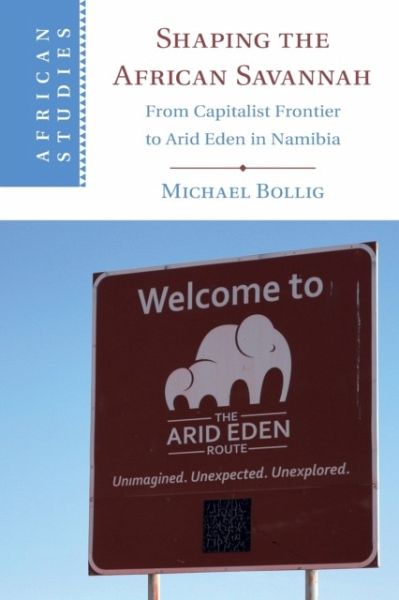
A history of 150 years of social-ecological transformations in one of southern Africa's most sought after exotic tourism destinations, often dubbed as 'Arid Eden'. It demonstrates the impacts of colonialism, capitalism and creative local adaptations of environmental infrastructures in the region.
A history of 150 years of social-ecological transformations in one of southern Africa's most sought after exotic tourism destinations, often dubbed as 'Arid Eden'. It demonstrates the impacts of colonialism, capitalism and creative local adaptations of environmental infrastructures in the region.
Michael Bollig is Professor of Social and Cultural Anthropology at the University of Cologne where his key interests lie in the environmental anthropology of sub-Saharan Africa. His current research projects focus on the social-ecological dynamics connected to large-scale conservation projects, the commodification of nature and the political ecology of pastoralism. He is the author of Risk Management in a Hazardous Environment (2006), co-author of African Landscapes (2009) with O. Bubenzer, Pastoralism in Africa (2013) with M. Schnegg and H.P. Wotzka, and Resilience and Collapse in African Savannahs (2017) with D. Anderson.
Inhaltsangabe
I. Introduction; 1. Doing research on a changing savannah landscape; II. The evolution of pre-colonial environmental infrastructures; 2. The prehistory of North-western Namibia and the riddled emergence of pastoralism; 3. Elephants and humans in the late 19th and early 20th century; III. Encapsulation and pastoralisation, 1900s to 1940s; 4. Scientist, cartographers, photographers and the establishment of western knowledge of the Kaokofeld; 5. The establishment of colonial administration and the re-immigration of pastoralists into the Kaokoveld - 1900s to 1920s; 6. The politics of encapsulation: game protection, instituting borders and controlling mobility; IV. The state, intervention, and local appropriations between 1950s and 1980s; 7. A hydrological revolution in an African savannah; 8.Conservation and poaching in the 1970s and 1980s; V. Dynamics of social-ecological relations between the 1990s and the present; 9: Pastoralism, environmental infrastructures and state-local society relations in the late 20th and early 21st century; 10. The establishment of "new commons" by government decree; 11. Into the future - envisioning, planning and negotiating environmental infrastructures; VI. Theorizing time, space, and change in a pastoral system; 12. The changing environmental infrastructure of the north-western Namibian savannah
I. Introduction; 1. Doing research on a changing savannah landscape; II. The evolution of pre-colonial environmental infrastructures; 2. The prehistory of North-western Namibia and the riddled emergence of pastoralism; 3. Elephants and humans in the late 19th and early 20th century; III. Encapsulation and pastoralisation, 1900s to 1940s; 4. Scientist, cartographers, photographers and the establishment of western knowledge of the Kaokofeld; 5. The establishment of colonial administration and the re-immigration of pastoralists into the Kaokoveld - 1900s to 1920s; 6. The politics of encapsulation: game protection, instituting borders and controlling mobility; IV. The state, intervention, and local appropriations between 1950s and 1980s; 7. A hydrological revolution in an African savannah; 8.Conservation and poaching in the 1970s and 1980s; V. Dynamics of social-ecological relations between the 1990s and the present; 9: Pastoralism, environmental infrastructures and state-local society relations in the late 20th and early 21st century; 10. The establishment of "new commons" by government decree; 11. Into the future - envisioning, planning and negotiating environmental infrastructures; VI. Theorizing time, space, and change in a pastoral system; 12. The changing environmental infrastructure of the north-western Namibian savannah
Es gelten unsere Allgemeinen Geschäftsbedingungen: www.buecher.de/agb
Impressum
www.buecher.de ist ein Internetauftritt der buecher.de internetstores GmbH
Geschäftsführung: Monica Sawhney | Roland Kölbl | Günter Hilger
Sitz der Gesellschaft: Batheyer Straße 115 - 117, 58099 Hagen
Postanschrift: Bürgermeister-Wegele-Str. 12, 86167 Augsburg
Amtsgericht Hagen HRB 13257
Steuernummer: 321/5800/1497
USt-IdNr: DE450055826