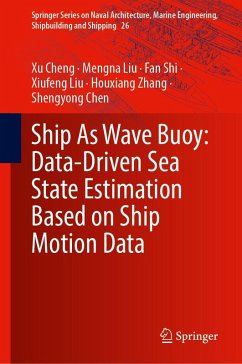
This book focuses on a comprehensive investigation into data-driven Sea State Estimation (SSE) by leveraging a vessel s own motion data. It presents a collection of advanced deep learning frameworks designed to overcome critical, real-world challenges inherent in this approach. This book systematically introduces key issues including: the class imbalance of sea state data, where rare but hazardous conditions are difficult to predict; the need for model transferability between different ships and loading conditions; and the crucial demand for security and robustness against adversarial data…mehr
This book focuses on a comprehensive investigation into data-driven Sea State Estimation (SSE) by leveraging a vessel s own motion data. It presents a collection of advanced deep learning frameworks designed to overcome critical, real-world challenges inherent in this approach. This book systematically introduces key issues including: the class imbalance of sea state data, where rare but hazardous conditions are difficult to predict; the need for model transferability between different ships and loading conditions; and the crucial demand for security and robustness against adversarial data attacks. To solve these problems, the book introduces a suite of innovative architectures employing techniques such as densely connected convolutional networks, prototype-based classifiers, multi-scale feature learning, adversarial transfer learning, and dynamic graph networks. The efficacy of these models is rigorously validated on both public benchmarks and specialized ship motion datasets, demonstrating superior performance over existing state-of-the-art methods and providing a robust toolkit for enhancing maritime safety and efficiency.
Produktdetails
Produktdetails
Springer Series on Naval Architecture, Marine Engineering, Shipbuilding and Shipping 26
Xu Cheng (Senior Member, IEEE) received his Ph.D. degree in Engineering from the Department of Ocean Operations and Civil Engineering, Intelligent Systems Laboratory, Norwegian University of Science and Technology (NTNU), Ålesund, Norway, in June 2020. From June 2020 to March 2022, he worked as a postdoctoral fellow, and researcher at the Department of Manufacturing and Civil Engineering, Gjøvik, Norway. From April 2022, he worked at Smart Innovation Norway as a permanent researcher. He has applied for and coordinated more than 5 projects supported by the Norwegian Research Council (NFR), the EU, and industry. He has published more than 130 papers as first and co-author and 1 book in Springer as first author in his research interests, including data analysis and artificial intelligence in maritime operations, time series analysis, and predictive maintenance of wind turbines. Mengna Liu is a Ph.D. candidate at the School of Computer Science and Engineering, Tianjin University of Technology, Tianjin, China, in 2023. With four years of experience as an algorithm engineer, she has developed expertise in designing algorithms and optimizing data processes. Her research interests include time series modeling and data mining. Fan Shi (Member, IEEE) is a professor at the School of Computer Science and Engineering, Tianjin University of Technology, Tianjin, China. Dr. Shi received his Ph.D. degree from Nankai University, Tianjin, China, in 2012. From June 2018 to August 2019, he was a research scholar in West Virginia University. His research interests include machine vision, pattern recognition and optics. Xiufeng Liu received the Ph.D. degree in computer science from Aalborg University, Denmark, in 2012. He was a postdoctoral researcher at the University of Waterloo and a research scientist at IBM, Canada, from 2013 to 2014. He is currently a senior researcher at the Department of Technology, Management and Economics at the Technical University of Denmark. His research interests include smart meter data analysis, data warehousing, energy informatics, and big data. Houxiang Zhang (Senior Member, IEEE) received the Ph.D. degree in mechanical and electronic engineering and the Habilitation degree in informatics from the University of Hamburg, Hamburg, Germany, in 2003 and February 2011, respectively. He is currently a full professor with the Department of Ocean Operations and Civil Engineering, Faculty of Engineering, Norwegian University of Science and Technology (NTNU), Trondheim, Norway. Since 2004, he has been a postdoctoral fellow and a Senior Researcher with the Department of Informatics, Faculty of Mathematics, Informatics and Natural Sciences, Institute of Technical Aspects of Multimodal Systems, University of Hamburg, Hamburg, Germany. He was with NTNU, where he is currently a professor of Mechatronics in April 2011. From 2011 to 2016, he also hold a Norwegian National GIFT Professorship on product and system design funded by the Norwegian Maritime Centre of Expertise. Shengyong Chen (Senior Member, IEEE) is a full professor at Tianjin University of Technology and the director of the Engineering Research Center of Learning-Based Intelligent System (Ministry of Education). He has been conducting research on vision sensors for robotics for more than 20 years. He obtained the Ph.D. degree in computer vision from City University of Hong Kong. From 2006 to 2007, he received a fellowship from the Alexander von Humboldt Foundation of Germany and worked at University of Hamburg, Germany. From 2008 to 2012, he worked as a visiting professor at Imperial College London and University of Cambridge, U.K. He has published over 300 scientific papers in international journals and conferences, including 80 papers in IEEE Transactions. He also published 10+ books in the past years and applied 100+ patents. He received the National Outstanding Youth Foundation Award of NSFC.
Inhaltsangabe
Introduction. State of the Art. Densely connected convolutional neural network for sea state estimation. Prototype enhanced convolutional neural network for sea state estimation. Graph convolutional neural network for sea state estimation. Class imbalanced neural network for sea state estimation. Secure Sea State Estimation: Adversarial Defense for Robust Maritime AI. Transferable convolutional neural network for sea state estimation. Adversarial robust convolutional neural network for sea state estimation. Concluding remarks.
Introduction. State of the Art. Densely connected convolutional neural network for sea state estimation. Prototype enhanced convolutional neural network for sea state estimation. Graph convolutional neural network for sea state estimation. Class imbalanced neural network for sea state estimation. Secure Sea State Estimation: Adversarial Defense for Robust Maritime AI. Transferable convolutional neural network for sea state estimation. Adversarial robust convolutional neural network for sea state estimation. Concluding remarks.
Es gelten unsere Allgemeinen Geschäftsbedingungen: www.buecher.de/agb
Impressum
www.buecher.de ist ein Internetauftritt der buecher.de internetstores GmbH
Geschäftsführung: Monica Sawhney | Roland Kölbl | Günter Hilger
Sitz der Gesellschaft: Batheyer Straße 115 - 117, 58099 Hagen
Postanschrift: Bürgermeister-Wegele-Str. 12, 86167 Augsburg
Amtsgericht Hagen HRB 13257
Steuernummer: 321/5800/1497
USt-IdNr: DE450055826