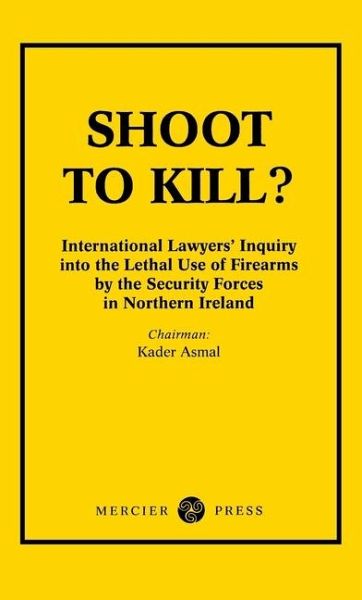
Asmal, Kader. Shoot to Kill? International Lawyers' Inquiry into the Lethal Use of Firearms by the Security Forces in Northern Ireland. Chairman, Kader Asmal. Cork, Mercier, 1985. 21 cm. 173 pages. Includes: The History of the use of Firearms by the Security Forces in Northern Ireland / Evidence / Plastic Bullets / Analysis of Evidence in the Light of International and Domestic Law / Civilians shot dead in disputed circumstances by members of the security forces in Northern Ireland / Individuals and Organisations who provided written testimony to the inquiry.
Asmal, Kader. Shoot to Kill? International Lawyers' Inquiry into the Lethal Use of Firearms by the Security Forces in Northern Ireland. Chairman, Kader Asmal. Cork, Mercier, 1985. 21 cm. 173 pages. Includes: The History of the use of Firearms by the Security Forces in Northern Ireland / Evidence / Plastic Bullets / Analysis of Evidence in the Light of International and Domestic Law / Civilians shot dead in disputed circumstances by members of the security forces in Northern Ireland / Individuals and Organisations who provided written testimony to the inquiry.
Abdul Kader Asmal (1934-2011), a noted human rights jurist and anti-apartheid advocate, was born into a modest Muslim family of Indian descent in Natal, South Africa. His early exposure to racial discrimination shaped his unwavering commitment to equality and justice, prompting him to abandon a teaching career for the study of law. After receiving his legal education at the London School of Economics and qualifying at Lincoln's Inn, he pursued socialist law. His key roles in the underground South African Communist Party and the African National Congress underpinned his crucial involvement in both national and international anti-apartheid activism. Additionally, Asmal's academic pursuits led him to serve as dean at Trinity College Dublin, contributing extensively to scholarly literature.Upon the ANC's unbanning in 1991, Asmal returned to South Africa and played an instrumental role in drafting the new constitution. His political career included tenures as Minister for Water Affairs and Forestry and later as Minister for Education. Even while battling cancer, he tirelessly campaigned against corruption, advocating for transparency within the ANC. Post-politics, he maintained his active engagement in human rights advocacy through various academic roles. Asmal, who passed away in 2011, is revered for his tireless pursuit of justice and equality, leaving behind an enduring legacy in South African and international politics.
Es gelten unsere Allgemeinen Geschäftsbedingungen: www.buecher.de/agb
Impressum
www.buecher.de ist ein Internetauftritt der buecher.de internetstores GmbH
Geschäftsführung: Monica Sawhney | Roland Kölbl | Günter Hilger
Sitz der Gesellschaft: Batheyer Straße 115 - 117, 58099 Hagen
Postanschrift: Bürgermeister-Wegele-Str. 12, 86167 Augsburg
Amtsgericht Hagen HRB 13257
Steuernummer: 321/5800/1497
USt-IdNr: DE450055826