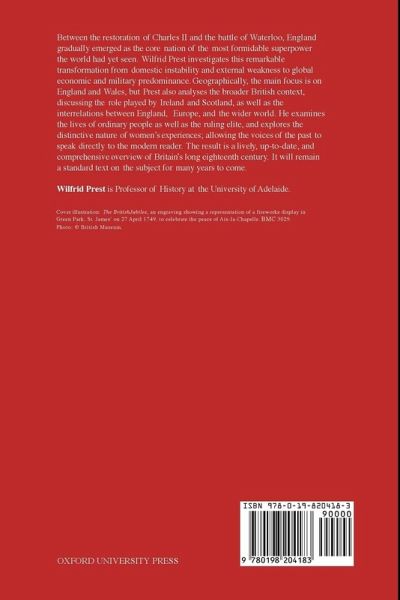
Between the restoration of Charles II and the battle of Waterloo, England gradually emerged as the core nation of the most formidable superpower the world had yet seen. Wilfrid Prest investigates this remarkable transformation from domestic instability and external weakness to global, economic, and military predominance. Geographically, the main focus is on England and Wales, but Prest also analyses the broader British context, discussing the role played by Ireland and Scotland, as well as the interrelations between England, Europe, and the wider world. He examines the lives of ordinary people…mehr
Between the restoration of Charles II and the battle of Waterloo, England gradually emerged as the core nation of the most formidable superpower the world had yet seen. Wilfrid Prest investigates this remarkable transformation from domestic instability and external weakness to global, economic, and military predominance. Geographically, the main focus is on England and Wales, but Prest also analyses the broader British context, discussing the role played by Ireland and Scotland, as well as the interrelations between England, Europe, and the wider world. He examines the lives of ordinary people as well as the ruling elite, and explores the distinctive nature of women's experiences, allowing the voices of the past to speak directly to the modern reader. The result is a lively, up-to-date, and comprehensive overview of Britain's 'long eighteenth century'. It will remain a standard text on the subject for many years to come.
* Part I: Restoration England 1660-1668 * 1: England and the English:- Time, land, people Getting and spending Hierarchies Government Church and dissent Culture and Ideas England, Britain, Europe, and the wider world * 2: Settlement Deferred:- Restoration, accommodation, demobilization Cavaliers, conspirators, dissenters Charles II and the crisis of 1666-1667 Unstable alliances, 1668-1677 Popish plot, reaction and proscription James II, 1685-1688: a threat to Church and state? William of Orange and the Protestant wind * Part II: Post-Revolutionary England, 1689-1715 * 3: Glorious Revolution?:- Revolutionary practice and principles Crown and parliament Law, liberty, and toleration: how much and for whom? Historians and the revolution * 4: The Rage of Party:- Political assumptions, ideologies, structures War and peace, 1689-1701 Queen Anne and a Church Militant, 1702-1710 Jacobitism and the Protestant succession, 1710-1715 * 5: War and the State:- Revolution, diplomacy, and war The sinews of war The state's servants Great Britain as a world power * 6: Trade and the Towns:- Commercial revolution Middling orders Urbanity: London and the provinces Economic concepts and calculations * Part III: Great Britain: Liberty and Property, 1707-1745 * 7: The State of the Union:- Defoe's England Wales Scotland Ireland * 8: From Party Strife to One-Party Rule:- The Elector of Hanover, King George I The Venetian oligarchy inaugurated Parliamentary management Opposition, war, and Walpole's fall Crown and parliament - who ruled Britain? * 9: Religious Belief and Practice:- Church and chapel Latitudarianism and freethinking `Serving the Designes of Enthusiasm' Confessional state or secularizing society? * 10: Production and Consumption:- The Landed interest - depression and improvement Manufactures and manufacturing consumers and consumerism Government and the economy * Part IV: Empires Won and Lost, 1746-1788 * 11: People:- Population growth The common people `The upper part of mankind' Childhood Education and literacy Love and marriage Minorities * 12: Politics, Popularity, and Patriotism:- The old corps: Pelham and Newcastle Willliam Pitt and the war with France A new reign, a new politics? `Wilkes and Liberty!' * 13: Ruling Institutions:- Blackstone and the rules of law Crime and punishment The Established Church, dissent and disability * 14: Burdens and Fruits of Empire:- Attitudes to Empire George III, Lord North, and the American Revolution The strains of war Ireland - patriots and volunteers Pitt and recovery India and the East The Pacific * 15: Sense and Sensibility:- The British Enlightenment Science and medicine Good works Humanity and nature * Part V: Economic Expansion and Diversification, 1750-1815 * 16: Industrializing England:- Historiography Feeding the people Infrastructure - canals and turnpikes Power Industry and invention Trade banking and finance Law, policy, and the State Organization of work and workers Labour and capital Standards of living Regional and national dimensions Revolution or evolution? * Part VI: Reform, Revolution, Reaction, 1789-1815 * 17: Radicals, Reformers, and the French Revolution, 1789-1793:- Radical and reformist traditions `Bliss was it in that dawn to be alive' Burke and Paine Jacobins and Loyalists * 18: The Last French Wars, 1793-1815:- Mobilization and repression Dearth and famine, discontent and mutiny Ireland: rebellion and union A peace to be glad of World wide war Victory and misery * 19: Retrospect and Conclusion:- Change and Continuity, 1660-1815 The Peculiarities of the English * Appendices: Monarchs and First Ministers, 1660-1815 Main British Colonies and Overseas Posessions, 1660-1815 * Chronology * Further Reading * Index
* Part I: Restoration England 1660-1668 * 1: England and the English:- Time, land, people Getting and spending Hierarchies Government Church and dissent Culture and Ideas England, Britain, Europe, and the wider world * 2: Settlement Deferred:- Restoration, accommodation, demobilization Cavaliers, conspirators, dissenters Charles II and the crisis of 1666-1667 Unstable alliances, 1668-1677 Popish plot, reaction and proscription James II, 1685-1688: a threat to Church and state? William of Orange and the Protestant wind * Part II: Post-Revolutionary England, 1689-1715 * 3: Glorious Revolution?:- Revolutionary practice and principles Crown and parliament Law, liberty, and toleration: how much and for whom? Historians and the revolution * 4: The Rage of Party:- Political assumptions, ideologies, structures War and peace, 1689-1701 Queen Anne and a Church Militant, 1702-1710 Jacobitism and the Protestant succession, 1710-1715 * 5: War and the State:- Revolution, diplomacy, and war The sinews of war The state's servants Great Britain as a world power * 6: Trade and the Towns:- Commercial revolution Middling orders Urbanity: London and the provinces Economic concepts and calculations * Part III: Great Britain: Liberty and Property, 1707-1745 * 7: The State of the Union:- Defoe's England Wales Scotland Ireland * 8: From Party Strife to One-Party Rule:- The Elector of Hanover, King George I The Venetian oligarchy inaugurated Parliamentary management Opposition, war, and Walpole's fall Crown and parliament - who ruled Britain? * 9: Religious Belief and Practice:- Church and chapel Latitudarianism and freethinking `Serving the Designes of Enthusiasm' Confessional state or secularizing society? * 10: Production and Consumption:- The Landed interest - depression and improvement Manufactures and manufacturing consumers and consumerism Government and the economy * Part IV: Empires Won and Lost, 1746-1788 * 11: People:- Population growth The common people `The upper part of mankind' Childhood Education and literacy Love and marriage Minorities * 12: Politics, Popularity, and Patriotism:- The old corps: Pelham and Newcastle Willliam Pitt and the war with France A new reign, a new politics? `Wilkes and Liberty!' * 13: Ruling Institutions:- Blackstone and the rules of law Crime and punishment The Established Church, dissent and disability * 14: Burdens and Fruits of Empire:- Attitudes to Empire George III, Lord North, and the American Revolution The strains of war Ireland - patriots and volunteers Pitt and recovery India and the East The Pacific * 15: Sense and Sensibility:- The British Enlightenment Science and medicine Good works Humanity and nature * Part V: Economic Expansion and Diversification, 1750-1815 * 16: Industrializing England:- Historiography Feeding the people Infrastructure - canals and turnpikes Power Industry and invention Trade banking and finance Law, policy, and the State Organization of work and workers Labour and capital Standards of living Regional and national dimensions Revolution or evolution? * Part VI: Reform, Revolution, Reaction, 1789-1815 * 17: Radicals, Reformers, and the French Revolution, 1789-1793:- Radical and reformist traditions `Bliss was it in that dawn to be alive' Burke and Paine Jacobins and Loyalists * 18: The Last French Wars, 1793-1815:- Mobilization and repression Dearth and famine, discontent and mutiny Ireland: rebellion and union A peace to be glad of World wide war Victory and misery * 19: Retrospect and Conclusion:- Change and Continuity, 1660-1815 The Peculiarities of the English * Appendices: Monarchs and First Ministers, 1660-1815 Main British Colonies and Overseas Posessions, 1660-1815 * Chronology * Further Reading * Index
Es gelten unsere Allgemeinen Geschäftsbedingungen: www.buecher.de/agb
Impressum
www.buecher.de ist ein Internetauftritt der buecher.de internetstores GmbH
Geschäftsführung: Monica Sawhney | Roland Kölbl | Günter Hilger
Sitz der Gesellschaft: Batheyer Straße 115 - 117, 58099 Hagen
Postanschrift: Bürgermeister-Wegele-Str. 12, 86167 Augsburg
Amtsgericht Hagen HRB 13257
Steuernummer: 321/5800/1497
USt-IdNr: DE450055826


![Utopia, Tr. by G. Burnet. to This Ed. Is Added, a Short Account of Sir Thomas More's Life and Trial. the Whole Revis'd, Corrected by T. Williamson. Revis'd by a Gentleman of Oxford [T. Williamson]](https://bilder.buecher.de/produkte/74/74766/74766125m.jpg "Utopia, Tr. by G. Burnet. to This Ed. Is Added, a Short Account of Sir Thomas More's Life and Trial. the Whole Revis'd, Corrected by T. Williamson. Revis'd by a Gentleman of Oxford [T. Williamson]")