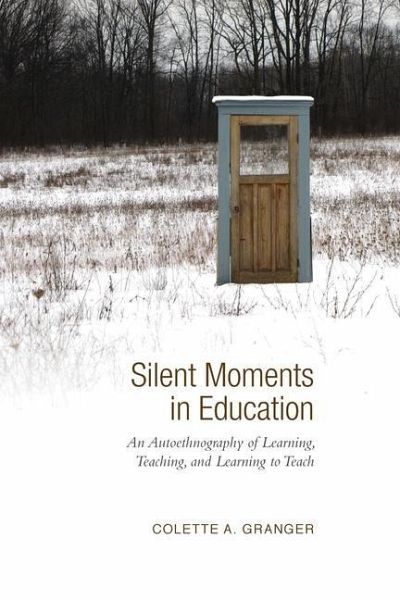
Colette A. Granger's highly original book considers moments in several areas of education in which silence may serve as both a response to difficulty and a means of working through it. The author, a teacher educator, presents narratives and other textual artefacts from her own experiences of learning and instruction. She analyses them from multiple perspectives to reveal how the qualities of education's silences can make them at once difficult to observe and challenging to think about. Silent Moments in Education combines autoethnography with psychoanalytic theory and critical discourse…mehr
Colette A. Granger's highly original book considers moments in several areas of education in which silence may serve as both a response to difficulty and a means of working through it. The author, a teacher educator, presents narratives and other textual artefacts from her own experiences of learning and instruction. She analyses them from multiple perspectives to reveal how the qualities of education's silences can make them at once difficult to observe and challenging to think about. Silent Moments in Education combines autoethnography with psychoanalytic theory and critical discourse analysis in a unique consideration of the relations teachers and learners forge with knowledge, with ideas, and with one another. This provocative and thoughtful work invites scholars and educators to consider the multiple silences of participants in education, and to respond to them with generosity and compassion.
Colette A. Granger holds a postdoctoral fellowship at Queen's University and the University of Toronto. She works in teacher education at these institutions and at York University.
Inhaltsangabe
Abstract Acknowledgements List of figures Prologue First Circumnarrative: the sun Introduction * Silent Moments * Conceptual framework: if it's not one thing, it's an Other * Telling the story: autoethnography * Reading the story: discourse analysis and psychoanalysis * The shape of the study: “Every moment is two moments” PART I * Second circumnarrative: the wind Chapter One Stories about facts: Ethnography, autoethnography, discourse analysis The facts * Ethnography and autoethnography: ways to write about things * Educational ethnography: ways to write about school things * Detour: Malinowski's diary, or, a funny thing happened on the way to autoethnography * Autoethnography: the researcher as one of those things * Discourse analysis: ways to think about things Chapter Two Stories of stories: Narrative, memory, psychoanalysis The field notes 1. Reading the field notes 2. The personal 3. Narrative and memory 4. Psychoanalytic concepts: ways of reading and thinking * The unconscious * Repression * Deferred action * The mystic writing-pad * Screen memories Chapter Three Field notes, felt-notes, felt and noted: Silencing learning, silencing desire 5. The data * Field notes, revised, with feeling, first part * Feel-ed/felt-notes, second part * Felt, and noted, third part 6. Reading the field/feel-ed/felt notes * Psychoanalysis reads * Psychoanalysis reads resistance * Psychoanalysis reads repression * Psychoanalysis reads desire 7. Telling and re-telling: the same old story? 8. Difference, discourse, desire. And moving on Part II * Third circumnarrative: the rain Chapter Four Curiosity kills the silence: On (not) representing sex in kindergarten * Mapping the body: pictures, words, silence * Constructing the child, constructing sex * Constructing the child: “sitting up, shutting up and lining up” in kindergarten * Constructing appropriateness * Orders and hints: reading the empty spaces Chapter Five Another nice mess: Teachers translated by technology * The computer and the teacher * The teacher's work, the teacher's power: autonomy and authority * A problem of identity: the teacher relocated * Self, love, work: the unconscious (in) teaching * Transference: the teacher in the (Lacanian) mirror * Translating and reflecting: computer screen as pixelated mirror Part III * Fourth circumnarrative: the snow Chapter Six Neither here nor there: Difficult moments in teacher education * Coming to theory: assumptions and beliefs about teaching and learning * Resisting theory: changing minds and making trouble * Troubling theory: a psychoanalytic reading * Splitting (through) theory: the self divided Chapter Seven Ghosts that haunt us: “Forbidden narratives” of learning to teach 9. Thinking theory: from splitting to insight 10. Practising practicum: coming to the data 11. Telling the tale: the data 12. Power and resistance: reading stories with Foucault 13. The ghost and the host (teacher): reading stories with psychoanalysi * Who do I think I am? The return of the repressed * Who do I think you are? Transference in the practicum * Who do I think I’m kid(d)ing? * Who do I think I’m killing? Matricide and the practicum 14. Remembering and repeating, objects and stories: what comes next? 15. Fifth circumnarrative: the spring (in)Conclusion * Conversation * Reflection * Silence * Secrets * Ethics * Listening * Caring, loving, hoping Epilogue Sixth circumnarrative: around and after words References
Abstract Acknowledgements List of figures Prologue First Circumnarrative: the sun Introduction * Silent Moments * Conceptual framework: if it's not one thing, it's an Other * Telling the story: autoethnography * Reading the story: discourse analysis and psychoanalysis * The shape of the study: “Every moment is two moments” PART I * Second circumnarrative: the wind Chapter One Stories about facts: Ethnography, autoethnography, discourse analysis The facts * Ethnography and autoethnography: ways to write about things * Educational ethnography: ways to write about school things * Detour: Malinowski's diary, or, a funny thing happened on the way to autoethnography * Autoethnography: the researcher as one of those things * Discourse analysis: ways to think about things Chapter Two Stories of stories: Narrative, memory, psychoanalysis The field notes 1. Reading the field notes 2. The personal 3. Narrative and memory 4. Psychoanalytic concepts: ways of reading and thinking * The unconscious * Repression * Deferred action * The mystic writing-pad * Screen memories Chapter Three Field notes, felt-notes, felt and noted: Silencing learning, silencing desire 5. The data * Field notes, revised, with feeling, first part * Feel-ed/felt-notes, second part * Felt, and noted, third part 6. Reading the field/feel-ed/felt notes * Psychoanalysis reads * Psychoanalysis reads resistance * Psychoanalysis reads repression * Psychoanalysis reads desire 7. Telling and re-telling: the same old story? 8. Difference, discourse, desire. And moving on Part II * Third circumnarrative: the rain Chapter Four Curiosity kills the silence: On (not) representing sex in kindergarten * Mapping the body: pictures, words, silence * Constructing the child, constructing sex * Constructing the child: “sitting up, shutting up and lining up” in kindergarten * Constructing appropriateness * Orders and hints: reading the empty spaces Chapter Five Another nice mess: Teachers translated by technology * The computer and the teacher * The teacher's work, the teacher's power: autonomy and authority * A problem of identity: the teacher relocated * Self, love, work: the unconscious (in) teaching * Transference: the teacher in the (Lacanian) mirror * Translating and reflecting: computer screen as pixelated mirror Part III * Fourth circumnarrative: the snow Chapter Six Neither here nor there: Difficult moments in teacher education * Coming to theory: assumptions and beliefs about teaching and learning * Resisting theory: changing minds and making trouble * Troubling theory: a psychoanalytic reading * Splitting (through) theory: the self divided Chapter Seven Ghosts that haunt us: “Forbidden narratives” of learning to teach 9. Thinking theory: from splitting to insight 10. Practising practicum: coming to the data 11. Telling the tale: the data 12. Power and resistance: reading stories with Foucault 13. The ghost and the host (teacher): reading stories with psychoanalysi * Who do I think I am? The return of the repressed * Who do I think you are? Transference in the practicum * Who do I think I’m kid(d)ing? * Who do I think I’m killing? Matricide and the practicum 14. Remembering and repeating, objects and stories: what comes next? 15. Fifth circumnarrative: the spring (in)Conclusion * Conversation * Reflection * Silence * Secrets * Ethics * Listening * Caring, loving, hoping Epilogue Sixth circumnarrative: around and after words References
Es gelten unsere Allgemeinen Geschäftsbedingungen: www.buecher.de/agb
Impressum
www.buecher.de ist ein Internetauftritt der buecher.de internetstores GmbH
Geschäftsführung: Monica Sawhney | Roland Kölbl | Günter Hilger
Sitz der Gesellschaft: Batheyer Straße 115 - 117, 58099 Hagen
Postanschrift: Bürgermeister-Wegele-Str. 12, 86167 Augsburg
Amtsgericht Hagen HRB 13257
Steuernummer: 321/5800/1497
USt-IdNr: DE450055826