
Andere Kunden interessierten sich auch für
 Reduced Ice Age Prediction Models15,00 €
 Field Work and Laboratory Experiments in Integrated Environmental Sciences76,99 €
 From Earth's Ecosystems to Exoplanets211,99 €
 Sustainable Living with Environmental Risks34,99 €
 The Quaternary in the Tropics90,99 €
 Geothermal Fields of India113,99 €
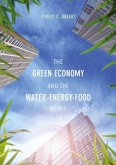
 The Green Economy and the Water-Energy-Food Nexus98,99 €

This is an open access book.
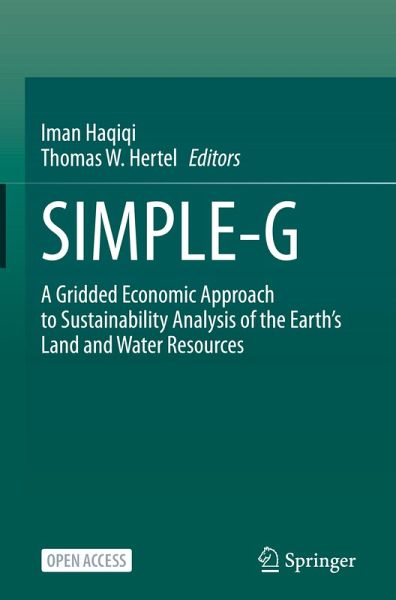
Crafted for both the economist and the curious mind, this book introduces a novel approach to blending economic and biophysical sciences to enable multi-scale analysis of a range of sustainability challenges confronting the world's land and water resources at both local and global scales. It focuses specifically on the interface between the environment and food systems, utilizing economic theory to structure the overall framework. However, within the SIMPLE-G framework, there is ample room to incorporate fine-scale biophysical knowledge from agronomy, climate science, ecology, geography, hydrology, as well as a range of socioeconomic considerations. This enables multi-scale analyses incorporating grid cells that can vary in size from 250 meters to sub-regional scales. This, in turn, allows for investigation of global change drivers' impacts on local sustainability, as well as feedbacks from local sustainability policies to regional and global outcomes.
The book opens with a foreword by a prominent sustainability scientist, Prof. Navin Ramankutty, and proceeds in five parts covering, respectively: (1) introduction and overview, (2) basic economic theory underpinning SIMPLE-G, (3) the SIMPLE-G framework, including structure, data, parameters, computer implementation, and validation, (4) eight diverse applications of the SIMPLE-G framework, covering a range of geographies and sustainability challenges, and (5) a forward-looking chapter on future directions. The book provides step-by-step guidance on building and utilizing gridded models with real-world case studies demonstrating practical applications which will facilitate its use by academics, practitioners, and students conducting research on climate impacts, land-use, water resource management, food security, poverty, equity, nutritional outcomes, and overall sustainability.
Crafted for both the economist and the curious mind, this book introduces a novel approach to blending economic and biophysical sciences to enable multi-scale analysis of a range of sustainability challenges confronting the world's land and water resources at both local and global scales. It focuses specifically on the interface between the environment and food systems, utilizing economic theory to structure the overall framework. However, within the SIMPLE-G framework, there is ample room to incorporate fine-scale biophysical knowledge from agronomy, climate science, ecology, geography, hydrology, as well as a range of socioeconomic considerations. This enables multi-scale analyses incorporating grid cells that can vary in size from 250 meters to sub-regional scales. This, in turn, allows for investigation of global change drivers' impacts on local sustainability, as well as feedbacks from local sustainability policies to regional and global outcomes.
The book opens with a foreword by a prominent sustainability scientist, Prof. Navin Ramankutty, and proceeds in five parts covering, respectively: (1) introduction and overview, (2) basic economic theory underpinning SIMPLE-G, (3) the SIMPLE-G framework, including structure, data, parameters, computer implementation, and validation, (4) eight diverse applications of the SIMPLE-G framework, covering a range of geographies and sustainability challenges, and (5) a forward-looking chapter on future directions. The book provides step-by-step guidance on building and utilizing gridded models with real-world case studies demonstrating practical applications which will facilitate its use by academics, practitioners, and students conducting research on climate impacts, land-use, water resource management, food security, poverty, equity, nutritional outcomes, and overall sustainability.