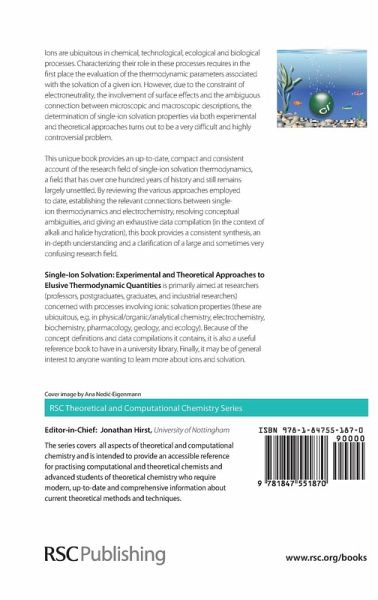
Philippe Hunenberger (Switzerland ETH Zurich), Maria Reif (Austria Universitat fur Bodenkultur Wien)Experimental and Theoretical Approaches to Elusive Thermodynamic Quantities
Single-Ion Solvation
Experimental and Theoretical Approaches to Elusive Thermodynamic Quantities
Herausgeber: Thiel, Walter; Lim, Carmay; Jordan, Kenneth D
Philippe Hunenberger (Switzerland ETH Zurich), Maria Reif (Austria Universitat fur Bodenkultur Wien)Experimental and Theoretical Approaches to Elusive Thermodynamic Quantities
Single-Ion Solvation
Experimental and Theoretical Approaches to Elusive Thermodynamic Quantities
Herausgeber: Thiel, Walter; Lim, Carmay; Jordan, Kenneth D
- Gebundenes Buch
- Merkliste
- Auf die Merkliste
- Bewerten Bewerten
- Teilen
- Produkt teilen
- Produkterinnerung
- Produkterinnerung
A clear understanding of the concepts, definitions and difficulties underlying the problem of determining single-ion solvation free energies via experiment or theory.
Andere Kunden interessierten sich auch für
Yizhak MarcusIons in Solution and Their Solvation128,99 €
Single Perturbation Problems in Chemical Physics486,99 €
Theory and Evaluation of Single-Molecule Signals159,99 €
Spectroscopy, Theory and Mechanism in Bioinorganic Chemistry186,99 €
Advanced Fragmentation Methods in Biomolecular Mass Spectrometry208,99 €
Bengt NordénLinear Dichroism and Circular Dichroism51,99 €
Hot-Electron Science and Microscopic Processes in Plasmonics and Catalysis208,99 €-
-
-
A clear understanding of the concepts, definitions and difficulties underlying the problem of determining single-ion solvation free energies via experiment or theory.
Produktdetails
- Produktdetails
- Theoretical and Computational Chemistry Series
- Verlag: Royal Society of Chemistry
- Seitenzahl: 664
- Erscheinungstermin: 18. April 2011
- Englisch
- Abmessung: 245mm x 164mm x 40mm
- Gewicht: 1478g
- ISBN-13: 9781847551870
- ISBN-10: 1847551874
- Artikelnr.: 30621431
- Herstellerkennzeichnung
- Libri GmbH
- Europaallee 1
- 36244 Bad Hersfeld
- gpsr@libri.de
- Theoretical and Computational Chemistry Series
- Verlag: Royal Society of Chemistry
- Seitenzahl: 664
- Erscheinungstermin: 18. April 2011
- Englisch
- Abmessung: 245mm x 164mm x 40mm
- Gewicht: 1478g
- ISBN-13: 9781847551870
- ISBN-10: 1847551874
- Artikelnr.: 30621431
- Herstellerkennzeichnung
- Libri GmbH
- Europaallee 1
- 36244 Bad Hersfeld
- gpsr@libri.de
Philippe Hünenberger, previously Assistant Professor, is now a Senior Scientist at the Institute of Physical Chemistry, ETH Zürich (ETHZ). He completed his undergraduate studies at the University of Lausanne and his PhD at ETHZ followed by a period of time at UCSD, San Diego as a post-doctoral fellow. He has received numerous undergraduate and graduate awards including the Ruzicka Prize in 2008 and has been awarded a number of research grants. With countless published papers and oral presentations at key international conferences, he is regarded as a world renowned expert in his field. Maria Reif is at the Institute of Physical Chemistry, ETH Zürich (ETHZ). She completed her Bachelor studies at the Technische Universitõt, München and her Master studies in Molecular Modelling in the Theoretical Chemistry Group at the University of Cardiff. She recently finished her PhD in the Group for Computer-Assisted Chemistry at ETHZ. Her research interests are in the properties of single ions in solution (free energies of solvation and its derivative properties); parameterisation of ions against (methodology-independent) hydration free energies; testing of ion parameter sets to validate a value for the proton hydration free energy; asymmetric solvation effects in different solvents and approximate-electrostatics artefacts on charge-charge interactions.

Chapter 1: Introduction
Chapter 2: Fundamental problems
Chapter 3: Concepts and definitions
Chapter 4: Methods
Chapter 5: Results
Chapter 6: Conclusion
Chapter 2: Fundamental problems
Chapter 3: Concepts and definitions
Chapter 4: Methods
Chapter 5: Results
Chapter 6: Conclusion
Chapter 1: Introduction
Chapter 2: Fundamental problems
Chapter 3: Concepts and definitions
Chapter 4: Methods
Chapter 5: Results
Chapter 6: Conclusion
Chapter 2: Fundamental problems
Chapter 3: Concepts and definitions
Chapter 4: Methods
Chapter 5: Results
Chapter 6: Conclusion