
Andere Kunden interessierten sich auch für
 Comparing ISO 9000, Malcolm Baldrige, and the SEI CMM for Software: A Reference and Selection Guide70,99 €
 Managing Quality38,99 €
 Brand Champions38,99 €
 Quality Issues in Heritage Visitor Attractions176,99 €
") Operations Excellence Management System (OEMS)47,99 €
Operations Excellence Management System (OEMS)47,99 € Superior Customer Value54,99 €
 The Weibull Distribution47,99 €



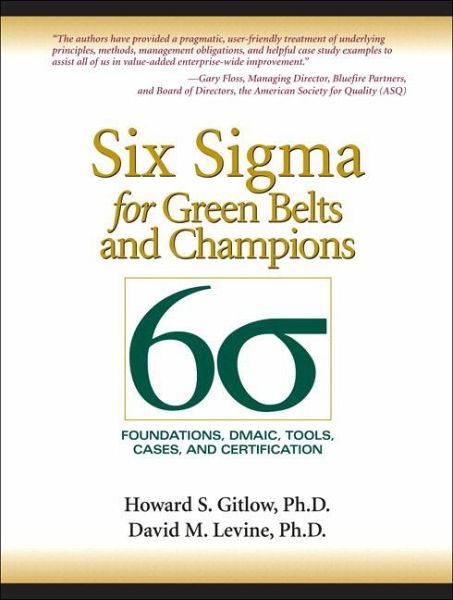
Authored by one of the world's most respected Quality and Six Sigma experts, Howard S. Gitlow, and a best selling statistics author David M. Levine. The first book that specifically targets green belts - the largest group of people who deal with Six Sigma. Shows how to understand and manage Six Sigma statistics, through practical, MiniTab-based application examples. Product Description
"Much has been said or written in recent times about the value of Six Sigma methodologies in driving organizational improvement. Yet, so many still seem to be intimidated by or skeptical about these principles and tools. In this text, Drs. Gitlow and Levine have provided a pragmatic, user-friendly treatment of underlying principles and methods, management obligations, and helpful case study examples to assist all of us in value-added enterprise-wide improvement."
–Gary Floss, Managing Director, Bluefire Partners, and Board of Directors, the American Society for Quality (ASQ)
"The authors provide the perfect blend of managerial insight and a straightforward "how to" approach to statistics. Anyone interested in learning about Six Sigma for the first time, or practitioners wanting to learn more, will find this book to-the-point, exciting, and easy to read. And also hard to put down!"
–Timothy C. Krehbiel, Professor of Decision Sciences and MIS, Miami University (Ohio)
"This book provides an excellent understanding of the foundations of quality management that provide a basis for the evolution of Six Sigma. For executives who wish to be "Champions" of Six Sigma, this book provides an understanding of what to expect of Green Belts as they work through a DMAIC project and what they should expect of themselves. Green Belt candidates will find the case studies extremely useful and informative. Both Champions and Green Belts will benefit from the comprehensive coverage of certification."
–Edward A. Popovich, Ph. D., Vice President, Enterprise Excellence, Boca Raton Community Hospital and President, Sterling Enterprises International, Inc.
The first complete Six Sigma implementation guide for Green Belts and Champions!
Understand the rationale for Six Sigma
Implement a proven executive framework for a successful quality initiative
Use the DMAIC method for improvement from start to finish: Define, Measure, Analyze, Improve, and Control
Manage Six Sigma statistics–without becoming a statistician
Learn through complete detailed manufacturing and service case studies
Learn how to understand and manage Six Sigma statistics, through practical, Minitab-based application examples. Includes instructions for using Minitab software
Learn how to pass Six Sigma certification examinations with sample questions and answers
If you're "project managing" Six Sigma (potential Green Belt)–or promoting it at the executive level (potential Champion)–this is your book. It's the first Six Sigma book written specifically for Green Belts, Champions...and anyone who plans to become one. Two experts help you master the entire DMAIC model: Define, Measure, Analyze, Improve, and Control. You'll discover realistic solutions for Six Sigma's profound human and technical challenges. You can even prepare for one of the world's leading Six Sigma certification programs. Clear, detailed, and proven...this is the one indispensable book for anyone who must manage Six Sigma to success.
© Copyright Pearson Education. All rights reserved.
Preface.
I. SIX SIGMA BASICS.
1. Overview of Six Sigma Management.
Successful Applications of Six Sigma Management.
Timeline for Six Sigma Management.
Key Ingredients for Success with Six Sigma Management.
Benefits of Six Sigma Management.
Process Basics (Voice of the Process).
Definition of a Process.
Variation in a Process.
Feedback Loops.
Definition of Quality (Voice of the Customer).
Goalpost View of Quality.
Continuous Improvement View of Quality.
Definitions of Six Sigma Management (Relationship Between VoC and VoP).
Nontechnical Definitions of Six Sigma.
Technical Definition of Six Sigma Management.
What Is New about Six Sigma Management?
Summary.
References.
2. Six Sigma Roles, Responsibilities, and Terminology.
Roles and Responsibilities in Six Sigma Management.
Senior Executive.
Executive Committee Member.
Champion.
Master Black Belt.
Black Belt.
Green Belt.
Process Owner.
Technical Terminology of Six Sigma Management.
Beginning Six Sigma Management.
Starting Six Sigma Management.
Responding to a Crisis.
Initiating Action for Six Sigma Management.
Retaining Outside Counsel.
Window of Opportunity Opens.
Develop a Six Sigma Transformation Plan.
Window of Opportunity Begins to Close.
Nonmanufacturing Industries.
Summary.
References.
II. SIX SIGMA MODEL.
3. Macro Model of Six Sigma Management (Dashboards).
Structure of a Dashboard.
Components of a Dashboard.
Mission Statement.
Key Objectives.
Key Indicators.
Tasks and Projects.
Example of a Dashboard.
Managing with a Dashboard.
Coordinating Projects in a Department or Area.
Prioritization of Six Sigma Projects.
Management Decides Whether a Project Team Is Necessary.
Summary.
References.
4. Define Phase of the DMAIC Model.
Activating a Six Sigma Project Team.
Structure of the Define Phase.
Project Charter.
Introduction.
Background for the Business Case.
Problem Statement.
Goal Statement.
Project Scope.
A Schedule with Milestones.
Benefits and Costs.
Roles and Responsibilities.
Prepare a Draft Project Objective.
Conducting an SIPOC Analysis.
Voice of the Customer Analysis.
Background on Market Segmentation.
Proactive Voice of the Customer Data.
Finalize Project Objective.
Champion and Process Owner Tollgate Reviews.
Tollgate Style Questions.
Tollgate Situations.
Presidential Tollgate Reviews.
Introduction.
Reasons for Conducting Presidential Reviews.
Benefits of Presidential Reviews.
Barriers to the Presidential Review.
Selecting the Departments and Topics to Review.
Informing the Departments to Be Reviewed.
Ground Rules for the Presidential Review.
Preparing for the Review.
Conducting the Review.
Keys to Successful Reviews.
Define Phase Tollgate Checklist.
Summary.
References.
5. Measure Phase of the DMAIC Model.
Constructing Operational Definitions for CTQs.
Background.
Effect of No Operational Definition.
Examples of an Operational Definition.
Operational Definitions of the CTQs in the MSD Case Study.
Establishing the Validity of the Measurement System for Each CTQ.
Questions to Ask About a Measurement System.
Terminology.
Measurement System Studies.
Establishing the Baseline Capabilities for CTQs.
Background.
Collect and Analyze VoP Data for Each CTQ.
Estimate Process Capability for Each CTQ.
Baseline for Durability and Functionality from the MSD
Case Study.
Measure Phase Tollgate Review Checklist.
Summary.
References.
Appendix 5.1 Using Minitab for Gage R&R Studies.
Obtaining a Gage Run?Chart.
Obtaining a Gage R&R Study (Crossed).
6. Analyze Phase of the DMAIC Model.
Identify the Xs for the Process Under Study.
Identify the Xs Related to Each CTQ.
Identify the High-Risk Xs for Each CTQ.
Develop Operational Definitions for High-Risk Xs.
Establish Measurement System for High-Risk Xs.
Establish Baseline Process Capabilities for Xs.
Stabilize High-Risk Xs.
Consider Major Nuisance Variables.
Using Screening Designs to Reduce the Number of High-Risk Xs.
Develop Hypotheses About the Relationships Between the High-Risk Xs and the CTQs.
Analyze Phase Tollgate Review Checklist.
The Analyze Phase for Processes with a Well-Established Dashboards.
Summary.
References.
Appendix 6 Using Minitab to Obtain a Multivari Chart.
Obtaining a Multivari Chart.
7. Improve Phase of the DMAIC Model.
Purpose of Designed Experiments.
Level of Process Knowledge.
Some Flawed Experimental Designs.
Two-Factor Factorial Designs.
Example of a Designed Experiment.
Avoid Potential Problems in the Xs.
Risk Management.
Mistake Proofing.
Conduct a Pilot Study.
Example of a Pilot Study.
Identify Actions Needed to Implement Optimized Process.
Improve Phase Tollgate Review Checklist.
Summary.
References.
8. Control Phase of the DMAIC Model.
Reduce the Effects of Collateral Damage to Related Processes.
Standardize Process Improvements in the Xs.
ISO 9000 and ISO 14000.
Generic Table of Contents of an ISO Standard.
Maintain Control of the Xs.
Develop a Control Plan for the Process Owner.
Identify and Document the Benefits and Costs of the Project.
Input Project into the Six Sigma Database.
Diffuse the Improvements Throughout the Organization.
Control Phase Tollgate Review.
Summary.
References.
III. SIX SIGMA TOOLS AND METHODS.
9. Basics of Statistical Studies.
Introduction to Statistics.
Enumerative and Analytic Studies.
Distinguishing Enumerative and Analytic Studies.
Types of Sampling.
Simple Random Sample.
Stratified Sample.
Systematic Sample.
Cluster Sample.
Types of Variables.
Operational Definitions.
Introduction to Graphics.
Graphing Attribute Data.
The Bar Chart.
The Pareto Diagram.
Line Chart.
Graphing Measurement Data.
Histogram.
The Dot Plot.
The Run Chart.
Measures of Central Tendency.
The Arithmetic Mean
Thousands of companies have discovered the value of Six Sigma in streamlining operations, cutting costs, improving quality, and increasing profitability. Now, there's a comprehensive guide to Six Sigma for the people who need it most: the "green belts" who manage Six Sigma, and "champions" who drive it at the executive level. Howard S. Gitlow and David M. Levine, present a complete executive framework for understanding quality and implementing Six Sigma. They systematically walk you through the five-step DMAIC implementation process, with detailed examples and real-world case studies. You'll learn how to make the business case for Six Sigma; manage Six Sigma statistics without becoming a statistician; even prepare for one of the field's most respected certification exams. Drawing on their unsurpassed expertise, the authors also present realistic solutions for the most significant obstacles in Six Sigma implementation: How do you sustain your initiative? How can you tell if it's working? If not, how do you get it back on track? From manufacturing to services, Six Sigma for Greenbelts and Champions helps leaders make Six Sigma work, so they can reap its full rewards.
"Much has been said or written in recent times about the value of Six Sigma methodologies in driving organizational improvement. Yet, so many still seem to be intimidated by or skeptical about these principles and tools. In this text, Drs. Gitlow and Levine have provided a pragmatic, user-friendly treatment of underlying principles and methods, management obligations, and helpful case study examples to assist all of us in value-added enterprise-wide improvement."
–Gary Floss, Managing Director, Bluefire Partners, and Board of Directors, the American Society for Quality (ASQ)
"The authors provide the perfect blend of managerial insight and a straightforward "how to" approach to statistics. Anyone interested in learning about Six Sigma for the first time, or practitioners wanting to learn more, will find this book to-the-point, exciting, and easy to read. And also hard to put down!"
–Timothy C. Krehbiel, Professor of Decision Sciences and MIS, Miami University (Ohio)
"This book provides an excellent understanding of the foundations of quality management that provide a basis for the evolution of Six Sigma. For executives who wish to be "Champions" of Six Sigma, this book provides an understanding of what to expect of Green Belts as they work through a DMAIC project and what they should expect of themselves. Green Belt candidates will find the case studies extremely useful and informative. Both Champions and Green Belts will benefit from the comprehensive coverage of certification."
–Edward A. Popovich, Ph. D., Vice President, Enterprise Excellence, Boca Raton Community Hospital and President, Sterling Enterprises International, Inc.
The first complete Six Sigma implementation guide for Green Belts and Champions!
Understand the rationale for Six Sigma
Implement a proven executive framework for a successful quality initiative
Use the DMAIC method for improvement from start to finish: Define, Measure, Analyze, Improve, and Control
Manage Six Sigma statistics–without becoming a statistician
Learn through complete detailed manufacturing and service case studies
Learn how to understand and manage Six Sigma statistics, through practical, Minitab-based application examples. Includes instructions for using Minitab software
Learn how to pass Six Sigma certification examinations with sample questions and answers
If you're "project managing" Six Sigma (potential Green Belt)–or promoting it at the executive level (potential Champion)–this is your book. It's the first Six Sigma book written specifically for Green Belts, Champions...and anyone who plans to become one. Two experts help you master the entire DMAIC model: Define, Measure, Analyze, Improve, and Control. You'll discover realistic solutions for Six Sigma's profound human and technical challenges. You can even prepare for one of the world's leading Six Sigma certification programs. Clear, detailed, and proven...this is the one indispensable book for anyone who must manage Six Sigma to success.
© Copyright Pearson Education. All rights reserved.
Preface.
I. SIX SIGMA BASICS.
1. Overview of Six Sigma Management.
Successful Applications of Six Sigma Management.
Timeline for Six Sigma Management.
Key Ingredients for Success with Six Sigma Management.
Benefits of Six Sigma Management.
Process Basics (Voice of the Process).
Definition of a Process.
Variation in a Process.
Feedback Loops.
Definition of Quality (Voice of the Customer).
Goalpost View of Quality.
Continuous Improvement View of Quality.
Definitions of Six Sigma Management (Relationship Between VoC and VoP).
Nontechnical Definitions of Six Sigma.
Technical Definition of Six Sigma Management.
What Is New about Six Sigma Management?
Summary.
References.
2. Six Sigma Roles, Responsibilities, and Terminology.
Roles and Responsibilities in Six Sigma Management.
Senior Executive.
Executive Committee Member.
Champion.
Master Black Belt.
Black Belt.
Green Belt.
Process Owner.
Technical Terminology of Six Sigma Management.
Beginning Six Sigma Management.
Starting Six Sigma Management.
Responding to a Crisis.
Initiating Action for Six Sigma Management.
Retaining Outside Counsel.
Window of Opportunity Opens.
Develop a Six Sigma Transformation Plan.
Window of Opportunity Begins to Close.
Nonmanufacturing Industries.
Summary.
References.
II. SIX SIGMA MODEL.
3. Macro Model of Six Sigma Management (Dashboards).
Structure of a Dashboard.
Components of a Dashboard.
Mission Statement.
Key Objectives.
Key Indicators.
Tasks and Projects.
Example of a Dashboard.
Managing with a Dashboard.
Coordinating Projects in a Department or Area.
Prioritization of Six Sigma Projects.
Management Decides Whether a Project Team Is Necessary.
Summary.
References.
4. Define Phase of the DMAIC Model.
Activating a Six Sigma Project Team.
Structure of the Define Phase.
Project Charter.
Introduction.
Background for the Business Case.
Problem Statement.
Goal Statement.
Project Scope.
A Schedule with Milestones.
Benefits and Costs.
Roles and Responsibilities.
Prepare a Draft Project Objective.
Conducting an SIPOC Analysis.
Voice of the Customer Analysis.
Background on Market Segmentation.
Proactive Voice of the Customer Data.
Finalize Project Objective.
Champion and Process Owner Tollgate Reviews.
Tollgate Style Questions.
Tollgate Situations.
Presidential Tollgate Reviews.
Introduction.
Reasons for Conducting Presidential Reviews.
Benefits of Presidential Reviews.
Barriers to the Presidential Review.
Selecting the Departments and Topics to Review.
Informing the Departments to Be Reviewed.
Ground Rules for the Presidential Review.
Preparing for the Review.
Conducting the Review.
Keys to Successful Reviews.
Define Phase Tollgate Checklist.
Summary.
References.
5. Measure Phase of the DMAIC Model.
Constructing Operational Definitions for CTQs.
Background.
Effect of No Operational Definition.
Examples of an Operational Definition.
Operational Definitions of the CTQs in the MSD Case Study.
Establishing the Validity of the Measurement System for Each CTQ.
Questions to Ask About a Measurement System.
Terminology.
Measurement System Studies.
Establishing the Baseline Capabilities for CTQs.
Background.
Collect and Analyze VoP Data for Each CTQ.
Estimate Process Capability for Each CTQ.
Baseline for Durability and Functionality from the MSD
Case Study.
Measure Phase Tollgate Review Checklist.
Summary.
References.
Appendix 5.1 Using Minitab for Gage R&R Studies.
Obtaining a Gage Run?Chart.
Obtaining a Gage R&R Study (Crossed).
6. Analyze Phase of the DMAIC Model.
Identify the Xs for the Process Under Study.
Identify the Xs Related to Each CTQ.
Identify the High-Risk Xs for Each CTQ.
Develop Operational Definitions for High-Risk Xs.
Establish Measurement System for High-Risk Xs.
Establish Baseline Process Capabilities for Xs.
Stabilize High-Risk Xs.
Consider Major Nuisance Variables.
Using Screening Designs to Reduce the Number of High-Risk Xs.
Develop Hypotheses About the Relationships Between the High-Risk Xs and the CTQs.
Analyze Phase Tollgate Review Checklist.
The Analyze Phase for Processes with a Well-Established Dashboards.
Summary.
References.
Appendix 6 Using Minitab to Obtain a Multivari Chart.
Obtaining a Multivari Chart.
7. Improve Phase of the DMAIC Model.
Purpose of Designed Experiments.
Level of Process Knowledge.
Some Flawed Experimental Designs.
Two-Factor Factorial Designs.
Example of a Designed Experiment.
Avoid Potential Problems in the Xs.
Risk Management.
Mistake Proofing.
Conduct a Pilot Study.
Example of a Pilot Study.
Identify Actions Needed to Implement Optimized Process.
Improve Phase Tollgate Review Checklist.
Summary.
References.
8. Control Phase of the DMAIC Model.
Reduce the Effects of Collateral Damage to Related Processes.
Standardize Process Improvements in the Xs.
ISO 9000 and ISO 14000.
Generic Table of Contents of an ISO Standard.
Maintain Control of the Xs.
Develop a Control Plan for the Process Owner.
Identify and Document the Benefits and Costs of the Project.
Input Project into the Six Sigma Database.
Diffuse the Improvements Throughout the Organization.
Control Phase Tollgate Review.
Summary.
References.
III. SIX SIGMA TOOLS AND METHODS.
9. Basics of Statistical Studies.
Introduction to Statistics.
Enumerative and Analytic Studies.
Distinguishing Enumerative and Analytic Studies.
Types of Sampling.
Simple Random Sample.
Stratified Sample.
Systematic Sample.
Cluster Sample.
Types of Variables.
Operational Definitions.
Introduction to Graphics.
Graphing Attribute Data.
The Bar Chart.
The Pareto Diagram.
Line Chart.
Graphing Measurement Data.
Histogram.
The Dot Plot.
The Run Chart.
Measures of Central Tendency.
The Arithmetic Mean
Thousands of companies have discovered the value of Six Sigma in streamlining operations, cutting costs, improving quality, and increasing profitability. Now, there's a comprehensive guide to Six Sigma for the people who need it most: the "green belts" who manage Six Sigma, and "champions" who drive it at the executive level. Howard S. Gitlow and David M. Levine, present a complete executive framework for understanding quality and implementing Six Sigma. They systematically walk you through the five-step DMAIC implementation process, with detailed examples and real-world case studies. You'll learn how to make the business case for Six Sigma; manage Six Sigma statistics without becoming a statistician; even prepare for one of the field's most respected certification exams. Drawing on their unsurpassed expertise, the authors also present realistic solutions for the most significant obstacles in Six Sigma implementation: How do you sustain your initiative? How can you tell if it's working? If not, how do you get it back on track? From manufacturing to services, Six Sigma for Greenbelts and Champions helps leaders make Six Sigma work, so they can reap its full rewards.