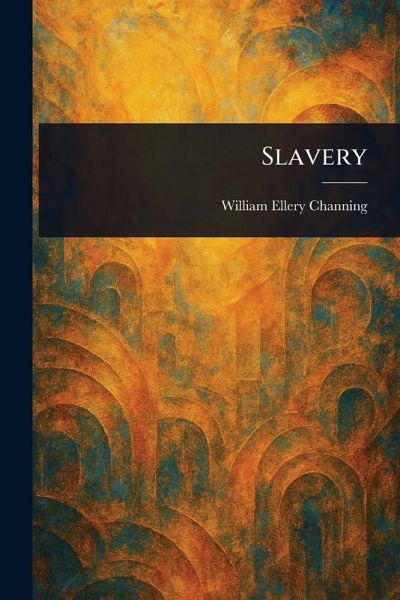
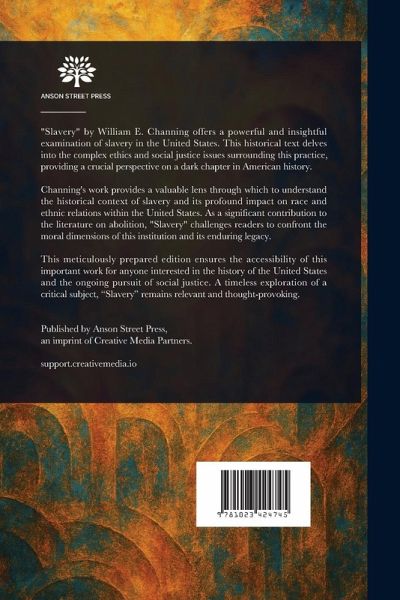
"Slavery" by William E. Channing offers a powerful and insightful examination of slavery in the United States. This historical text delves into the complex ethics and social justice issues surrounding this practice, providing a crucial perspective on a dark chapter in American history. Channing's work provides a valuable lens through which to understand the historical context of slavery and its profound impact on race and ethnic relations within the United States. As a significant contribution to the literature on abolition, "Slavery" challenges readers to confront the moral dimensions of this…mehr
"Slavery" by William E. Channing offers a powerful and insightful examination of slavery in the United States. This historical text delves into the complex ethics and social justice issues surrounding this practice, providing a crucial perspective on a dark chapter in American history. Channing's work provides a valuable lens through which to understand the historical context of slavery and its profound impact on race and ethnic relations within the United States. As a significant contribution to the literature on abolition, "Slavery" challenges readers to confront the moral dimensions of this institution and its enduring legacy. This meticulously prepared edition ensures the accessibility of this important work for anyone interested in the history of the United States and the ongoing pursuit of social justice. A timeless exploration of a critical subject, "Slavery" remains relevant and thought-provoking. This work has been selected by scholars as being culturally important, and is part of the knowledge base of civilization as we know it. This work is in the public domain in the United States of America, and possibly other nations. Within the United States, you may freely copy and distribute this work, as no entity (individual or corporate) has a copyright on the body of the work. Scholars believe, and we concur, that this work is important enough to be preserved, reproduced, and made generally available to the public. We appreciate your support of the preservation process, and thank you for being an important part of keeping this knowledge alive and relevant.
William Ellery Channing (1780-1842) was a preeminent figure in American religious history, widely recognized for his contributions to Unitarian theology and social reform, particularly the anti-slavery movement. Born in Newport, Rhode Island, to a family descending from a signer of the Declaration of Independence, Channing was destined for a life interwoven with America's formative years. He graduated from Harvard University in 1798 and was ordained a minister in 1803, serving at the Federal Street Church in Boston for nearly four decades. Channing's eloquence and intellectual rigor positioned him as a leader in the early 19th century Unitarianism, espousing a theology that emphasized the unity of God, the goodness of human nature, and the moral authority of reason. Notably, in his 1835 anti-slavery treatise 'Slavery,' Channing denounced the institution as a grave moral evil and a blight on the national character. His arguments combined moral persuasion with legal and economic critiques, exemplifying his belief in social progress through ethical conviction and pragmatic action. Channing's literary style is characterized by clarity, earnestness, and a humanitarian ethos, underpinning his influence as a preacher, author, and social philosopher. His enduring legacy is reflected in his impassioned pleas for both individual self-cultivation and societal transformation.
Inhaltsangabe
Introduction 1. Property 2. Rights 3. Explanations 4. The evils of slavery 5. Scripture 6. Means of removing slavery 7. Abolitionism 8. Duties Notes.