
Andere Kunden interessierten sich auch für
 Grenze/Granica55,00 €
 Filippino Lippi199,99 €
 Images of Miraculous Healing in the Early Modern Netherlands170,99 €
 Plaster Casts in the Life and Art of Seventeenth-Century Dutch Painters155,99 €
 Cimabue: High Renaissance and Mannerism 1510-160088,99 €
 Animals in Eden136,99 €
 Crazy about Dymphna48,99 €


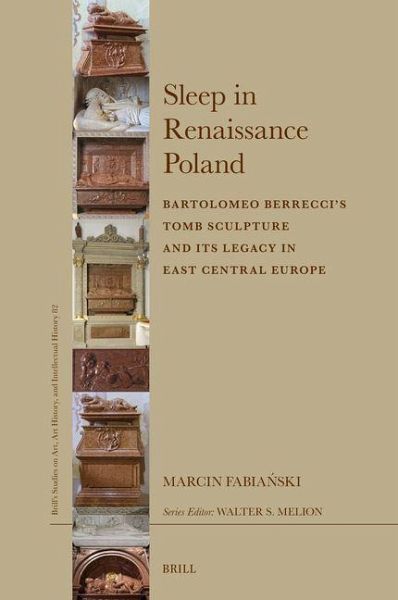
Focusing on the Italian architect and sculptor Bartolomeo Berrecci, this monograph examines an important subset of his sepulchral works--recumbent statuary--and offers insights into their patronage, reception, and interpretation. Berrecci's exploration of this sculptural type predates its eventual spread beyond Italy, Spain, and Poland. Indeed, he proved so successful that well over two hundred statues can still be found in present-day Poland and Lithuania, Latvia, Belarus, Ukraine, and Sweden. Although he mainly produced them for Catholic clients, examples of such monuments also exist in Lutheran, Calvinist, and Orthodox settings. The volume draws on a vast array of primary sources, visual, textual, and archival, and compares Berrecci's workshop to the Tuscan Quattrocento workshops of Lorenzo Ghiberti, Donatello, Perugino, and others. Originally published in Polish as Sen w rzeźbie nagrobnej Bartolomea Berrecciego. Kraków: TAiWPN Universitas, 2022.