
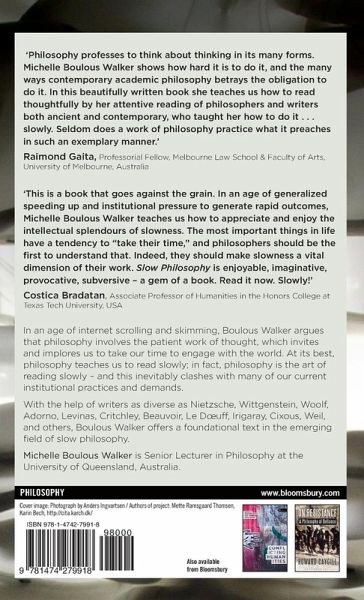
In an age of internet scrolling and skimming, where concentration and attention are fast becoming endangered skills, it is timely to think about the act of reading and the many forms that it can take. Slow Philosophy: Reading Against the Institution makes the case for thinking about reading in philosophical terms. Boulous Walker argues that philosophy involves the patient work of thought; in this it resembles the work of art, which invites and implores us to take our time and to engage with the world. At its best, philosophy teaches us to read slowly; in fact, philosophy is the art of reading…mehr
In an age of internet scrolling and skimming, where concentration and attention are fast becoming endangered skills, it is timely to think about the act of reading and the many forms that it can take. Slow Philosophy: Reading Against the Institution makes the case for thinking about reading in philosophical terms. Boulous Walker argues that philosophy involves the patient work of thought; in this it resembles the work of art, which invites and implores us to take our time and to engage with the world. At its best, philosophy teaches us to read slowly; in fact, philosophy is the art of reading slowly - and this inevitably clashes with many of our current institutional practices and demands. Slow reading shares something in common with contemporary social movements, such as that devoted to slow food; it offers us ways to engage the complexity of the world. With the help of writers as diverse as Nietzsche, Wittgenstein, Woolf, Adorno, Levinas, Critchley, Beauvoir, Le Douff, Irigaray, Cixous, Weil, and others, Boulous Walker offers a foundational text in the emerging field of slow philosophy, one that explores the importance of unhurried time in establishing our institutional encounters with complex and demanding works.
Acknowledgements Preface: Why Slow Reading Today? Posing the Question: what is it to read? About the Chapters Introduction: On Being Slow and Doing Philosophy The Love of Wisdom and the Desire to Know The Play Between the Instituting and the Instituted in Philosophy Philosophy as a Way of Life: Slow Reading - Slow Philosophy Resisting Institutional Reading 1 Habits of Reading: Le Douff's Future Philosophy Philosophy as Discipline Philosophy's Old Habits of Reading How Men and Women Read Teaching Reading: Sadism, Collaboration? Le Douff's Habits of Reading A Philosophy Still to Come: Open-ended Work Habits of Slow Reading 2 Reading Essayistically: Levinas and Adorno Emmanuel Levinas: An Ethics of Reading? Institution and Instrumental Reason Theodor W. Adorno: The Essay as Form Luiz Costa Lima: Criticity and the Essay Hans Ulrich Gumbrecht: Reading for "Stimmung" Robert Musil: Essay, Ethics, Aesthetics 3 Re-reading: Irigaray on Love and Wonder Psychoanalysis, Listening, Attention Irigaray's Diotima: The Arts of Philosophy, Reading, and Love Descartes's "Passions of the Soul": Irigaray's Wondrous Reading Love and Wonder: Reading 4 The Present of Reading: Irigaray's Attentive Listening The Nobility of Sight: Hans Jonas Listening-to: Luce Irigaray's Way of Love The Present of Reading: Friedrich Nietzsche and Others 5 Romance and Authenticity: Beauvoir's Lesson in Reading Romantic and Authentic Love Reading and Love Authenticity as Ethics? Returning to Beauvoir: How does she read? Le Douff's Reading of Beauvoir's Reading of Sartre: "Operative Philosophy" Rethinking "Operative Philosophy" with the help of Beauvoir's Own Categories of Romance and Authenticity Beauvoir Reading the Couple: "Sartre and Beauvoir" 6 Intimate Reading: Cixous's Approach A Desire resonant with Love Cixous Writing: "Entredeux" Writing as Gift and Generosity Generosity, Love, Abandon Cixous Reading: Intimacy, Giving The Approach: A slow passage between the self and the strangeness of the other Cixous and Irigaray: extreme proximity? The Gifts of Abandon and Grace: An ethics of reading Conclusion: The Attentive Work of Grace Simone Weil: attention to gravity and grace Martin Heidegger: rapture (Rausch) and meditative thinking Reading as an Aesthetic Experience Hans Ulrich Gumbrecht: reading for intensity Notes Bibliography
Es gelten unsere Allgemeinen Geschäftsbedingungen: www.buecher.de/agb
Impressum
www.buecher.de ist ein Internetauftritt der buecher.de internetstores GmbH
Geschäftsführung: Monica Sawhney | Roland Kölbl | Günter Hilger
Sitz der Gesellschaft: Batheyer Straße 115 - 117, 58099 Hagen
Postanschrift: Bürgermeister-Wegele-Str. 12, 86167 Augsburg
Amtsgericht Hagen HRB 13257
Steuernummer: 321/5800/1497
USt-IdNr: DE450055826