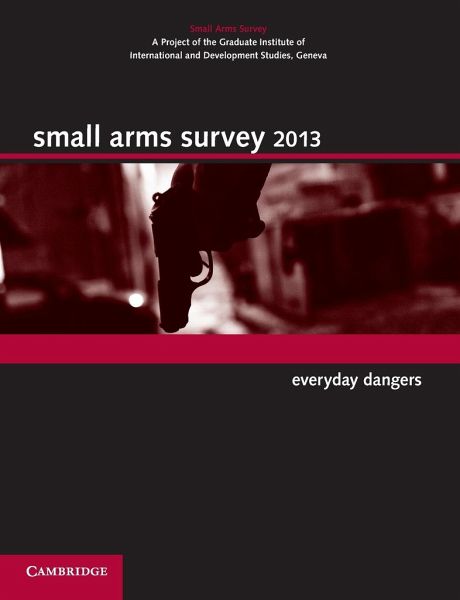
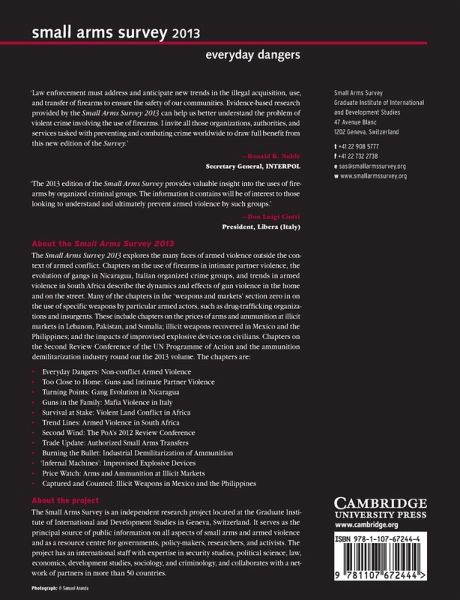
The Small Arms Survey 2013 explores the many faces of armed violence outside the context of armed conflict. Chapters on the use of firearms in intimate partner violence, the evolution of gangs in Nicaragua, Italian organised crime groups, and trends in armed violence in South Africa describe the dynamics and effects of gun violence in the home and on the street. Many of the chapters in the 'weapons and markets' section zero in on the use of specific weapons by particular armed actors, such as drug-trafficking organisations and insurgents. These include chapters on the prices of arms and…mehr
The Small Arms Survey 2013 explores the many faces of armed violence outside the context of armed conflict. Chapters on the use of firearms in intimate partner violence, the evolution of gangs in Nicaragua, Italian organised crime groups, and trends in armed violence in South Africa describe the dynamics and effects of gun violence in the home and on the street. Many of the chapters in the 'weapons and markets' section zero in on the use of specific weapons by particular armed actors, such as drug-trafficking organisations and insurgents. These include chapters on the prices of arms and ammunition at illicit markets in Lebanon, Pakistan and Somalia; illicit weapons recovered in Mexico and the Philippines; and the impacts of improvised explosive devices on civilians. Chapters on the Second Review Conference of the UN Programme of Action and the industrial demilitarisation industry round out the 2013 volume.
The Small Arms Survey is an independent research project located at the Graduate Institute of International and Development Studies in Geneva, Switzerland. It serves as the principal source of public information on all aspects of small arms and armed violence and as a resource centre for governments, policymakers, researchers and activists. The project has an international staff with expertise in security studies, political science, law, economics, development studies, sociology and criminology, and collaborates with a network of partners in more than 50 countries.
Inhaltsangabe
Introduction 1. Everyday dangers: non-conflict armed violence 2. Too close to home: guns and intimate partner violence 3. Turning points: gang evolution in Nicaragua 4. Guns in the family: Mafia violence in Italy 5. Survival at stake: violent land conflict in Africa 6. Trend lines: armed violence in South Africa 7. Second wind: the PoA's 2012 review conference 8. Trade update: authorised small arms transfers 9. Burning the bullet: industrial demilitarisation of ammunition 10. 'Infernal machines': improvised explosive devices 11. Price watch: arms and ammunition at illicit markets 12. Captured and counted: illicit weapons in Mexico and the Philippines.
Introduction 1. Everyday dangers: non-conflict armed violence 2. Too close to home: guns and intimate partner violence 3. Turning points: gang evolution in Nicaragua 4. Guns in the family: Mafia violence in Italy 5. Survival at stake: violent land conflict in Africa 6. Trend lines: armed violence in South Africa 7. Second wind: the PoA's 2012 review conference 8. Trade update: authorised small arms transfers 9. Burning the bullet: industrial demilitarisation of ammunition 10. 'Infernal machines': improvised explosive devices 11. Price watch: arms and ammunition at illicit markets 12. Captured and counted: illicit weapons in Mexico and the Philippines.
Es gelten unsere Allgemeinen Geschäftsbedingungen: www.buecher.de/agb
Impressum
www.buecher.de ist ein Internetauftritt der buecher.de internetstores GmbH
Geschäftsführung: Monica Sawhney | Roland Kölbl | Günter Hilger
Sitz der Gesellschaft: Batheyer Straße 115 - 117, 58099 Hagen
Postanschrift: Bürgermeister-Wegele-Str. 12, 86167 Augsburg
Amtsgericht Hagen HRB 13257
Steuernummer: 321/5800/1497
USt-IdNr: DE450055826