
31,99 €
inkl. MwSt.
Versandkostenfrei*
Versandfertig in 1-2 Wochen
payback
16 °P sammeln
  • Broschiertes Buch

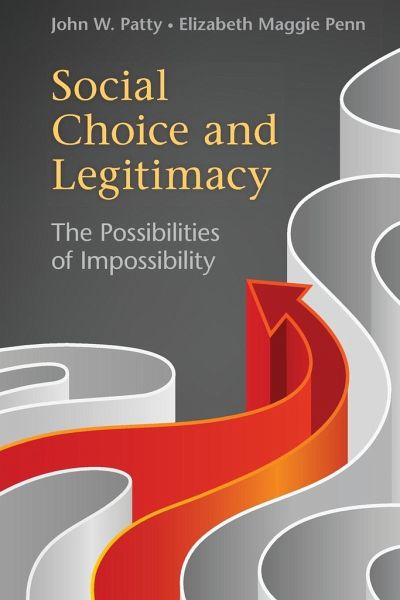
Governing requires choices, and hence trade-offs between conflicting goals or criteria. This book asserts that legitimate governance requires explanations for such trade-offs and then demonstrates that such explanations can always be found, though not for every possible choice. In so doing, John W. Patty and Elizabeth Maggie Penn use the tools of social choice theory to provide a new and discriminating theory of legitimacy. In contrast with both earlier critics and defenders of social choice theory, Patty and Penn argue that the classic impossibility theorems of Arrow, Gibbard, and…mehr

Produktbeschreibung
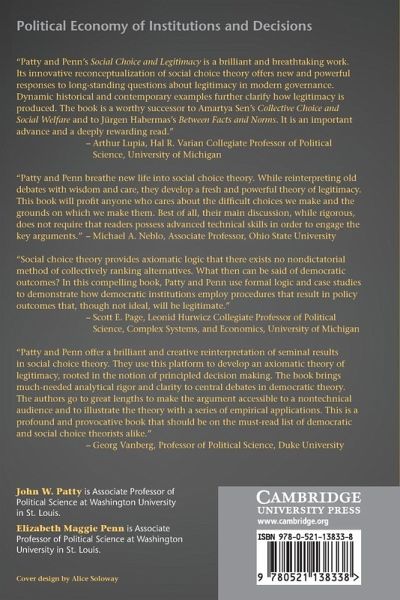
Governing requires choices, and hence trade-offs between conflicting goals or criteria. This book asserts that legitimate governance requires explanations for such trade-offs and then demonstrates that such explanations can always be found, though not for every possible choice. In so doing, John W. Patty and Elizabeth Maggie Penn use the tools of social choice theory to provide a new and discriminating theory of legitimacy. In contrast with both earlier critics and defenders of social choice theory, Patty and Penn argue that the classic impossibility theorems of Arrow, Gibbard, and Satterthwaite are inescapably relevant to, and indeed justify, democratic institutions. Specifically, these institutions exist to do more than simply make policy - through their procedures and proceedings, these institutions make sense of the trade-offs required when controversial policy decisions must be made.
Autorenporträt
John W. Patty is Associate Professor of Political Science at Washington University, St Louis. His research focuses on mathematical models of political institutions. His work has been published in various journals, including the American Journal of Political Science, Games and Economic Behavior, the Journal of Politics, the Journal of Theoretical Politics, the Quarterly Journal of Political Science, and Social Choice and Welfare. He also co-authored Learning While Governing (2013) with Sean Gailmard, which won the William H. Riker Prize awarded by the Political Economy Section of the American Political Science Association for the best book published on political economy.